

When you hear the term actual cash value (or ACV), think about the real-world, present-day value of your property. It’s not about what you paid for it back then; it’s about what it’s worth right now. A good way to picture it is the "garage sale price"—the cost to buy a similar new item, but with a discount for its age and the wear and tear it’s accumulated.
What Is Actual Cash Value in Simple Terms
Let's use a real-life example. Say you bought a great-looking sofa five years ago for $2,000. It's been the star of your living room, but it's also weathered countless movie nights, a few spilled sodas, and the general hustle and bustle of life. The cushions aren't as firm as they used to be, and the color has faded a bit.
If a fire destroyed that sofa today, your insurance company wouldn't just hand you a check for the original $2,000. Why? Because a five-year-old, well-loved sofa isn't the same as a brand-new one. Instead, they'd calculate its actual cash value, and the difference between its shiny new price and its current worth is something called depreciation.
The Core Idea of Depreciation
Depreciation is the secret ingredient in the ACV formula. It’s the unavoidable drop in an item's value over its lifetime, and it happens for a few key reasons:
- Age: Simply put, older items are usually worth less than newer ones.
- Wear and Tear: The scuffs, scratches, and fading from everyday use take their toll on value.
- Obsolescence: Sometimes, new models or technologies come out that make older versions less valuable.
This visual helps break down how an item's value shrinks from its initial price to what it’s worth today.
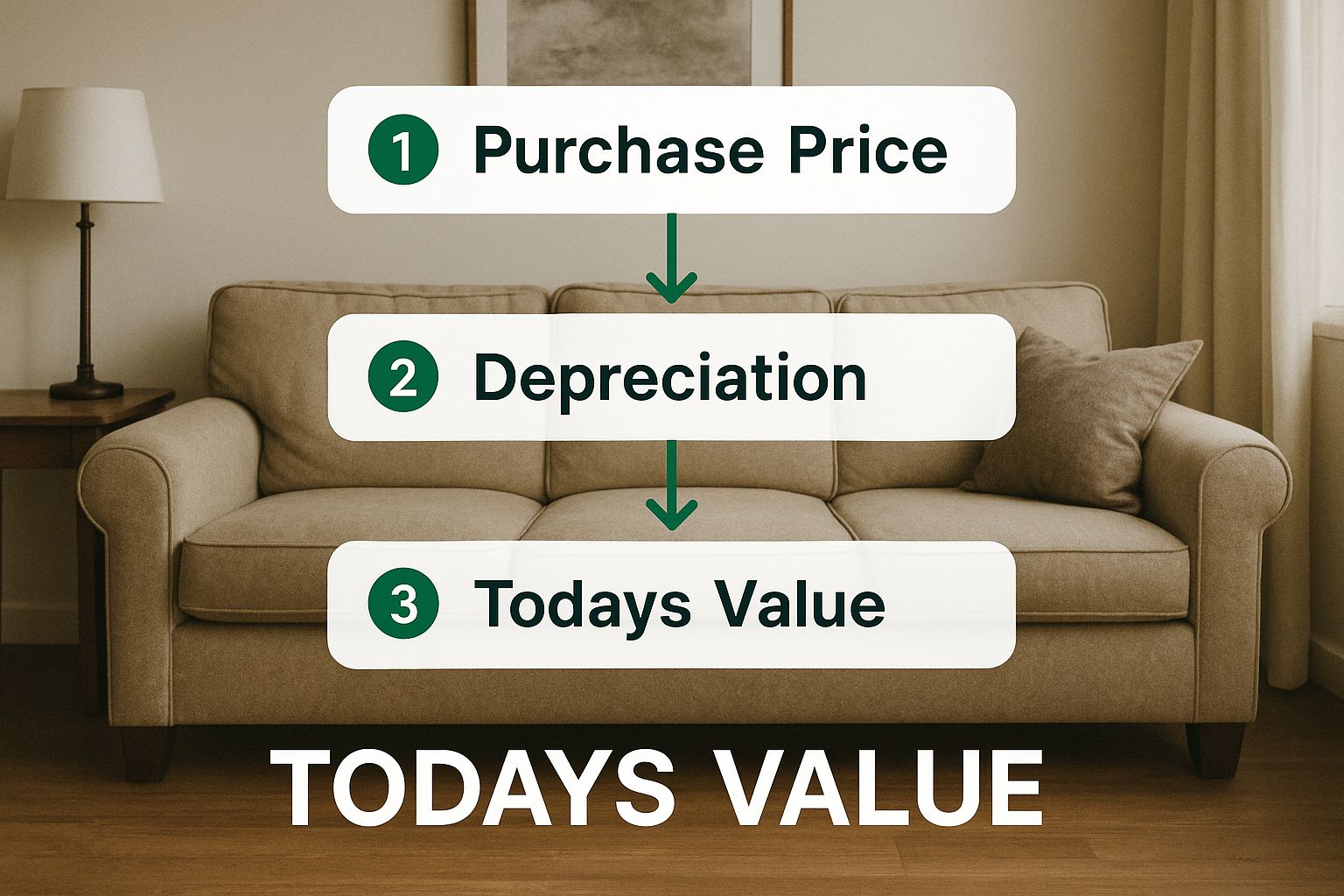
As the graphic illustrates, the value today is almost always lower than the brand-new price. That's the whole concept of ACV in a nutshell.
This valuation method is a cornerstone of the insurance industry, used in everything from home and auto to general property policies. It’s all about determining what someone would realistically pay for that used item today, not what it cost when it first came out of the box.
Key Takeaway: ACV covers the value of what you actually lost, not the cost to go out and buy a brand-new replacement. This is a crucial distinction that directly affects your claim check and is a fundamental part of how home insurance is explained to policyholders.
How Insurers Calculate Your ACV Payout
When you file a claim, your insurance adjuster isn’t just picking a number at random. They use a specific, logical process to figure out the payout for items covered by an actual cash value policy. Once you understand their math, you gain a lot of clarity on how your final settlement takes shape.
The formula itself is pretty straightforward:
Replacement Cost Value (RCV) – Depreciation = Actual Cash Value (ACV)
Let’s pull back the curtain on each part of that equation to see how it works in the real world.

Step 1: Replacement Cost Value
The calculation always starts with the Replacement Cost Value (RCV). This isn't what you paid for the item way back when. RCV is what it would cost to buy a brand-new, similar item on the market today.
Think about it this way: say your five-year-old laptop, which you originally bought for $1,200, gets stolen. Your insurer won’t look at that old receipt. Instead, they'll research the current price for a new laptop with comparable specs and quality. If that price is $1,300 today, then $1,300 is your RCV.
Step 2: Calculating Depreciation
Next, the adjuster has to figure out the depreciation. This is the value your item lost over time due to normal wear and tear, age, and its overall expected lifespan. While insurers often have standard tables to guide them, a few key factors come into play:
- Age: This one is obvious. A 10-year-old appliance has depreciated a lot more than one that’s only two years old.
- Expected Lifespan: Every item has a different life expectancy. A well-built roof might be expected to last 30 years, whereas a smartphone is realistically only useful for four or five.
- Condition: Was your item in mint condition, or was it already showing its age before the damage occurred? If you can show it was exceptionally well-maintained, you might be able to argue for a smaller depreciation amount.
Pro Tip: The exact definitions for terms like these matter a great deal. It’s always a good idea to know how to read an insurance policy so you can find the specific language in your own contract.
Putting It All Together: A Real-World Example
Let's walk through a common claim scenario to see the formula in action. Imagine a storm damages your 10-year-old asphalt shingle roof.
- Establish the RCV: The adjuster gets a quote and determines that replacing the entire roof today with new, similar-quality materials would cost $15,000.
- Calculate Depreciation: The roofer confirms that these types of shingles have a 25-year expected lifespan. Your roof is already 10 years old, so it has used up 40% of its functional life (10 years ÷ 25 years).
- Apply the Formula:
- Depreciation Amount = $15,000 (RCV) x 40% = $6,000
- ACV = $15,000 (RCV) – $6,000 (Depreciation) = $9,000
In this situation, your insurance payout for the roof would be $9,000 (before your deductible is subtracted). Seeing the numbers laid out like this demystifies the whole process and shows you the clear logic behind your claim settlement.
Actual Cash Value vs. Replacement Cost
When you're choosing an insurance policy, one of the most critical decisions you'll make is between Actual Cash Value (ACV) and Replacement Cost (RCV) coverage. It’s a choice that directly impacts your financial security after a loss.
Think of it this way: ACV pays you for the value of the item you lost, factoring in wear and tear. RCV, on the other hand, gives you the money to buy a brand new replacement. One looks back at what your property was worth, while the other looks forward to what you'll need to move on.
This single difference has a huge effect on everything from your monthly premiums to how much you'll have to pay out-of-pocket when you file a claim. Let's dig into how each one works in the real world.
How ACV Works in a Claim
An ACV policy calculates your payout based on a simple formula: the cost to replace an item today, minus all the depreciation it has built up over the years. The biggest draw for this type of policy is the lower premium. Because the insurance company’s potential payout is less, they can offer you a more budget-friendly rate.
But that lower cost comes with a significant trade-off. If a fire or major storm destroys your belongings, the ACV check you receive might not cover the full cost of buying new replacements. You’re essentially getting the "garage sale" value for your stuff, leaving you to pay the difference to get back to where you were.
How Replacement Cost Works in a Claim
A Replacement Cost Value policy is built to put you back in the same position you were in before the loss. It completely ignores depreciation. If your five-year-old laptop gets fried in a power surge, RCV coverage gives you enough money to go out and buy a new, comparable model at today's market price.
This higher level of protection naturally comes with a higher premium. You’re paying for the confidence of knowing that a disaster won't also turn into a personal financial crisis. If you want to dive deeper into this topic, our guide on what is replacement cost coverage breaks it down even further.
It's common for RCV policies to pay out in two parts. You'll first receive a payment for the actual cash value. Once you've bought the replacement item and sent the receipt to your insurer, they'll send a second check for the remaining balance.
Comparing ACV and RCV Head-to-Head
To truly understand the impact of your choice, let's look at a side-by-side comparison of how these two policy types function. The table below breaks down the key differences between an ACV and an RCV policy.
Comparing ACV and RCV Insurance Policies
| Feature | Actual Cash Value (ACV) | Replacement Cost Value (RCV) |
|---|---|---|
| Premium Cost | Lower | Higher |
| Claim Payout | Replacement Cost – Depreciation | Full Replacement Cost (No Depreciation) |
| Out-of-Pocket Expense | Potentially High | Minimal to None (besides deductible) |
| Financial Security | Basic protection | Comprehensive protection |
| Best For | Budget-conscious needs, older items | Protecting assets and minimizing risk |
As you can see, the decision boils down to a balance between your budget and your risk tolerance. ACV offers affordability upfront, while RCV provides much stronger financial protection on the back end when you need it most.
The Real-World Impact of an ACV Claim

It’s one thing to understand the formula for actual cash value on paper. It's something else entirely to feel its impact after a devastating loss. The gap between an ACV check and the money you actually need to put your life back together can be a harsh financial shock.
While ACV policies come with those tempting lower premiums, that savings can disappear in an instant when you actually have to file a claim. You quickly learn that the upfront discount comes with a serious backend risk.
Let's walk through a common scenario. Imagine a kitchen fire destroys your major appliances. Your refrigerator, which you bought five years ago for $1,800, is gone. So is your $1,200 oven and your $700 dishwasher. They all worked just fine, but every year, they lost a little bit of value—that’s depreciation.
When you file your claim, the insurance adjuster starts calculating. They determine your fridge has depreciated by 40%, the oven by 30%, and the dishwasher by a full 50%.
The Financial Gap in Action
Here’s where the numbers get real. This is what your insurance payout looks like compared to what it will cost to buy new, similar appliances today:
- Refrigerator Payout: You get $1,080 (after $720 in depreciation).
- Oven Payout: You get $840 (after $360 in depreciation).
- Dishwasher Payout: You get $350 (after $350 in depreciation).
Your total insurance check comes out to $2,270. The problem? Heading to the store to replace all three with brand-new models will set you back $3,700. Suddenly, you're on the hook for a $1,430 bill you probably weren't expecting, all while trying to recover from a house fire.
This gap is the classic trade-off of an ACV policy. The money you saved on premiums over the years is now being spent—and then some—on the costs your insurance simply won't cover.
The Larger Scale of ACV Claims
This financial shortfall becomes catastrophic in the wake of widespread disasters. Following Hurricane Katrina in 2005, for example, countless homeowners with ACV policies were stunned to receive checks for just the depreciated value of their destroyed property.
Studies have shown that payouts for total loss claims can be 20% to 40% lower under ACV policies. That difference creates an enormous barrier for families trying to rebuild.
The situation gets even worse if your home is unlivable. On top of replacing your belongings, you’re also paying for a hotel or rental. It's crucial to know what your policy says about additional living expense coverage and how it works with your main property claim.
An ACV policy, especially when combined with a major disaster, can drain a family's savings in a heartbeat. It’s a stark reminder of how much your choice of coverage matters in the real world.
Where You'll Typically See Actual Cash Value
The concept of actual cash value might sound a bit like insurance jargon, but you see it in action all the time. It’s the standard for valuing items that naturally lose value over time through use, age, or just becoming outdated.
Knowing where ACV usually pops up helps you understand your policy better and sets the right expectations if you ever need to file a claim. Let's look at the most common places you'll find it.
Personal Property and Electronics
Your personal stuff is the number one spot for ACV. We're talking about everything from your couch and clothes to your TV and laptop. These items depreciate pretty fast, thanks to everyday wear and tear and the relentless pace of new technology.
Think about it: a five-year-old laptop just isn't worth what a new one is. It's slower, the battery doesn't last as long, and new models have features it can't match. An ACV policy acknowledges this reality. It pays you for the value of your used laptop, not the price of a brand-new one. To see how this fits into your overall coverage, check out our guide on what is personal property coverage.
Vehicles and Automobiles
Car insurance is probably the most familiar example of ACV. If your car is totaled in an accident, the insurance company isn't going to buy you a brand-new car off the lot (unless you have a special policy for that). Instead, they’ll cut you a check for its actual cash value—what your car was worth the moment before the crash.
How do they figure that out? An insurer will look at the local market for cars just like yours—same make, model, year, mileage, and general condition—to land on a fair value.
This is why a 10-year-old sedan with a ton of miles on it will get a much smaller payout than a two-year-old SUV, even if both were meticulously maintained. The value is tied directly to what someone would realistically pay for it on the used-car market today.
Parts of Your Home's Structure
This one can surprise people. While your home itself is usually covered for its replacement cost, certain parts of it—the ones with a predictable lifespan—are often handled on an ACV basis.
These are things that are expected to wear out and be replaced every so often.
- Roofing: A standard asphalt shingle roof is built to last about 20-30 years. If a storm damages your 15-year-old roof, your insurance payout will likely be for a roof that's halfway through its life, not for a brand-new one.
- Fences: A wooden fence is constantly exposed to rain, sun, and wind, so it degrades over time.
- Siding: Some types of siding have a clear depreciation schedule based on their material and age.
- Carpeting: That wall-to-wall carpet in your living room definitely shows its age after a few years of foot traffic.
The logic from the insurer's perspective is to avoid "betterment"—paying to put you in a better position than you were before the loss. They're paying for the value of what you lost, which was an older, depreciated item.
Got Questions About Actual Cash Value? We've Got Answers.
Stepping into the world of insurance can feel like learning a new language. One of the most important terms to get a handle on is actual cash value, because it directly impacts how much you’ll receive after a claim. We’ve answered some of the most common questions people have to help you feel more confident about your coverage.
What if I Disagree With the Insurance Company's ACV Offer?
You can, and often should, question the initial offer from your insurer. It's important to remember that their first calculation isn't the final word. If the number they give you feels off, your first move is to ask for a detailed breakdown. You want to see exactly how the adjuster calculated both the replacement cost and the depreciation.
Once you have that in hand, it’s time to build your case. This is where being prepared really makes a difference. You can strengthen your position with solid proof, like:
- Original receipts: These establish the item's age and what you paid for it.
- Photos and videos: Got pictures showing your couch or TV was in pristine condition before the damage? Use them.
- Current market prices: Do some online shopping to find listings for comparable new items. This helps you argue for a higher replacement cost.
If it's a large, complex claim and you’re far apart on the numbers, consider bringing in a public adjuster. They work for you, not the insurance company, and can provide an independent valuation that carries a lot of weight. Don't be afraid to negotiate—it’s a normal part of the process.
Is an ACV Policy Ever a Good Idea?
While a Replacement Cost Value (RCV) policy offers a bigger safety net, there are definitely times when an ACV policy is the smarter financial move. The biggest advantage is simple: a lower premium. This can make insurance much more affordable.
An ACV policy can be a great fit for:
- Older belongings where you wouldn't necessarily need or want a brand-new replacement.
- A second home or vacation property where the contents aren't as vital to your daily life.
- An older car where the vehicle’s value is low enough that paying for pricier RCV coverage just doesn't make financial sense.
It all boils down to your personal risk assessment. When you choose an ACV policy, you’re trading lower monthly payments for the possibility of paying more out-of-pocket if you ever have to file a claim.
Key Insight: The right policy is all about balancing your budget against your tolerance for risk. For the things you can't live without, RCV is usually worth the extra cost. For everything else, the savings from an ACV policy can be very attractive.
How Is Actual Cash Value Different from Market Value?
This is a common point of confusion, especially when it comes to real estate. While the terms sound similar, they mean very different things.
Market Value is what a willing buyer would pay for your property in its current state, on the open market. It’s a real-world price that includes the value of the land, the desirability of the location, and current housing trends.
Actual Cash Value, on the other hand, is an insurance term. It completely ignores the land and location. It only looks at the physical building—what it would cost to rebuild it today, minus all the depreciation it has accumulated over the years.
Think of it this way: An old, worn-out house in a hot, up-and-coming neighborhood could have a huge market value simply because of the land it's on. But its ACV might be incredibly low because the building itself is old and in poor shape. In the world of auto insurance, however, the two values are much closer, as a car's ACV is essentially its used-car market price.
At Wexford Insurance Solutions, we believe understanding your policy is the foundation of true peace of mind. Our experts are here to walk you through the details of ACV, RCV, and everything in between to find coverage that truly fits your life. Contact us today to review your policy options.
 How to Dispute Insurance Claim: Proven Steps to WinDifference Between Insurance Agent and Insurance Broker | Key Insights


