

Unplanned downtime is the single greatest threat to a fleet’s profitability and operational efficiency. A single vehicle breakdown can trigger a cascade of negative consequences, including delayed deliveries, dissatisfied customers, and unforeseen, often escalating, repair costs. The key to avoiding these disruptions lies in shifting from a reactive repair model to a proactive maintenance strategy. This article provides the ultimate fleet vehicle maintenance checklist, a comprehensive resource designed to systematically prevent the majority of common vehicle issues.
We move beyond generic advice to deliver actionable, role-specific checklists organized by frequency, from daily pre-trip inspections for drivers to in-depth annual assessments for technicians. You'll gain access to downloadable templates for inspection logs, practical recordkeeping tips, and a clear framework for building a preventive maintenance schedule that works. We will also explore crucial safety and compliance checkpoints, inventory management for parts and fluids, and proven cost-saving measures.
Moreover, we'll connect these practices directly to your bottom line, illustrating how meticulous maintenance can significantly lower your insurance premiums and mitigate overall business risk. As fleets evolve, incorporating different vehicle types also demands specialized knowledge. For instance, fleets transitioning to electric vehicles will find that while some principles overlap, understanding the nuances is crucial; this requires a comprehensive guide to electric vehicle fleet management to maintain efficiency and prevent new forms of downtime. By implementing the systematic approach detailed here, you can transform maintenance from an unpredictable expense into a strategic investment that maximizes uptime, enhances driver safety, and drives sustainable profitability.
1. The Foundational Pre-Trip Checklist: A Driver's Daily 10-Minute Shield
The pre-trip inspection is the cornerstone of any effective fleet vehicle maintenance checklist. It is a brief yet critical daily routine performed by drivers before their vehicle ever leaves the lot. This simple, systematic walk-around empowers drivers to become the first line of defense, identifying potential safety hazards and mechanical issues before they can escalate into costly breakdowns or compliance violations on the road.
This check is not a deep mechanical diagnosis; instead, it is a high-level operational and safety verification. By making this a mandatory, non-negotiable part of the daily workflow, fleet managers instill a culture of proactive responsibility and safety. It is the single most impactful, highest-return-on-investment activity in a fleet’s maintenance program, directly preventing downtime and accidents.
How to Implement a Pre-Trip Checklist
Successful implementation hinges on simplicity, consistency, and accountability. The goal is to create a process that takes no more than 10-15 minutes but covers all essential vehicle systems.
- Standardize the Form: Create a simple, intuitive checklist, either on paper or through a digital app. A digital solution is often superior as it provides instant submission, time-stamping, and photo evidence capabilities.
- Train Your Drivers: Don't just hand over a checklist. Conduct hands-on training to demonstrate what to look for, such as how to check tire tread depth with a penny, identify fluid leaks, or test all light functions correctly.
- Establish a Clear Reporting Protocol: Drivers must know exactly what to do when they find a problem. Create a clear "if this, then that" protocol: "If you find a nail in a tire, report it to the on-site technician immediately and do not drive the vehicle."
Key Insight: Treat the pre-trip inspection as a critical job function, not an optional task. Integrate its completion into driver performance metrics and daily sign-off procedures to ensure 100% compliance. This transforms the check from a chore into a core safety responsibility.
2. Tire Inspection and Rotation: Maximizing Safety and Longevity
Tires are a fleet’s direct connection to the road, making their consistent maintenance a non-negotiable pillar of any comprehensive fleet vehicle maintenance checklist. This process involves regular examination of tire pressure, tread depth, alignment, and wear patterns, coupled with a systematic rotation schedule. Proper tire management is a direct investment in safety, preventing dangerous blowouts, while also significantly improving fuel efficiency and extending tire life by up to 30%.
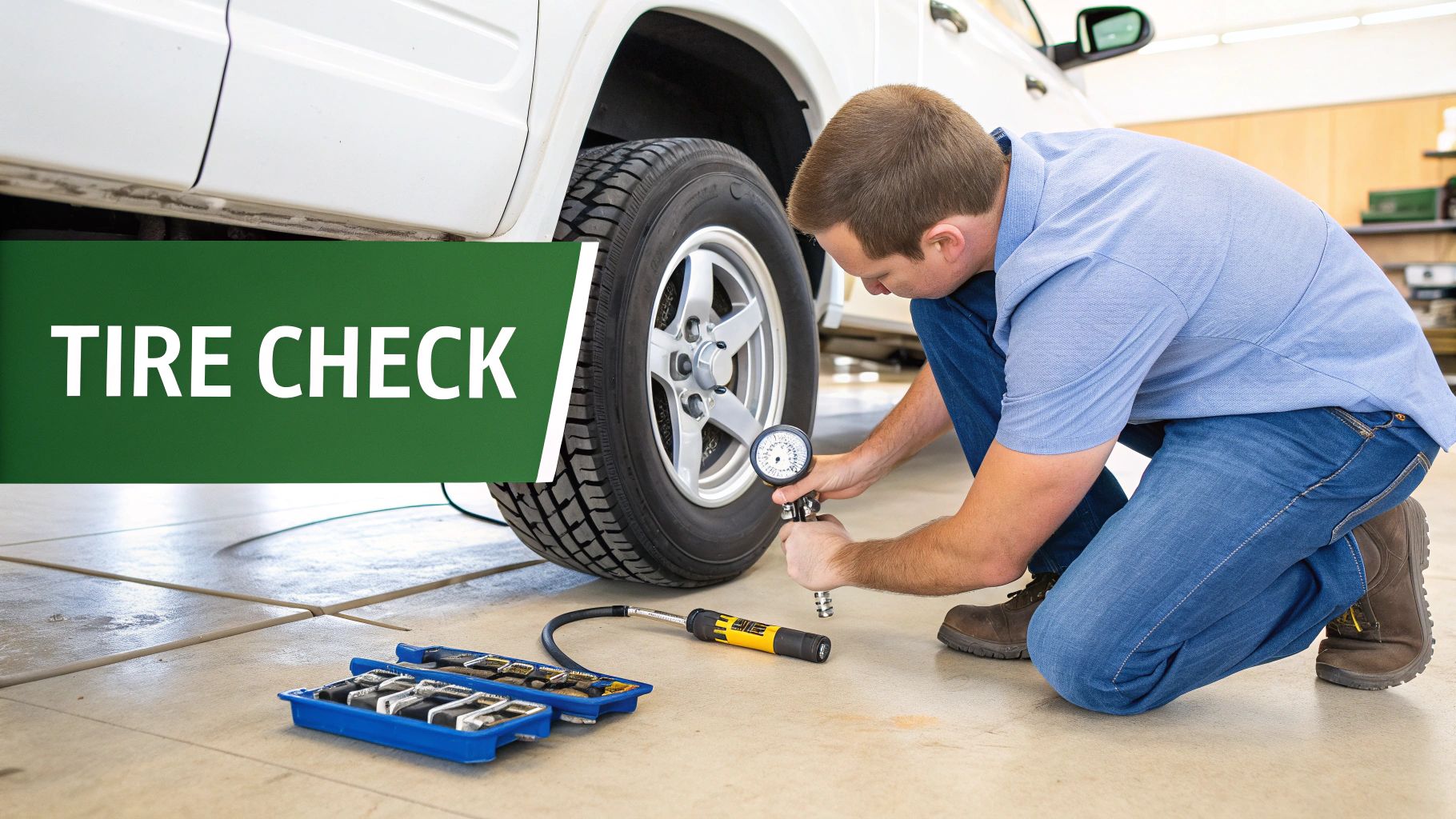
Neglecting tires introduces unacceptable risks and operational costs, from decreased fuel economy due to underinflation to catastrophic accidents. By establishing a formal tire inspection and rotation protocol, fleet managers can mitigate these risks, ensure DOT compliance, and control one of their largest variable expenses. Major logistics companies like FedEx, for instance, adhere to strict rotation schedules to keep their massive fleet moving safely and efficiently.
How to Implement a Tire Maintenance Program
A successful program combines routine driver checks with scheduled professional service. The goal is to catch issues early and ensure even wear across all tires, maximizing their usable lifespan and performance.
- Integrate into Pre-Trip Checks: Train drivers to visually inspect tires daily for obvious damage and to check pressure weekly. This simple step catches most common problems, such as punctures or slow leaks, before they cause a failure.
- Establish a Rotation Schedule: Set a clear rotation interval based on mileage (e.g., every 7,500 miles) or operating hours, depending on the vehicle type. Schedule these rotations to coincide with other preventive maintenance tasks like oil changes to improve efficiency.
- Set Proactive Replacement Thresholds: Don't wait for tires to reach the legal minimum tread depth of 2/32". A safer, more proactive standard is to replace tires when they reach 4/32", which provides a much better safety margin for traction, especially in wet conditions.
Key Insight: Use fleet management software to create a "tire profile" for every vehicle. Track purchase dates, mileage at installation, rotation history, and tread depth measurements. This data provides invaluable insights into tire performance by brand and vehicle type, enabling smarter purchasing decisions and predictive maintenance.
3. Brake System Assessment
The brake system is arguably the most critical safety component on any vehicle, and its regular, thorough assessment is a non-negotiable part of any fleet vehicle maintenance checklist. Unlike a simple pre-trip check, this is a deep-dive evaluation that goes beyond visual confirmation, assessing the wear and tear on pads, rotors, drums, and the integrity of the hydraulic or air systems. A proactive brake assessment strategy directly prevents catastrophic failures, reduces liability, and ensures compliance with strict DOT and FMCSA regulations.
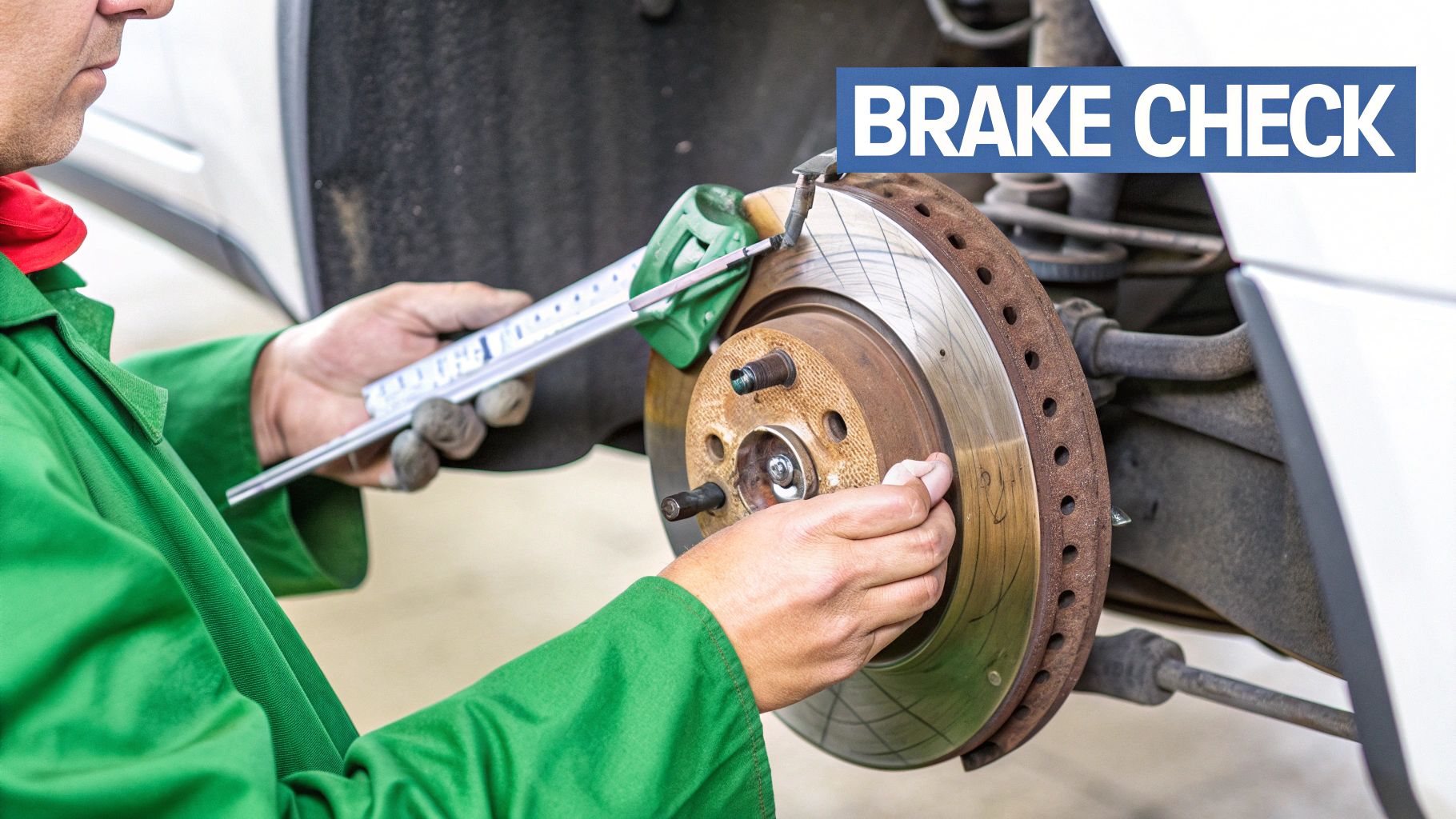
Neglecting this system introduces unacceptable risks, not just to the driver and cargo but to the public. For industries like commercial trucking or emergency services, where stopping power is paramount, a well-documented brake maintenance program is essential. This scheduled inspection ensures that every component, from the master cylinder to the brake lines, functions reliably under demanding conditions. When planning your fleet's regular maintenance schedule, from weekly checks to annual overhauls, understanding the key differences between predictive and preventive maintenance can help you build a more robust and cost-effective program.
How to Implement a Brake System Assessment
A successful brake assessment program is systematic and data-driven. It relies on scheduled intervals, clear wear-limit standards, and meticulous record-keeping to catch issues before they compromise safety.
- Establish Standardized Inspection Intervals: Don't wait for a problem. Mandate comprehensive brake inspections every six months or at a specific mileage interval based on vehicle type and usage. Document every measurement and observation.
- Train Drivers on Early Warning Signs: Educate drivers to immediately report any signs of brake trouble, such as a soft or spongy pedal, grinding noises, or the vehicle pulling to one side during braking. This feedback is an invaluable early warning system.
- Define Clear Component Replacement Thresholds: Work with your technicians or service provider to set specific, non-negotiable wear limits for brake pads, shoes, and rotors. This removes guesswork and ensures components are replaced based on condition, not just age.
Key Insight: Treat brake maintenance as a core safety investment, not just a repair cost. Meticulous records of brake inspections and service can significantly reduce liability and lower insurance premiums. Learn more about how a proactive maintenance approach can impact your commercial auto coverage.
4. Battery Health and Charging System Testing
A dead battery is one of the most common and disruptive causes of vehicle downtime, yet it is also one of the most preventable. Systematic battery health and charging system testing is a core component of a proactive fleet vehicle maintenance checklist, designed to ensure reliable starts and stable electrical system performance. This process goes beyond simply waiting for a battery to fail; it involves regularly evaluating battery voltage, load capacity, terminal integrity, and the alternator's ability to maintain a proper charge.
For any fleet, a stranded vehicle due to a failed battery translates directly to a failed delivery, a missed service call, and lost revenue. By integrating regular battery diagnostics, fleet managers shift from a reactive, failure-based model to a predictive one. This approach prevents the cascading costs associated with towing, emergency repairs, and operational disruptions, safeguarding both the vehicle's electrical components and the company's bottom line.
How to Implement Battery and Charging System Checks
A consistent testing schedule is the key to preventing unexpected electrical failures. This process should be standardized across the fleet and performed by qualified technicians, whether in-house or at a partner shop.
- Establish a Testing Cadence: Perform a comprehensive load test on every vehicle's battery and alternator quarterly. This is especially critical before the onset of winter, as cold temperatures significantly reduce a battery's cranking power.
- Prioritize Proactive Replacement: Do not wait for a battery to die. Track the age of every battery in your fleet and schedule proactive replacements every 4 to 5 years, regardless of its apparent condition. This policy prevents the majority of age-related failures.
- Equip and Train for Cleanliness: A common cause of poor electrical connection is terminal corrosion. Train technicians to regularly inspect and clean battery terminals using a simple baking soda and water solution and a wire brush. This simple step can restore proper charging and starting power.
Key Insight: Treat batteries as critical wear items with a defined service life, not as components that last until they fail. By tracking battery age and replacement history for each vehicle, you can create a highly accurate, data-driven replacement schedule that virtually eliminates on-road electrical failures.
5. Filter Replacement (Air, Oil, Cabin): The Lungs and Lifeline of Your Fleet
Often overlooked, the various filters within a vehicle are the unsung heroes of engine health, fuel efficiency, and driver comfort. A systematic filter replacement schedule is a non-negotiable part of any comprehensive fleet vehicle maintenance checklist, directly protecting your most expensive assets. Clogged air filters starve the engine of oxygen, oil filters fail to remove damaging contaminants, and dirty cabin filters degrade the in-vehicle environment, impacting driver health and alertness.
Treating filter replacement as a core preventive maintenance task is crucial for optimizing performance and avoiding cascading failures. For instance, a clogged engine air filter can reduce fuel economy by up to 10% and lead to increased emissions, while a degraded oil filter allows abrasive particles to circulate, causing premature wear on critical engine components. This simple, low-cost service prevents expensive, high-impact repairs down the line.
How to Implement a Filter Replacement Program
A successful program is built on OEM guidance, adapted for real-world operating conditions, and meticulously tracked. The goal is to replace filters before they become restrictive and cause performance issues.
- Create a Condition-Based Schedule: Start with the manufacturer's recommended intervals, but adjust them based on your fleet’s specific environment. A construction fleet operating in dusty conditions may need to replace engine air filters every 3,000 miles, whereas a long-haul highway fleet might adhere to a 15,000-mile schedule.
- Stock and Standardize: Identify the most common filter types (air, oil, cabin) across your fleet and maintain an on-site inventory. This minimizes vehicle downtime by ensuring the right part is always available for scheduled service. Use high-quality, OEM-certified filters to guarantee proper fit and filtration media performance.
- Integrate Tracking into PMs: Log every filter change in your fleet management software. This creates a service history for each asset, automates alerts for the next scheduled replacement, and helps identify any vehicles that are prematurely clogging filters, which could indicate other mechanical issues.
Key Insight: Don't treat all filters the same. The engine air filter is vital for performance, the oil filter is critical for longevity, and the cabin air filter is essential for driver health and HVAC system efficiency. Giving each the attention it deserves within your fleet vehicle maintenance checklist creates a multi-layered defense against wear and tear.
6. Battery and Electrical System Monitoring (Advanced)
Moving beyond manual checks, advanced electrical system monitoring represents a shift from reactive repairs to proactive, data-driven maintenance. This approach leverages telematics and sophisticated onboard diagnostics to continuously track the health of a vehicle's battery, alternator, and starter. By analyzing real-time data on voltage, charging cycles, and parasitic drain, fleet managers can anticipate electrical failures before they result in a dead battery and an unexpected service call.
This technology transforms electrical maintenance from a guessing game into a precise science. Instead of replacing batteries on a fixed schedule, fleets can replace them based on actual performance degradation, preventing both premature replacement costs and costly roadside breakdowns. It is a cornerstone of a modern fleet vehicle maintenance checklist, providing visibility into one of the most common causes of vehicle downtime.
How to Implement Advanced Electrical Monitoring
Effective implementation requires selecting the right technology and integrating its data into your maintenance workflow. The goal is to turn raw data into actionable alerts and predictive service schedules.
- Select a Compatible Telematics Provider: Choose a system like Samsara, Verizon Connect, or Geotab that offers robust electrical health monitoring features compatible with your vehicle models. OEM-specific platforms like Ford Telematics also provide deep integration.
- Establish Custom Alert Thresholds: Don't rely on default settings. Configure voltage-drop alerts and battery health warnings based on your specific vehicle types and operating conditions (e.g., extreme temperatures, high-accessory usage).
- Integrate Data into Maintenance Protocols: Create clear procedures for your team. When a "low battery health" alert is received, the protocol should trigger a diagnostic test and potential replacement during the vehicle’s next scheduled downtime, not after it fails to start. Utilizing this data can also provide insights into the impact of technology on trucking insurance by demonstrating proactive risk management.
Key Insight: Treat telematics data as a leading indicator, not just a historical record. By analyzing weekly electrical health reports and spotting downward trends in battery performance, you can schedule maintenance proactively, virtually eliminating electrical system failures as a source of unplanned downtime.
7. Suspension and Steering System Inspection
A vehicle's suspension and steering systems are fundamental to driver control, vehicle stability, and safety. This inspection goes beyond basic checks to evaluate the core components that absorb road shock and guide the vehicle, such as shock absorbers, struts, springs, bushings, and steering linkages. A compromised system not only leads to a poor ride but also critically affects braking effectiveness, increasing stopping distances and creating significant safety risks.
Regular, in-depth evaluations of these systems are essential for any comprehensive fleet vehicle maintenance checklist. For fleets like courier services, proper suspension protects cargo integrity, while for emergency vehicles, it ensures high-speed stability and reliability. Ignoring these components can lead to premature tire wear, driver fatigue, and a loss of control that can cause catastrophic accidents, making this check a non-negotiable part of preventive care.
How to Implement a Suspension and Steering Inspection
A systematic approach ensures that nothing is overlooked, transforming this from a reactive repair into a proactive safety measure. This inspection is typically performed quarterly or annually by a qualified technician.
- Standardize the Inspection Points: Create a detailed checklist that includes checking shock absorbers and struts for leaks, inspecting springs for cracks or fatigue, examining bushings for wear or degradation, and checking tie rods and ball joints for looseness.
- Integrate with Other Services: The most efficient time to perform a thorough suspension check is during an annual safety inspection or when a vehicle is in for tire rotation or replacement. This allows for a proper wheel alignment check, which is critical after any suspension or tire work.
- Train for Early Detection: While technicians perform the deep dive, train drivers to listen for clunking or knocking sounds when going over bumps and to report any changes in steering feel, such as pulling to one side or excessive play in the steering wheel. This provides an early warning system.
Key Insight: Always replace shock absorbers and struts in pairs (both front or both rear) to maintain balanced performance and vehicle stability. A single new component can create an imbalance, negatively affecting handling and braking, defeating the purpose of the repair.
8. Engine Air Filter and Fuel Filter Replacement
Just as humans need clean air to breathe, a vehicle's engine requires a clean, unrestricted flow of air and fuel to perform optimally. The engine air and fuel filters are the gatekeepers, preventing harmful contaminants like dust, dirt, and debris from entering sensitive engine components. Neglecting these filters directly leads to reduced engine power, poor fuel economy, and potentially catastrophic engine damage over time.
This item on the fleet vehicle maintenance checklist is a critical preventive measure that protects your most expensive asset: the engine. Clogged filters force the engine to work harder, increasing wear and tear, raising emissions, and consuming more fuel. For any fleet, where fuel is a major operational expense, regular filter replacement is a simple task with a significant return on investment.
How to Implement a Filter Replacement Schedule
A successful filter replacement program is built on precision, documentation, and adherence to manufacturer specifications. The goal is to replace filters before they become restrictive enough to impact performance.
- Follow OEM Intervals: Start with the Original Equipment Manufacturer's (OEM) recommended replacement intervals. Adjust these based on your specific operating conditions; for instance, construction or agricultural fleets operating in dusty environments will require much more frequent air filter changes.
- Stock Common Filters: Identify the filter part numbers for the most common vehicles in your fleet and maintain a ready inventory. This eliminates delays and ensures the correct part is always available, preventing technicians from using an incorrect or low-quality substitute.
- Train for Correct Installation: Proper installation is crucial. An improperly seated air filter can allow unfiltered air to bypass the seal, while an incorrectly installed fuel filter can cause leaks or fuel starvation. Ensure technicians understand the specific procedures for each model.
Key Insight: Monitor fuel economy data as a real-world indicator of filter health. A noticeable, fleet-wide dip in MPG that isn't tied to other factors can often be an early warning sign that filters are clogged and a replacement cycle is overdue.
9. Lighting System and Visibility Check
A vehicle’s lighting and visibility systems are its primary tools for communication and awareness on the road. This check involves a comprehensive inspection of all lights-including headlights, taillights, brake lights, turn signals, and hazard lights-as well as the operational status of windshield wipers, mirrors, and reflectors. Its purpose is to ensure the driver can see clearly and, just as importantly, that the vehicle can be seen by others under all conditions, making it a non-negotiable pillar of any fleet vehicle maintenance checklist.
This check is fundamental to both safety and regulatory compliance. A single malfunctioning brake light or a cracked mirror can lead to a preventable accident or a costly roadside citation. For fleets operating at dawn, dusk, or in adverse weather, such as waste management or emergency services, a fully functional lighting system is a critical operational requirement, directly impacting driver safety and public perception.
How to Implement a Lighting and Visibility Check
A systematic and frequent approach ensures that no detail is overlooked and that issues are caught before they become liabilities. The key is to make this a routine, easily repeatable process.
- Create a Visibility Checklist: Develop a specific checklist that requires drivers or technicians to verify each light function (low beam, high beam, brake, reverse, signal) and assess the condition of wipers, washer fluid levels, and all mirrors.
- Establish a Weekly Cadence: While critical lights are part of the daily pre-trip, a more thorough inspection should be scheduled weekly. This is an ideal task for a shift change or a designated pre-weekend check.
- Stock Essential Parts: Minimize downtime by keeping a ready inventory of common bulb types, fuses, and wiper blades at your maintenance facility. This turns a potential vehicle-down situation into a quick, five-minute fix.
Key Insight: Upgrade to high-quality LED lighting to significantly reduce maintenance frequency and improve visibility. While the initial cost is higher, the longer lifespan and superior brightness offer a strong return on investment through lower labor costs, fewer bulb replacements, and enhanced safety on the road.
10. Preventive Maintenance Scheduling and Records Management
Moving beyond reactive repairs to a proactive system is the hallmark of a mature fleet operation. Preventive maintenance (PM) scheduling and meticulous records management form the central nervous system of your entire fleet vehicle maintenance checklist. This is the practice of systematically scheduling maintenance based on time, mileage, or engine hours, rather than waiting for a failure to occur. This strategy relies on robust data and digital record-keeping to track every service activity, ensuring compliance and enabling data-driven decisions.
This approach transforms maintenance from a cost center into a strategic asset. By adhering to manufacturer-recommended service intervals and analyzing vehicle performance data, fleet managers can anticipate needs, optimize vehicle lifespan, and prevent the cascading failures that lead to expensive downtime. Companies like FedEx, managing over 680,000 vehicles globally with a proprietary system, exemplify how critical this systematic approach is to large-scale operational success.
How to Implement a PM Scheduling and Records System
Effective implementation requires a combination of the right technology and disciplined processes. The goal is to create a single source of truth for every vehicle's maintenance history and future needs, making proactive management seamless.
- Select the Right Software: Choose a Computerized Maintenance Management System (CMMS) or fleet management software like Fleetio or Samsara. The key is selecting a platform that integrates with your existing systems, such as telematics or fuel cards, to automate data collection.
- Establish Data Standards: Create and enforce consistent data entry protocols for all team members. This includes standardizing how services are named (e.g., "75k Mile Service" vs. "75,000 Mile Service"), how parts are logged, and how labor hours are recorded to ensure data integrity for future analysis.
- Automate and Analyze: Configure the system to automatically send service reminders to drivers, technicians, and managers. Regularly review system-generated reports to identify trends, such as specific vehicle models with recurring issues or opportunities to adjust service intervals based on real-world usage patterns.
Key Insight: Your maintenance records are more than just a history; they are a predictive tool. By consistently capturing and analyzing data, you can move from a fixed PM schedule to a predictive maintenance model, servicing vehicles based on actual component wear and performance data, which is a core tenet of modern fleet management best practices.
Fleet Maintenance: 10-Point Checklist Comparison
| Item | 🔄 Implementation Complexity | ⚡ Resource & Time | 📊 Expected Outcomes | Ideal Use Cases | ⭐ Key Advantages / 💡 Tips |
|---|---|---|---|---|---|
| Oil and Fluid Level Checks | Low 🔄 | Very low time; basic tools ⚡⚡⚡ | 📊 Reduces breakdowns ~40–50%; extends engine life | Daily/dispatch checks; logistics, rental, construction | ⭐ High ROI; 💡 schedule pre-dispatch and keep digital logs |
| Tire Inspection and Rotation | Medium 🔄🔄 | Moderate time/tools; rotation every 5–8k mi ⚡⚡ | 📊 Improves fuel economy 3–5%; extends tire life 20–30% | Delivery, long‑haul, high‑mileage fleets | ⭐ Safety & cost savings; 💡 use TPMS and sync with other services |
| Brake System Assessment | High 🔄🔄🔄 | Time‑intensive; specialized diagnostics ⚡ | 📊 Prevents brake failures; reduces liability and claims | Transit, emergency, heavy commercial fleets | ⭐ Critical safety control; 💡 inspect biannually and flush fluid per schedule |
| Battery Health & Charging Testing | Medium 🔄🔄 | Quick with testers; periodic checks ⚡⚡ | 📊 Prevents no‑starts; improves reliability and battery life | Taxis, delivery, seasonal/winter prep fleets | ⭐ Low‑cost prevention; 💡 test quarterly and clean terminals |
| Filter Replacement (Air, Oil, Cabin) | Low 🔄 | Fast replacements; low cost ⚡⚡⚡ | 📊 Improves fuel economy ~2–3%; reduces emissions; protects engine | Dusty, urban, construction, high‑use fleets | ⭐ Simple, low cost; 💡 stock common sizes and follow OEM intervals |
| Battery & Electrical Monitoring (Advanced) | High 🔄🔄🔄 | High upfront & subscription; integration effort ⚡⚡ | 📊 Enables predictive maintenance; reduces emergency calls; boosts uptime | Large fleets, high‑value assets, data‑driven ops | ⭐ Data‑driven reliability; 💡 choose compatible telematics and set thresholds |
| Suspension & Steering Inspection | Medium–High 🔄🔄🔄 | Moderate to high; alignment equipment needed ⚡ | 📊 Improves stability, reduces tire wear, protects cargo | Cargo‑sensitive fleets, ambulances, heavy‑duty vehicles | ⭐ Enhances safety and comfort; 💡 align after tire work and replace in pairs |
| Engine Air & Fuel Filter Replacement | Low 🔄 | Fast; routine service ⚡⚡⚡ | 📊 Maintains performance; prevents injector/clogging; +2–3% economy | Diesel fleets, off‑road, taxis, long‑haul | ⭐ Cost‑effective prevention; 💡 stock correct filters and document changes |
| Lighting System & Visibility Check | Low 🔄 | Quick (10–15 min); minimal tools ⚡⚡⚡ | 📊 Prevents accidents; ensures compliance; high safety impact | School buses, emergency, early/late routes, delivery | ⭐ High safety value for low cost; 💡 weekly checks, stock bulbs, consider LED upgrades |
| Preventive Maintenance Scheduling & Records | High 🔄🔄🔄 | High implementation effort; training required ⚡⚡ | 📊 Cuts unplanned downtime 30–40%; extends fleet life 15–20% | Large/regulatory fleets, warranty management, multi‑site ops | ⭐ Centralizes data & compliance; 💡 pick CMMS with telematics, automate alerts and train staff |
From Checklist to Competitive Advantage
The journey through the intricacies of a comprehensive fleet vehicle maintenance checklist reveals a powerful truth: meticulous maintenance is not merely an operational task; it is a cornerstone of strategic business management. Moving beyond the simple act of ticking boxes, the structured approach we’ve outlined, segmented by frequency, role, and purpose, transforms routine procedures into a dynamic system for enhancing performance, safety, and profitability. This is where the real value of a robust fleet vehicle maintenance checklist comes to life.
We have navigated the daily pre-trip inspections that empower drivers to be the first line of defense, the weekly and monthly checks that prevent minor issues from escalating, and the deep-dive quarterly and annual assessments that guarantee long-term vehicle health. By clearly defining responsibilities from the driver to the fleet manager and integrating digital record-keeping, you build a transparent, accountable, and highly efficient maintenance ecosystem. The templates and schedules provided are not just documents; they are the architectural plans for a more resilient and reliable fleet.
The Shift from Reactive Repairs to Proactive Excellence
The most critical takeaway is the paradigm shift from a reactive to a proactive mindset. A fleet that runs on a "fix-it-when-it-breaks" model is a fleet riddled with unpredictable downtime, spiraling costs, and unacceptable safety risks. In contrast, a fleet guided by a proactive maintenance schedule operates with predictable efficiency and a culture of prevention.
Key Insight: Your maintenance log is more than a history of repairs; it's a data-rich asset. Analyzing this data reveals patterns in component failure, vehicle performance, and operational stress, enabling you to refine your maintenance strategy, optimize parts inventory, and make smarter vehicle acquisition decisions in the future.
This strategic approach has a direct and measurable impact on your bottom line. It extends the lifespan of your vehicles, maximizes their resale value, improves fuel efficiency, and, most importantly, minimizes the costly disruptions of unplanned downtime.
Your Actionable Next Steps to Fleet Optimization
To turn this knowledge into tangible results, focus on these immediate actions:
- Customize and Deploy: Take the checklist templates provided in this article and adapt them to your specific fleet composition, operational demands, and regulatory environment. Don't adopt a one-size-fits-all solution; tailor it to your unique needs.
- Train and Empower: Implement a comprehensive training program. Ensure every driver, technician, and manager understands their role, the importance of their tasks, and how to use the designated tools and software for logging inspections and maintenance.
- Integrate and Automate: Transition from paper logs to a digital Fleet Management System (FMS). Automating scheduling, alerts, and reporting reduces administrative burden, minimizes human error, and provides instant access to critical data for analysis.
- Review and Refine: Treat your fleet vehicle maintenance checklist as a living document. Schedule quarterly reviews with your team to discuss what’s working, identify bottlenecks, and update procedures based on new data, vehicle models, or operational changes.
By embracing this systematic process, you are not just maintaining vehicles; you are building a competitive advantage. You are fostering a culture where safety is paramount, reliability is standard, and operational excellence is the driving force behind your success. Your commitment to a detailed maintenance checklist is a clear signal to your employees, customers, and partners that you are dedicated to quality and risk management at every level.
A well-documented maintenance program is your best defense against unforeseen risks and a key factor in securing favorable insurance terms. The team at Wexford Insurance Solutions specializes in crafting commercial auto and fleet insurance policies that reward proactive risk management. Partner with us to ensure your diligent maintenance efforts are reflected in a comprehensive and cost-effective insurance strategy. Contact Wexford Insurance Solutions today to learn how your commitment to safety can strengthen your coverage and protect your bottom line.


