

Think of your insurance policy as a standard, off-the-lot car. It’s reliable and covers all the essentials to get you from point A to point B safely. An insurance policy rider is like adding custom features—maybe it's all-wheel drive for tricky weather, a high-end sound system for the commute, or a tow package for weekend adventures. It’s an add-on that modifies your policy to give you extra benefits or specific coverage that your base plan just doesn't have.
Why a Standard Policy Is Often Not Enough
Standard insurance policies are designed to cover the most common risks for the average person. But let’s be honest, almost no one has an “average” life. Your specific needs are shaped by your unique assets, your family, and the way you live. This is where a one-size-fits-all policy starts to show its limitations.
These base policies almost always have sublimits, which are just caps on how much they’ll pay out for certain high-value items. For example, a typical homeowners policy might cap coverage for stolen jewelry at $1,500 or firearms at $2,500, no matter what they're actually worth. If your engagement ring or prized collection is valued higher than that, you're left with a major financial gap. Before you can see the true value of a rider, it helps to understand the fundamentals of homeowners insurance coverage and identify where these common gaps exist.
Tailoring Protection to Your Reality
This is where an insurance policy rider comes in. It’s not a separate policy; it's an amendment that gets attached to your original contract, working to expand or change the terms to cover what the standard policy leaves out.
A rider can do a few key things:
- Add Coverage: It can introduce new types of protection that weren't in the original policy, like coverage for sewer and drain backups or identity theft protection.
- Increase Limits: It lets you raise those low caps on specific categories—think fine art, antiques, or high-end electronics—to make sure they’re insured for their full appraised value.
- Alter Terms: A rider can even change the conditions of your policy. A great example is a waiver of premium, which would pause your payments if you became disabled and couldn't work.
By adding a rider, you’re actively personalizing your financial safety net. You're moving past generic coverage to build a plan that truly reflects what you need to protect.
The Importance of a Proactive Review
Knowing the limits of your current plan is the first step toward real protection. Unfortunately, many people only find out they’re underinsured after a disaster strikes, and by then, it’s too late. Taking the time to review your policy helps you spot vulnerabilities before they turn into expensive problems. For a walkthrough on how to do this, check out our guide on how to read an insurance policy.
Ultimately, an insurance policy rider transforms a standard agreement into a personalized shield. It ensures that the things you value most—from precious heirlooms to your family's financial future—are properly protected against the unexpected.
Understanding Riders Versus Endorsements
In the insurance world, you'll often hear "rider" and "endorsement" tossed around, sometimes as if they mean the same thing. They don't. While both are used to adjust your policy, they work in fundamentally different ways, and mixing them up can leave you with a false sense of security about your coverage.
Let’s think of your insurance policy as the original blueprint for a house.
A rider is like deciding to build a brand-new, detached garage. It’s a separate structure that adds a completely new function—in this case, protecting your car—that the original house blueprint never included. It expands what your policy can do.
An endorsement, however, is more like remodeling the kitchen. You're not adding a new room; you're just changing the specifics of what’s already there. You might upgrade the countertops, add a new sink, or change the cabinet layout. The kitchen's core purpose stays the same, but you’ve modified its features and terms.
Riders and Endorsements in the Real World
The core difference is simple: a rider adds entirely new coverage, while an endorsement changes existing coverage. This distinction is what separates simple tweaks from major enhancements to your protection.
Let's look at a classic example. Adding long-term care benefits to a life insurance policy is a perfect illustration of a rider. The base life policy was only built to pay out a benefit upon death. The rider introduces a totally new function: letting you tap into those funds for nursing home or in-home care while you're still alive.
On the flip side, an endorsement is often used for administrative updates. Say you move to a new house. An endorsement is issued to officially change the insured property address on your homeowner's policy. It doesn't add a new type of protection; it just corrects a detail in the existing contract.
Here's the easiest way to keep it straight: Riders add new capabilities to your policy. Endorsements adjust the settings on the capabilities you already have.
How These Changes Shape Your Coverage
Grasping this difference helps you have much clearer conversations with your insurance advisor. You can pinpoint exactly what you need—whether that's fine-tuning a current limit or bolting on a whole new layer of protection.
Here’s a quick way to think about it:
- You need a Rider when: You want to add a benefit your policy doesn’t have. Think about adding guaranteed insurability to a life policy or identity theft protection to your home insurance.
- You need an Endorsement when: You need to change a detail within your existing coverage. This could be something like increasing your auto liability limit from $100,000 to $300,000 or adding a newly married spouse to your policy.
A common and critical endorsement for homeowners is Ordinance or Law coverage. This doesn't add coverage for a new peril like an earthquake. Instead, it modifies your existing dwelling coverage to help pay for the higher costs of rebuilding your home to meet today’s tougher building codes after a claim. You can see a full breakdown by reading our ordinance or law coverage in our detailed guide.
Ultimately, both riders and endorsements are your tools for customizing insurance. Knowing which one to reach for ensures your policy isn't just an off-the-shelf product but a shield crafted specifically for your life and your risks.
Common Insurance Policy Riders You Should Know
Alright, now that we have a solid grasp of what a rider is, let's get into the practical side of things. Think of this as your field guide to the most popular and useful riders out there, broken down by the type of insurance they beef up. Looking at these real-world examples is the best way to spot potential weak spots in your own coverage and see exactly how to fix them.

To give you a quick overview, we've put together a simple table outlining some of the most common riders.
A Quick Guide to Common Riders and Their Functions
This table provides a snapshot of popular insurance policy riders, outlining what each one covers and the type of policy it typically enhances.
| Rider Name | Policy Type | Primary Function |
|---|---|---|
| Accelerated Death Benefit | Life Insurance | Allows early access to death benefit funds for a terminally ill policyholder. |
| Waiver of Premium | Life Insurance | Pauses premium payments if you become totally disabled, keeping the policy active. |
| Scheduled Personal Property | Homeowners/Renters | Provides full-value coverage for specific high-value items like jewelry or art. |
| Water Backup | Homeowners | Covers damage from sewer or drain backups, which is usually excluded. |
| Gap Insurance | Auto Insurance | Pays the difference between your car loan balance and its cash value if it's totaled. |
| Business Interruption | Commercial | Replaces lost income and covers operating expenses if your business must shut down. |
This is just the tip of the iceberg, but it shows how riders can plug very specific, and often very expensive, holes in a standard policy.
Essential Life Insurance Riders
Life insurance is the cornerstone of financial security for so many families, but riders are what make that foundation truly resilient. They add a layer of flexibility that you can tap into long before the policy pays out, creating a vital safety net for some of life's toughest moments.
- Accelerated Death Benefit Rider: If a policyholder is diagnosed with a terminal illness, this rider lets them access a chunk of their death benefit while they are still alive. Those funds can go toward medical bills, hospice care, or simply making life more comfortable, easing the financial strain on the entire family.
- Waiver of Premium Rider: Imagine becoming totally disabled and unable to work. This rider steps in and waives your premium payments, making sure your life insurance doesn't lapse when you can least afford it. It's a true lifeline.
- Long-Term Care (LTC) Rider: This is a game-changer. It allows you to use your death benefit to pay for services like a nursing home or an in-home health aide if you can no longer manage daily activities on your own.
The Long-Term Care rider is a powerful tool for asset protection. It transforms a standard life insurance policy into a hybrid solution that addresses the high costs of extended care without requiring a separate, often expensive, LTC policy.
These LTC riders are quickly becoming a core part of modern financial planning. With a growing elderly population, LTC rider sales recently soared to $432.4 billion in annuities, a 12% jump. And with nearly 2 billion people globally expected to be in retirement by 2050, these riders are set to become more crucial than ever.
Key Homeowners Insurance Riders
For most people, their home is their biggest asset. But a standard policy has some surprising gaps, especially when it comes to valuable possessions or certain kinds of water damage. A well-chosen rider can fill these gaps for just a few extra dollars a month.
The most common—and arguably most important—is the Scheduled Personal Property rider. Your basic homeowner's policy puts very low limits on things like jewelry, fine art, and firearms, often capping a claim at just $1,500. This rider lets you list, or "schedule," these items for their full appraised value. That way, if your engagement ring is stolen, you get its full value back, not just a fraction. To see if this is something you need, check out our guide on what is scheduled personal property coverage.
A few other critical homeowner riders include:
- Water Backup and Sump Pump Overflow: This is a big one. Standard policies almost never cover damage from a backed-up sewer or drain. This rider adds that protection, covering the messy and expensive cleanup from one of the most common home disasters.
- Identity Theft Protection: If your identity is stolen, the financial fallout can be devastating. This rider helps with the recovery, covering costs for legal fees, credit restoration services, and even lost wages while you sort everything out.
Popular Auto Insurance Riders
Everyone has auto insurance, but the basic coverage is just the beginning. Riders can add layers of convenience and financial protection that can save you a world of headache and out-of-pocket cash after a crash.
- New Car Replacement: If you total your brand-new car in its first year or two, the insurance company will typically only pay you its depreciated value. This rider changes that, ensuring you get a brand-new vehicle of the same make and model.
- Roadside Assistance: This is one of the most popular riders for a reason. For a very small cost, it covers towing, flat tire changes, jump-starts, and lockout services. It’s pure peace of mind on the road.
- Gap Insurance: If you have a loan or lease on your vehicle, this is non-negotiable. If your car is totaled, it pays the difference—the "gap"—between what you owe and what the car is actually worth. Without it, you could be stuck making payments on a car that’s sitting in a junkyard.
The Real Cost of Customizing Your Coverage
When you start thinking about adding extra protection to your policy, the first question is always about the bottom line: how much is this going to cost? There’s no secret formula for pricing an insurance policy rider, but it’s also not a flat fee. It all comes down to the amount of risk the insurance company is taking on for you.
I like to use a shipping analogy. Sending a small, lightweight box across town is cheap. But if you’re shipping a large, fragile, and heavy item overseas, the cost skyrockets because the risk of something going wrong is much higher. An insurance rider works on the very same principle—the bigger the potential payout, the higher the premium.
This means you could pay just a few dollars a month for a simple roadside assistance rider on your car insurance. On the other hand, something more substantial, like a long-term care rider on your life insurance policy, will represent a much bigger slice of your premium.
How Underwriters Calculate Rider Costs
Think of underwriters as the risk detectives of the insurance world. When you ask for a rider, their job is to dig into the details and figure out what that extra coverage should cost. They're trying to strike a balance between the premium you pay and the potential claim they might have to pay out later.
What they look at depends entirely on the type of rider you want:
- Value of the Asset: This is a big one for scheduled personal property. Insuring a $15,000 engagement ring is naturally going to cost more than covering a $2,000 camera collection. The value of the item is the starting point.
- Likelihood of the Event: A water backup rider will probably cost you more if you live in an area with aging sewer infrastructure or a history of flash floods. The higher the perceived risk, the higher the premium.
- Personal Risk Factors: For any rider tied to your health—like a waiver of premium or an accelerated death benefit—underwriters will look at your age, health history, and sometimes even your job to assess the risk involved.
Is the Extra Cost Worth the Investment
This is where you have to do your own math. It’s easy to get fixated on the immediate cost, but the true value of a rider is measured by the catastrophic loss it helps you sidestep.
Paying an extra $15 a month might feel like just another expense, but it pales in comparison to the $20,000 bill for cleanup and repairs after a sewer backup your standard policy wouldn't touch.
The true value of an insurance policy rider is not measured by its monthly cost, but by the financial disaster it prevents. It transforms a manageable, predictable premium into a shield against an unpredictable, potentially devastating expense.
Your decision should also factor in the other moving parts of your policy. Understanding how your premium, coverage limits, and potential claims all work together is crucial. For a closer look at one of these key pieces, our guide explains in detail what is a deductible in insurance and how it affects your total cost of protection.
Beyond standard riders, you can also look into options like supplemental health insurance coverage to fill other gaps, which comes with its own cost-benefit analysis. In the end, it’s all about finding that sweet spot between what you pay today and the peace of mind that comes from knowing you’re truly covered for what matters most.
How to Add or Change a Rider on Your Policy
Thinking about adjusting your insurance coverage can feel like a chore, but adding or changing a rider is actually one of the most proactive things you can do. It's how you make sure your protection keeps up with your life. Maybe you just bought a new piece of jewelry, had a major life event, or suddenly realized a gap in your existing plan. Whatever the reason, tweaking your policy with a rider is just smart financial management.
The whole process is simpler than you might think. It really comes down to a few key actions: figuring out your needs, calling your agent, and making the change official. It's less about drowning in paperwork and more about having a clear conversation to get exactly what you need.
Step 1: Review Your Current Policy for Gaps
Before you can add anything, you need to know what you’re working with. What does your current policy actually cover, and—more importantly—what does it leave out? It's time to pull out your policy documents or log into your client portal and head straight for the declarations page. This is your cheat sheet for coverage limits and any special sublimits on specific types of property.
Be on the lookout for weak spots. For instance, does your standard policy put a $2,000 cap on jewelry theft, even though your collection is worth $10,000? Do you live in an area known for heavy rains but have zero coverage for a sewer backup? Pinpointing these gaps is the critical first step. It tells you exactly which rider to ask for.
This flowchart breaks down the simple logic: evaluate your risk, see what it costs, and then add the protection.
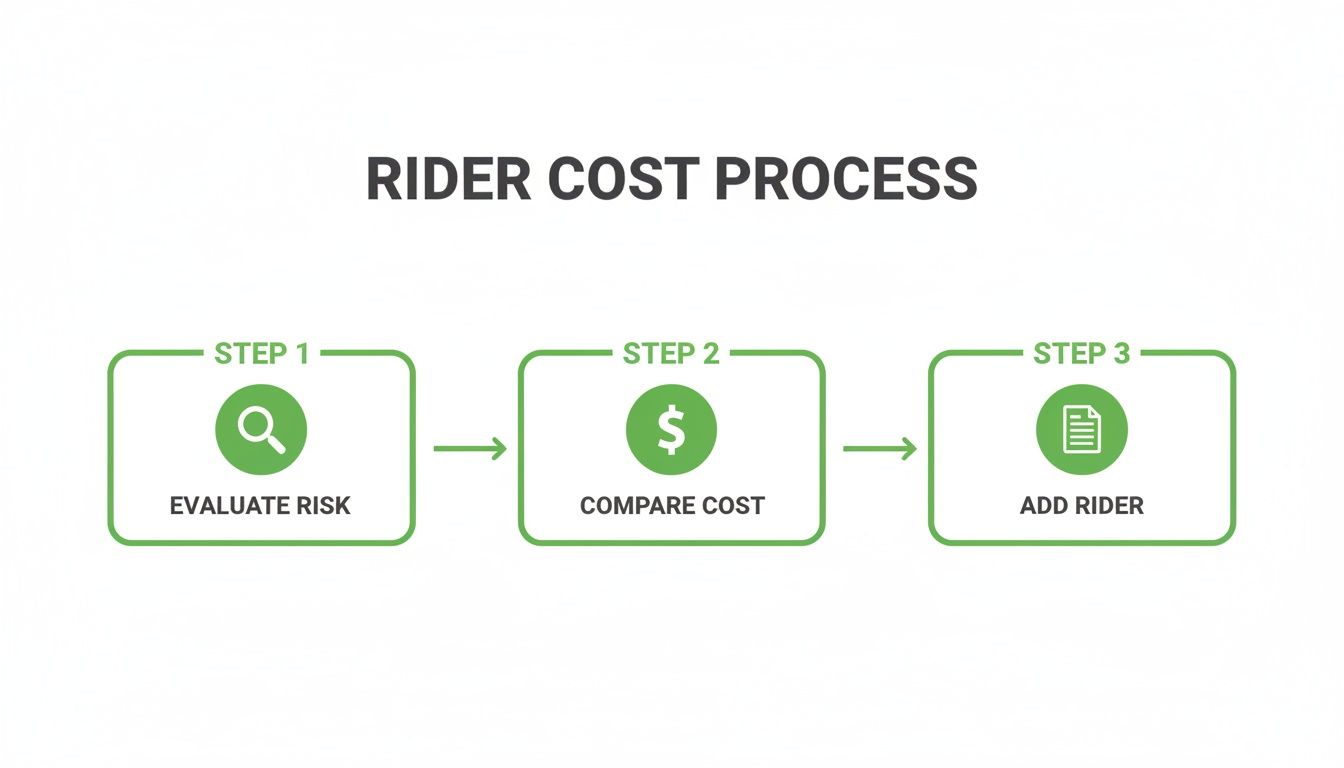
As you can see, this isn't a random decision. Adding a rider starts with a clear-eyed look at where you're vulnerable before you take the practical steps to get it done.
Step 2: Determine the Best Time to Make a Change
You can usually add a rider mid-term, but some moments are just better for making policy changes. Your annual renewal is the perfect time. You're already looking over your coverage and premium, so it’s a natural point to fold in any adjustments. For a deeper dive on this, check out our guide on the insurance policy renewal process.
But don't wait for your renewal if something big changes. Certain life events should trigger an immediate call to your agent.
- Getting married or divorced: You’ll likely need to add or remove people from your policy and rethink coverage for shared assets.
- Having a child: This is the perfect time to consider adding a child term rider to your life insurance.
- Buying something valuable: A new engagement ring, a piece of art, or a high-end collection needs its own protection right away.
- Starting a home-based business: Your standard homeowners policy almost certainly won't cover your business equipment or liability.
Step 3: Contact Your Agent with the Right Questions
Once you know what you need and you're ready to add it, it's time to talk to your insurance agent. Go into that conversation prepared with a list of questions so you leave with a full understanding of the new coverage.
A perfect real-world example of how a rider can evolve is the accelerated death benefit. This rider became a common feature in life insurance largely because of the AIDS crisis in the 1980s and 1990s. By 1991, states began requiring policies to give terminally ill individuals the option to access 50-100% of their death benefit early, a shift that provided crucial financial help when it was needed most.
Don't just ask, "How much does it cost?" A cheap rider that doesn't actually protect you is a total waste of money. The real goal is to understand the value and the specific details of the coverage you're adding.
Here are a few must-ask questions for your agent:
- How much will this rider add to my total premium?
- What are the exact exclusions or limitations for this new coverage?
- Does this rider have its own deductible?
- How will this rider work with the other coverages I already have?
- What kind of documents do I need to provide, like appraisals for my valuables?
Once you give the green light, your insurer will issue an endorsement or an updated declarations page that shows the added rider. Read that document carefully to make sure everything is correct, then file it away with your original policy.
Building a Custom Safety Net with Wexford Insurance
Your life, your family, and your business aren’t like anyone else’s. So why would a generic, off-the-shelf insurance policy give you the right level of protection?
The short answer is, it often can't. This is where the true value of an insurance policy rider really shines. Think of riders as the tools we use to transform a standard policy into a financial shield built just for you. They close the gaps that standard coverage leaves open, making sure your protection is a perfect fit for your specific risks and assets. A one-size-fits-all policy simply doesn't cut it when your financial well-being is at stake.
Your Partner in Personalized Protection
At Wexford Insurance, our job is to help you see the whole picture. We don’t just sell policies; we build protective strategies from the ground up. Our advisors are skilled at spotting your unique exposures—whether that’s a valuable art collection, a complex business operation, or the need for more robust liability protection—and then hand-picking the right riders to cover them.
The goal is to move beyond basic coverage to create a safety net that adapts and grows with you. The process is much more straightforward than you might think. We typically start with a complimentary policy review to identify any vulnerabilities and find opportunities to strengthen your coverage.
The need for this kind of specialized protection is growing worldwide. For example, the critical illness rider has seen a huge surge in demand in Asia, where the health insurance market recently grew by 12.6%. This growth is driven by riders covering conditions like cancer and stroke, which affect millions of new people each year. You can dive deeper into these global insurance trends and what they mean for consumers in this McKinsey report on the pursuit of growth.
A Strategy That Evolves with You
Our commitment doesn't stop once we put your policy in place. Life is always changing, and your insurance should keep up.
An insurance strategy is not a "set it and forget it" product. It's a living plan that should be revisited after major life events, business milestones, or changes in your financial situation to ensure your protection remains perfectly aligned with your needs.
Don't settle for coverage that leaves you exposed. The right combination of riders provides genuine peace of mind, knowing your safety net is built for your reality, not someone else's.
Ready to see how we can build a better safety net for you? Contact a Wexford advisor today to schedule your complimentary policy review and make sure your protection is a perfect fit.
Answering Your Questions About Insurance Riders
It’s only natural to have a few practical questions when you start looking at customizing your insurance. Riders are fantastic tools for tailoring a policy to your life, but you need to know the nuts and bolts of how they work to really get the most out of them. Let's tackle some of the most common questions we hear from clients every day.
Think of this as the owner’s manual for your policy add-ons. You wouldn't install a new high-tech feature in your car without reading up on it first, right? The same idea applies here. Getting the details straight from the start means no unpleasant surprises later on.
When Can I Add a Rider to My Policy?
This is probably the most common question we get: "Can I add a rider whenever I want?"
The easiest and most straightforward times to add a rider are when you first buy a policy or at your annual renewal. Everything gets bundled together neatly at that point. But you're not necessarily stuck waiting for those windows. Most insurance companies will let you make changes mid-term, especially if a major life event—like getting married or buying a new piece of art—prompts the need for more coverage.
Just know that adding a rider in the middle of your policy term might trigger a quick review or even a bit of re-underwriting. The insurer needs to evaluate the new risk they're taking on. This could mean some extra paperwork or a fresh appraisal for a high-value item. The best advice is to be proactive; don't wait to ask for coverage you know you need right now.
Are Insurance Riders Tax Deductible?
The tax question is a tricky one because the answer completely depends on the type of policy the rider is attached to. There’s no simple "yes" or "no" that applies to everyone.
For business owners, the answer is often a resounding yes. If you add a rider to a commercial policy—say, for business interruption or hired and non-owned auto coverage—it's typically considered a necessary business expense. That means it's generally tax-deductible, which can help bring down the true cost of managing your company's risk.
For your personal policies, however, it's a different story. Riders added to your homeowners, personal auto, or personal life insurance are not tax-deductible in most cases.
Tax laws are complicated and depend heavily on your specific financial picture. Your best move is always to chat with a qualified tax professional who can give you advice based on your unique situation.
How Do Riders Affect Your Policy Deductible?
Another popular question is whether adding a rider will bump up your main policy's deductible. In most cases, it won't.
A rider is built to adjust your premium and your coverage, not the fundamental deductible on your base policy. You'll pay a bit more in premiums for the extra protection, but the deductible you originally chose for your home or auto policy should stay exactly the same.
That said, there's one important exception to watch out for. Some very specific riders, especially for unique risks like earthquakes or certain kinds of water damage, might have their own, separate deductible. If you file a claim under that specific rider, you'd pay the rider's deductible, not your main one. It’s crucial to ask your agent about this so you know exactly what your out-of-pocket costs would be for any type of claim.
At Wexford Insurance Solutions, our job is to cut through the confusion and build a policy that gives you total clarity and peace of mind. If you have more questions or want a second look at your current coverage to spot any gaps, our advisors are ready to help. Schedule a complimentary policy review with us today.
 Difference Between an Insurance Agent and a Broker: Who Do You Trust?Does Insurance Cover Water Damage? A Homeowner's Guide


