

Think of cleaning business insurance as your company’s financial safety net. It’s there to catch you when the unexpected happens—and in the cleaning business, the unexpected is just a normal Tuesday.
At its core, this insurance protects you from the financial fallout of accidents, property damage, and injuries that can happen on the job. We’re talking about real-world scenarios, like a team member accidentally shattering a client’s antique vase or someone slipping on a freshly mopped floor. This isn't just about ticking a box; it's about building a resilient, professional operation from the ground up.
Why Cleaning Business Insurance Is Your First Line of Defense

Let’s be honest. Accidents happen. A vacuum cord gets tripped over. The wrong cleaning solution is used on a sensitive surface. Without insurance, the full weight of a lawsuit, medical bills, or replacement costs lands squarely on your shoulders. It can put your personal assets at risk and jeopardize the future of the business you've worked so hard to build.
Proper insurance coverage acts as a vital shield, and it’s the bedrock of any serious cleaning company for a few key reasons:
- Financial Protection: It steps in to pay for legal fees, settlements, and medical bills, so a single mishap doesn’t sink your entire business.
- Client Trust and Credibility: When you can show a certificate of insurance, you're telling clients you’re a professional who takes responsibility seriously. In fact, many commercial clients won't even entertain a bid without it.
- Contractual Requirements: Want to land those bigger, more lucrative commercial contracts? You'll find that nearly all of them require you to carry specific insurance minimums. It's a non-negotiable part of playing in the big leagues.
- Peace of Mind: This might be the most underrated benefit. Knowing you're covered lets you focus on what you do best—growing your business—instead of constantly worrying about what could go wrong.
Building a Foundation for Growth
It's helpful to stop thinking of insurance as just another bill. It's an investment in your company's stability and your professional reputation. The global cleaning services market is massive, valued at well over USD 400 billion in recent years. With that growth comes incredible opportunity, but it also brings more risk. More jobs mean more chances for property damage or injuries, making solid coverage more essential than ever.
Insurance is what allows a small mistake to remain just that—a mistake. Without it, that same mistake can become a business-ending catastrophe. It’s the difference between a simple apology and a devastating lawsuit.
Solid insurance is also a cornerstone of effective business continuity planning, helping ensure you can keep operating even when things go sideways. The right policy is a key piece of your entire risk management puzzle.
To get a better handle on the nuts and bolts of different policies, take a look at our deeper dive into what commercial insurance covers. It breaks down exactly what you need to know.
What Insurance Does a Cleaning Business Actually Need?
Figuring out insurance for your cleaning business can feel overwhelming. With all the different policies and jargon, it's easy to feel lost. Let’s cut through the noise and break down the essential coverages that will truly protect your hard-earned business.
Think of your insurance not as a bunch of separate bills, but as layers of armor. Each policy guards against a different kind of risk you face every single day on the job. We'll start with the absolute must-haves and build from there.
General Liability: Your First Line of Defense
If you buy only one policy, this is it: General Liability Insurance. It's the bedrock of your protection and, frankly, non-negotiable for any serious cleaning business. This policy is all about protecting you from claims made by third parties—think clients, their customers, or visitors to a property you're cleaning.
Imagine this: one of your crew members accidentally tips a bucket of water onto a client's server, frying their system. Or a visitor at an office you clean slips on a freshly mopped floor and breaks their wrist. General liability is what steps in to handle the mess.
Specifically, it covers:
- Property Damage: Pays to repair or replace a client's property that you or your team accidentally damage.
- Bodily Injury: Covers medical expenses and legal fees if a non-employee gets hurt because of your work.
- Advertising Injury: Protects you if you're accused of things like slander, libel, or copyright infringement in your marketing.
Without it, a simple slip-and-fall accident could spark a lawsuit that threatens not just your business, but your personal savings, too.
Workers’ Compensation: A Must-Have for Your Team
The moment you hire your first employee, you need Workers' Compensation Insurance. In almost every state, this isn't just a smart move—it's the law. This policy is the safety net for your most valuable assets: your people.
If an employee throws out their back lifting a floor buffer or has a bad reaction to a cleaning chemical, workers' comp is there to cover their medical bills and a portion of their lost wages while they get back on their feet.
Workers' compensation doesn't just protect your employees; it protects your business from them. By providing these benefits, it generally prevents an injured employee from suing you directly for a workplace injury. It creates a much more stable and secure environment for everyone involved.
The risks in the cleaning industry are real. Labor makes up a staggering 70–80% of your operating costs, and most claims are directly tied to your team's physical work. Things like falls and chemical exposures are common, making both general liability and workers' comp absolutely critical. You can dig into more data on cleaning industry risks and claims if you're curious.
Commercial Auto Insurance: Covering Your Business on Wheels
Do you use a company van to haul supplies? Or even just your personal car to drive between job sites? If the answer is yes, your personal auto policy isn't going to cut it. You need Commercial Auto Insurance.
Here’s the catch most people miss: personal auto policies almost always have a "business use exclusion." That means if you get into an accident while driving for work, your insurer can legally deny your claim, leaving you on the hook for every penny of the damages.
Commercial auto is designed specifically for vehicles used for work, making sure you're properly covered when you're on the road for your business.
The Business Owner's Policy (BOP): A Smart, All-in-One Package
For many small to mid-sized cleaning businesses, a Business Owner's Policy (BOP) is often the smartest and most affordable way to go. A BOP is a package deal that bundles several essential coverages together, usually for less than you'd pay for them individually.
A standard BOP typically includes:
- General Liability Insurance
- Commercial Property Insurance (to cover your own equipment, supplies, and office)
- Business Interruption Insurance (to replace lost income if something like a fire at your office forces you to shut down temporarily)
This bundled approach makes managing your insurance much simpler while giving you a solid foundation of protection. To figure out if it's the right move for your company, you can learn more about what a Business Owner's Policy covers in our complete guide.
Essential vs. Recommended Insurance for Cleaning Businesses
To make things even clearer, let's break down which policies are non-negotiable and which are highly recommended as you grow. Think of the "essential" column as your starting point—the bare minimum you need to operate safely and legally. The "recommended" column includes coverage you should strongly consider as your business expands, takes on different types of jobs, or acquires more assets.
| Policy Type | What It Covers | Who Needs It |
|---|---|---|
| General Liability | Bodily injury and property damage to third parties (e.g., clients, visitors). | All cleaning businesses, regardless of size. This is foundational. |
| Workers' Compensation | Medical bills and lost wages for employees injured on the job. | Any business with one or more employees. It's legally required in most states. |
| Commercial Auto | Liability and physical damage for vehicles used for business purposes. | Any business that uses vehicles to transport equipment, supplies, or employees. |
| Business Owner's Policy (BOP) | A package bundling General Liability, Commercial Property, and Business Interruption. | Small to medium-sized businesses looking for comprehensive coverage at a better price. |
| Inland Marine (Tool/Equipment) | Covers your cleaning equipment while it's in transit or at a job site. | Businesses with valuable, portable equipment like floor buffers, carpet extractors, or pressure washers. |
| Umbrella Liability | Provides extra liability coverage above the limits of your other policies. | Businesses with significant assets or those working on large commercial contracts with high insurance requirements. |
| Cyber Liability | Protects against data breaches and cyberattacks if you store sensitive client data. | Businesses that store client information digitally, such as credit card numbers, addresses, or contracts. |
Choosing the right mix of essential and recommended policies is the first real step toward building a resilient, professional cleaning business that's prepared for whatever comes its way.
Understanding Policy Limits and Premium Costs
Once you know which policies you need, the next step is to get comfortable with the numbers behind them. Diving into policy limits and premiums can feel a bit like learning a new language, but the concepts are actually pretty straightforward when you break them down. These numbers dictate the strength of your coverage and what you’ll pay for it, so getting them right is crucial for your budget and your peace of mind.
Think of your insurance policy as a financial safety net. The policy limits tell you how big and strong that net really is. You'll usually see them expressed as two key figures.
This diagram shows how your core insurance policies work together to protect your business from all sides.
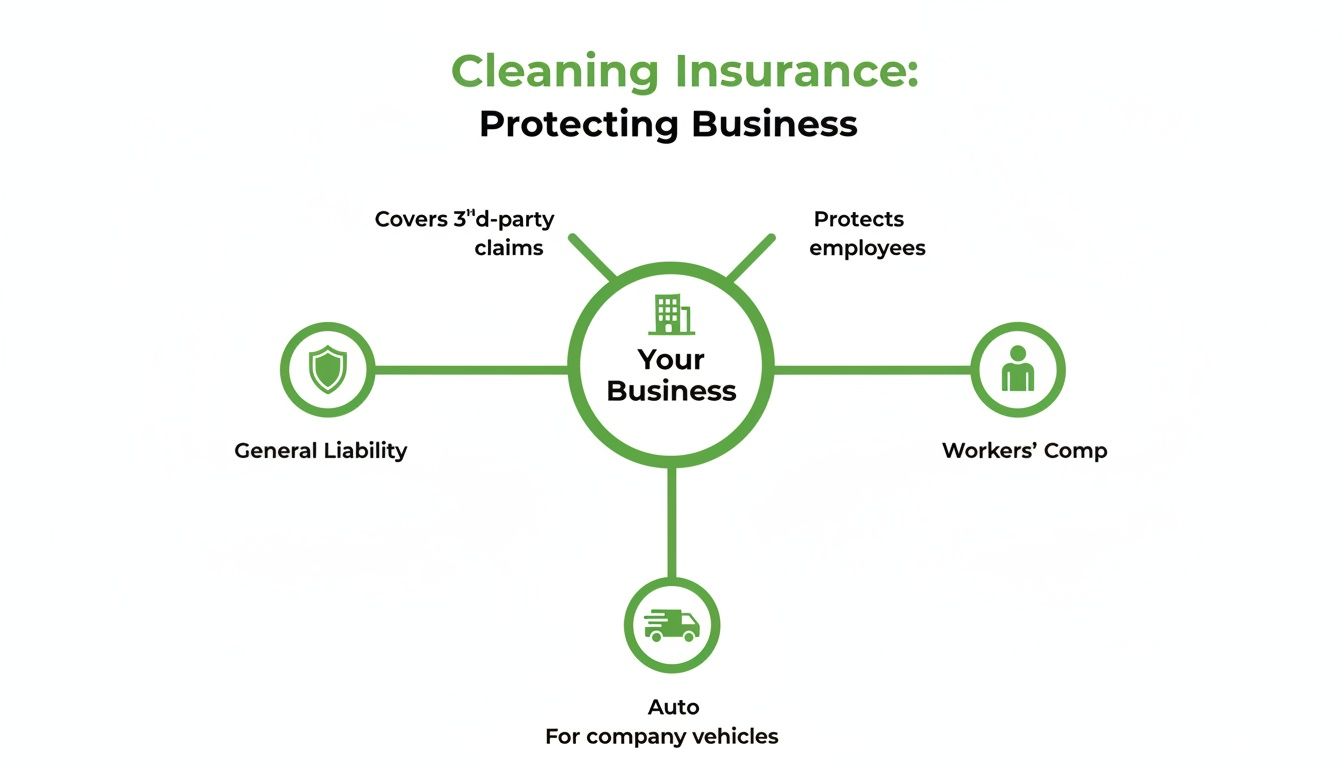
As you can see, General Liability, Workers' Comp, and Commercial Auto are separate shields, but they're all essential for the total security of your operation.
Per-Occurrence vs. Aggregate Limits
This is the most important distinction to grasp when you're looking at your policy. It’s the key to understanding how your coverage actually works when you need it most.
- Per-Occurrence Limit: This is the maximum amount your insurance company will pay out for a single claim. Let's say one of your cleaners accidentally starts a small fire, causing $500,000 in damage. If your per-occurrence limit is $1 million, your policy can cover the entire cost. It’s the ceiling for any one accident.
- Aggregate Limit: This is the absolute total your insurer will pay for all claims combined during your policy term (usually one year). Think of it as your insurance "bank account" for the year. Once it's gone, it's gone.
For example, a standard general liability policy is often written as $1 million / $2 million. This means you get up to $1 million for any single incident, but no more than a total of $2 million for all claims added together that year.
This $1 million per-occurrence and $2 million aggregate limit is exactly what most commercial clients will require you to have. It gives them confidence that you can handle one big disaster without completely draining your coverage for any other potential issues that might pop up during the year.
Getting these limits right is fundamental. For a deeper dive, it’s worth learning more about what aggregate insurance coverage means and how it affects your company’s financial safety net.
What Determines Your Premium Cost?
So, what goes into the price tag—the premium—you actually pay? It all comes down to risk. Insurance carriers are in the business of calculating the odds that you'll file a claim.
The more risk they see, the higher your premium. Here are the main factors they'll look at.
1. Business Size and Payroll
The bigger your team, the bigger the risk. This is especially true for workers' comp, where premiums are tied directly to your total payroll. It’s a simple numbers game: more people on the job means more chances for someone to get hurt.
2. Services Offered
What you clean matters. A lot. A crew that only does standard residential cleaning is a much lower risk than a team that offers high-rise window washing or handles post-construction cleanup with heavy equipment. If you offer specialized or higher-risk services, expect to pay more for your coverage.
3. Location and Service Area
Insurance rates aren't the same everywhere; they can vary by state or even by county. Some areas have higher rates of lawsuits or stricter local regulations, which directly translates to higher insurance costs. Where you work is a big piece of the puzzle.
4. Claims History
Your track record is one of the most powerful factors. If your business has a history of frequent claims, an underwriter will see you as a higher risk and price your policy accordingly. On the flip side, keeping a clean claims record is one of the best things you can do to keep your insurance costs down over the long run.
Your premium isn't just some random number. It's a direct reflection of your business's unique risk profile. Understanding these factors gives you a clearer picture of what's driving your costs and where you might be able to make changes to save money.
How to Find and Choose the Right Insurance Policy
Shopping for insurance for your cleaning business doesn't have to be a headache. If you know what to look for and the right questions to ask, you can confidently find a policy that truly protects all your hard work. It really just comes down to knowing where to start.
Your first step is understanding who actually sells insurance. You’ve basically got three main options, and each one offers a totally different experience.
Comparing Your Options: Agents, Brokers, and Carriers
Picking the right partner to help you buy insurance is just as important as picking the right policy. This choice really shapes everything—the advice you get, the policies you see, and the help you receive if you ever need to file a claim.
Let’s break down the main players in the game:
-
Captive Agents: Think of agents who work for one specific company, like State Farm or Allstate. They are experts on their company’s products, but that’s all they can offer you. This can be a problem if that one company’s policies aren’t a great match for the unique risks a cleaning business faces.
-
Direct Online Carriers: You can always go straight to an insurer’s website and buy a policy yourself. It’s fast and convenient, sure, but you’re completely on your own. You have to be the expert, figuring out your own coverage and limits without any professional guidance, which can be a recipe for disaster if you're not an insurance pro.
-
Independent Agents or Brokers: Unlike captive agents, independent agents aren’t tied to a single insurance company. They work with many different carriers, which means they can shop around for you. They’ll compare policies and prices to find the best fit for your specific needs, acting as your advocate, not a salesperson for one brand.
To really get a feel for this, it’s worth understanding the difference between an insurance agent and a broker. Knowing the nuances can help you decide which professional is the right ally for your business.
Why a Specialist Matters
The cleaning industry is its own world, a niche market valued between USD 1.1 billion and USD 2.6 billion. Because so many commercial cleaning contracts require very specific types of coverage, insurers have created policies tailored to these risks. Working with someone who gets this is a huge advantage. Discover more insights about the specialized cleaning insurance market.
An agent who specializes in cleaning businesses already knows the difference between residential and commercial risks. They understand what "care, custody, or control" coverage is and why you absolutely need it. They know which carriers have the best rates for janitorial services. That expertise saves you time and, more importantly, protects you from dangerous gaps in your coverage.
Getting an Accurate Quote Starts With You
To get quotes that are both competitive and accurate, you need to have some basic information about your business ready to go. Think of it as creating a clear snapshot of your operations for the insurance underwriters.
Here’s what you should have handy:
- Annual Revenue Projections: Your best estimate of your total gross sales for the year.
- Total Payroll: The full amount you pay your team annually, if you have employees.
- List of Services: Get specific. Do you do residential, commercial janitorial, window washing, or carpet cleaning?
- Business Structure: Are you operating as a sole proprietor, LLC, or a corporation?
- Claims History: A simple record of any insurance claims you’ve filed in the past.
Having this info organized and ready will make the quoting process much smoother and ensure the price you see is the price you’ll actually pay.
Don't Skip the Fine Print: Policy Exclusions
Okay, this is important. Before you sign on the dotted line, you have to read the policy carefully, especially the exclusions section. This is the part of the contract that spells out exactly what your policy won't cover.
For a cleaning business, you might find exclusions for things like mold remediation, damage from certain types of harsh chemicals, or asbestos abatement.
Understanding these limitations is absolutely critical. A policy that looks great on the surface is worthless if it excludes the exact risks you face every single day. This is another area where a good agent earns their keep—they can help you cut through the jargon and make sure the policy you choose has you covered where it counts.
What Happens When You Need to File a Claim

Insurance can feel like a safety net you hope you never have to use. But when an accident does happen, that abstract policy becomes a very real and powerful tool. Understanding the claims process demystifies your coverage and shows you exactly how your cleaning business insurance works to protect you from financial disaster.
Let's walk through a few real-world scenarios to see how different policies spring into action during a crisis. These stories will illustrate the entire journey, from the initial incident to the final resolution, making the value of your coverage tangible.
Scenario One: The Broken Antique Vase
Imagine your team is cleaning a high-end residential home. While dusting a mantelpiece, an employee accidentally knocks over an antique vase. It shatters on the floor. The client is understandably upset and informs you the vase was a family heirloom valued at $5,000.
This is a classic case for your General Liability Insurance, which covers property damage to a third party. Here’s a play-by-play of what happens next.
- Immediate Action: First things first, you document everything. Take clear photos of the broken vase and the surrounding area. It's also smart to get a written statement from your employee about what happened while it's fresh in their mind.
- Notify Your Insurer: You contact your insurance agent immediately to report the incident. They’ll open a claim file and assign an adjuster to the case.
- Investigation: The adjuster will review your documentation, speak with you and your employee, and likely contact the client to get details about the vase's value. They may ask for an old receipt or an appraisal to verify the cost.
- Resolution: Once the adjuster confirms the vase's value and verifies the damage was accidental and covered by your policy, the insurance company issues a payment to the client for the replacement cost, minus your deductible. Your business is protected from a $5,000 out-of-pocket loss.
Navigating these steps can seem daunting, but a good agent will guide you. For a more detailed breakdown, check out our guide on how to file a property damage claim to prepare for any situation.
Scenario Two: The Slippery Floor Lawsuit
Now, picture a commercial setting. Your crew has just finished mopping the lobby of an office building. Despite putting up "Wet Floor" signs, a visitor rushes through, slips, falls, and breaks their arm. They decide to sue your cleaning business for $75,000 to cover medical bills, lost wages, and pain and suffering.
This is a bodily injury claim, also handled by your General Liability policy. The stakes are much higher now that legal action is involved.
This type of claim highlights the dual protection of liability insurance. It doesn't just cover the settlement; it also pays for your legal defense—the attorney fees, court costs, and expert witnesses needed to fight the lawsuit, which can be incredibly expensive on their own.
The process is more involved:
- Initial Report: You immediately report the injury to your insurer, providing all details about the incident, including where the warning signs were placed and any witness information you gathered.
- Legal Defense: Your insurance company appoints a law firm to represent your business. They take the reins, handling all communication with the plaintiff's attorney, filing court documents, and building your defense.
- Negotiation and Settlement: Most lawsuits like this get settled out of court. The attorneys will negotiate a fair amount (let's say $40,000), and your insurer pays it. If a settlement can't be reached, they will defend you at trial.
- Financial Shield: No matter the outcome, your policy covers the legal bills and the final settlement or judgment, up to your policy limit. This protects your business's assets from being seized to pay the claim.
Scenario Three: The Employee Back Injury
Finally, let's look at an incident involving your own team. An employee is lifting a heavy floor buffer out of the company van and strains their back. They need medical attention and will have to take time off work to recover. This is where your Workers' Compensation Insurance is absolutely essential.
- Seek Medical Care: Your first priority is making sure the employee gets the medical care they need, no questions asked.
- File the Claim: You must report the injury to your workers' comp carrier right away. The process is regulated by the state and has strict deadlines, so prompt reporting is key.
- Benefits Paid: The insurance company works directly with the medical providers to pay the bills. They also calculate and pay wage replacement benefits to your employee while they are unable to work.
- Return-to-Work Program: A good insurer will help coordinate a plan to get your employee back on the job safely, perhaps starting with light-duty tasks before they are fully recovered.
In this case, your policy covers the employee’s medical costs and lost wages, and it legally protects you from being sued by that employee for the workplace injury. It’s a critical system that protects both your people and your business.
Answering Your Top Insurance Questions
When you're busy running your cleaning business, insurance can feel like a whole other language. You've got questions, and you need straight answers—not a bunch of industry jargon. This is your quick-reference guide, designed to tackle the most common questions we hear from cleaning pros just like you.
Whether you're just starting as a solo cleaner or you're managing a growing team, these answers will clear things up and help you protect the business you're working so hard to build.
Do I Need Insurance If I Am a Solo Cleaner?
Yes. Absolutely, one hundred percent. This is one of the most important things a new business owner can understand.
Even on your own, you face the same risks as a big company—a broken heirloom, a damaged floor, or someone tripping over your vacuum cord. The scary part? Without a business policy, any claim or lawsuit comes after you personally. That means your car, your savings, and even your home could be on the line.
General liability insurance is your first line of defense, and it’s non-negotiable from day one. It doesn't just protect your finances; it also shows clients you're a serious professional. Many customers won't even consider hiring a cleaner who can't show proof of insurance.
What Is a Certificate of Insurance and Why Do Clients Ask for It?
Think of a Certificate of Insurance (COI) as your insurance ID card. It’s a simple, one-page document that proves you have active coverage, and clients (especially commercial ones) love it.
A typical COI gives them a quick snapshot of your policy, showing:
- What kind of coverage you have (like General Liability)
- Your policy limits (for example, $1 million per incident)
- Who your insurance carrier is
- When your policy starts and ends
Commercial clients almost always demand a COI before you can start work. Why? It gives them peace of mind. They know that if one of your employees accidentally causes damage, your insurance policy—not theirs—is there to handle it. It's a standard and non-negotiable part of professional contracts.
Are Subcontractors Covered by My Insurance Policy?
This is a huge gray area for a lot of business owners, and getting it wrong can be costly. The short answer is almost always no. Your insurance policies are designed to cover your direct employees—the people you pay on a W-2.
Independent contractors (who you'd pay via 1099) are considered their own separate businesses. They are not automatically included under your coverage.
The best way to handle this is to require every subcontractor to carry their own insurance. Before they do any work for you, ask for a copy of their COI to prove they have, at a minimum, their own general liability policy. If they have their own crew, they need their own workers' comp, too.
Pro Tip: For an extra layer of protection, ask your subcontractors to add your business as an "additional insured" on their policy. This means if they make a mistake that leads to a claim, their insurance has to defend your company, too. It’s a smart way to shield yourself from their errors.
If you don't verify their insurance and they cause damage, guess who the client is coming after for the bill? You.
How Can I Lower My Cleaning Business Insurance Costs?
Insurance is a must-have expense, but that doesn't mean you can't be smart about it. Your goal shouldn't be to find the absolute cheapest policy, but to get the best value for the right protection.
Here are four practical ways to keep your premiums in check:
- Build a Strong Safety Program: The easiest claim to deal with is the one that never happens. Documented safety training—covering things like chemical safety, proper lifting, and how to prevent slips and falls—proves to an insurer that you're a low-risk business. A good safety record is your ticket to lower rates over time.
- Choose a Higher Deductible: The deductible is what you pay out-of-pocket on a claim before the insurance company pays the rest. Raising your deductible from, say, $500 to $1,000 will lower your yearly premium. Just make sure you can comfortably cover that higher amount if something goes wrong.
- Bundle Your Policies: It works for your home and auto, and it works for your business, too. A Business Owner's Policy (BOP) is a popular package that combines general liability and commercial property coverage, often for less than buying each policy separately.
- Work With an Independent Agent: This might be the most effective move you can make. An independent agent who knows the cleaning industry can shop your coverage with multiple insurance companies to find the best fit and the most competitive price. They know what you need and, just as importantly, what you don't.
Getting a handle on your risks and being strategic about how you buy insurance can save you real money without leaving your business exposed.
Navigating insurance is a crucial part of building a resilient and professional cleaning business. Having an expert partner to guide you through the process can make all the difference. At Wexford Insurance Solutions, we simplify the complexities of insurance, ensuring you get the right coverage at the best price.
Ready to secure your peace of mind? Get a personalized quote from Wexford Insurance Solutions today!
 What Is Experience Modification Rate and How Does It Affect Your Costs?A Shipper's Guide to Marine Cargo Insurance


