

Imagine your business gets hit with a lawsuit so massive it blows right through your standard liability insurance limits. What happens next? This is where commercial umbrella coverage comes in—it's the financial backstop that kicks in when your primary policies are tapped out.
Think of it as a second, much larger roof built over your existing insurance, shielding your business assets when a catastrophic claim threatens to wash you out.
How Umbrella Coverage Really Works
At its heart, a commercial umbrella policy isn't something you buy on its own. It’s a powerful layer of extra liability protection that sits on top of the business insurance you already have. Your primary policies, like General Liability or Commercial Auto, are your first line of defense, and each has its own coverage limit.
An umbrella policy only springs into action when a claim is big enough to completely exhaust the limit of one of those underlying policies. It then steps in to pay the rest, all the way up to its own, much higher limit. This structure is what stops a single, devastating event from becoming a financial knockout blow for your company.
Your Financial Safety Net for "What-If" Scenarios
Without this extra protection, your business would be on the hook for any judgment that goes beyond your primary policy limits. That money has to come from somewhere—company bank accounts, the sale of property, or even bankruptcy. The need for this kind of protection is growing, and the market numbers prove it.
The global commercial umbrella insurance market hit USD 45.2 billion in 2023 and is expected to reach USD 78.6 billion by 2033. North America is currently the largest market, which makes sense given the complex legal risks businesses here navigate every single day. You can dig into these trends in the full DataHorizzon Research report.
Key Takeaway: An umbrella policy isn't for small, everyday claims. It’s for the rare, high-stakes events that could financially cripple an otherwise healthy business. It’s peace of mind in a policy.
To give you a clearer picture, let's break down its role in a simple table.
Commercial Umbrella Coverage at a Glance
This table offers a quick snapshot of what a commercial umbrella policy does and why it's so important for protecting your business's long-term financial health.
| Function | What It Means for Your Business |
|---|---|
| Extends Liability Limits | Provides millions in extra coverage on top of your existing policies. |
| Covers Catastrophic Claims | Protects your business assets from massive lawsuits that exceed primary limits. |
| Fills Potential Gaps | Can sometimes cover certain claims not included in your underlying policies. |
| Provides Peace of Mind | Safeguards your company's future against unusually large liability losses. |
Ultimately, this coverage gives your business the financial resilience it needs to withstand a worst-case scenario.
How It Layers Over Your Core Policies
Simply put, an umbrella policy extends the financial reach of your most important liability policies. It’s built to work with them, not replace them. The main policies it sits on top of are:
- General Liability Insurance: This covers claims of bodily injury or property damage happening on your premises or because of your business operations.
- Commercial Auto Insurance: This handles liability from accidents involving your company vehicles.
- Employer's Liability Insurance: As part of your workers' comp, this protects you from lawsuits by employees over work-related injuries that aren't covered by standard benefits.
By adding this extra buffer, you're making sure your business is truly prepared for the unexpected. For a deeper dive into the specifics, you can learn more about what umbrella insurance covers in our detailed guide.
How Umbrella Coverage Works with Your Existing Policies
Think of a commercial umbrella policy as an extra layer of financial armor for your business. It doesn't replace the insurance you already have; it sits on top of it, waiting in the wings for a truly serious claim.
Your primary policies, like General Liability or Commercial Auto, are your first line of defense. They handle the everyday risks and bumps in the road. But what happens when a claim is so big it completely overwhelms those policies? That’s exactly when your umbrella policy kicks in.
This layered structure is the whole point. The umbrella policy stays inactive until a claim is large enough to exhaust the entire limit of your primary coverage. Only then does it spring into action.
The Role of Underlying Limits
This brings us to a key term: underlying limits. It's simply the maximum amount your primary insurance policies will pay for a single claim. Before an umbrella policy even gets a look-in, a covered claim has to burn through this entire underlying limit first.
Let's say your business has a standard setup:
- Commercial General Liability: $1,000,000 per occurrence
- Commercial Auto Liability: $1,000,000 per accident
- Employer's Liability: $500,000 per incident
These are your foundational coverages. Your umbrella carrier will require you to keep these (or similar) policies in place. If a lawsuit or settlement blows past one of these limits, the umbrella is there to pick up the tab for the rest, all the way up to its own, much larger limit.
This diagram helps visualize how an umbrella policy adds that crucial protective layer over your other coverages to safeguard your business assets.
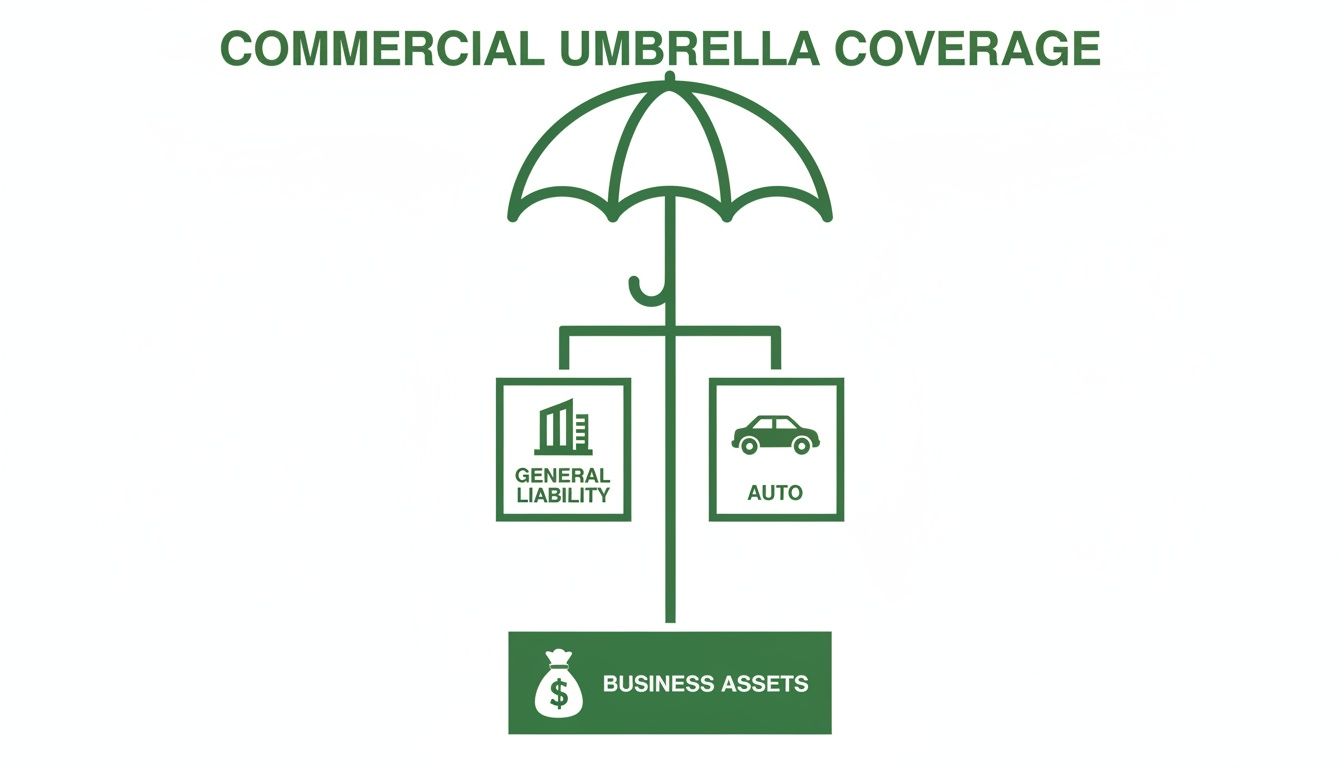
As you can see, it creates a hierarchy of protection, with the umbrella acting as the final, broad shield when things go very wrong.
A Real-World Claims Scenario
Let’s make this real. Imagine one of your company's delivery drivers is found at fault for a serious multi-car pile-up. The resulting medical bills and property damage lead to a lawsuit, and the final judgment against your company is $2.5 million.
Your Commercial Auto policy has a $1 million liability limit. Without an umbrella, your business is on the hook for the remaining $1.5 million. That’s a figure that could easily bankrupt a company, forcing you to sell off assets just to pay the bill.
But with a $5 million commercial umbrella policy, the story is completely different:
- Primary Policy Pays First: Your Commercial Auto policy pays out its full $1,000,000 limit.
- Underlying Limit Is Exhausted: The primary policy is now maxed out, but there’s still a $1.5 million shortfall.
- Umbrella Policy Activates: Your umbrella policy is triggered, covering the entire remaining $1,500,000.
The Outcome: The business is shielded from a devastating financial blow. The umbrella policy did its job perfectly, bridging the gap between the primary coverage and the massive cost of the claim, keeping your company’s assets safe and sound.
This layered defense ensures you’re prepared for the worst-case scenarios. While your general liability handles more common operational risks, the umbrella is your safety net for the extraordinary ones. You can get a refresher on your primary coverage by reading our guide on what is commercial general liability. Putting it all together is the key to truly comprehensive risk management.
Real-World Scenarios Where Umbrella Insurance Saves the Day
It’s one thing to talk about umbrella insurance in theory, but where the rubber really meets the road is in real-life situations. The truth is, catastrophic accidents often spring from the most ordinary, everyday circumstances. When they do, a standard policy limit can be wiped out in the blink of an eye.
These aren't just hypothetical what-ifs; they are grounded in the risks that business owners like you face every single day. Let's walk through a few examples to see how an umbrella policy can be the one thing that keeps a business standing after a major claim.
The Major Slip-and-Fall Incident
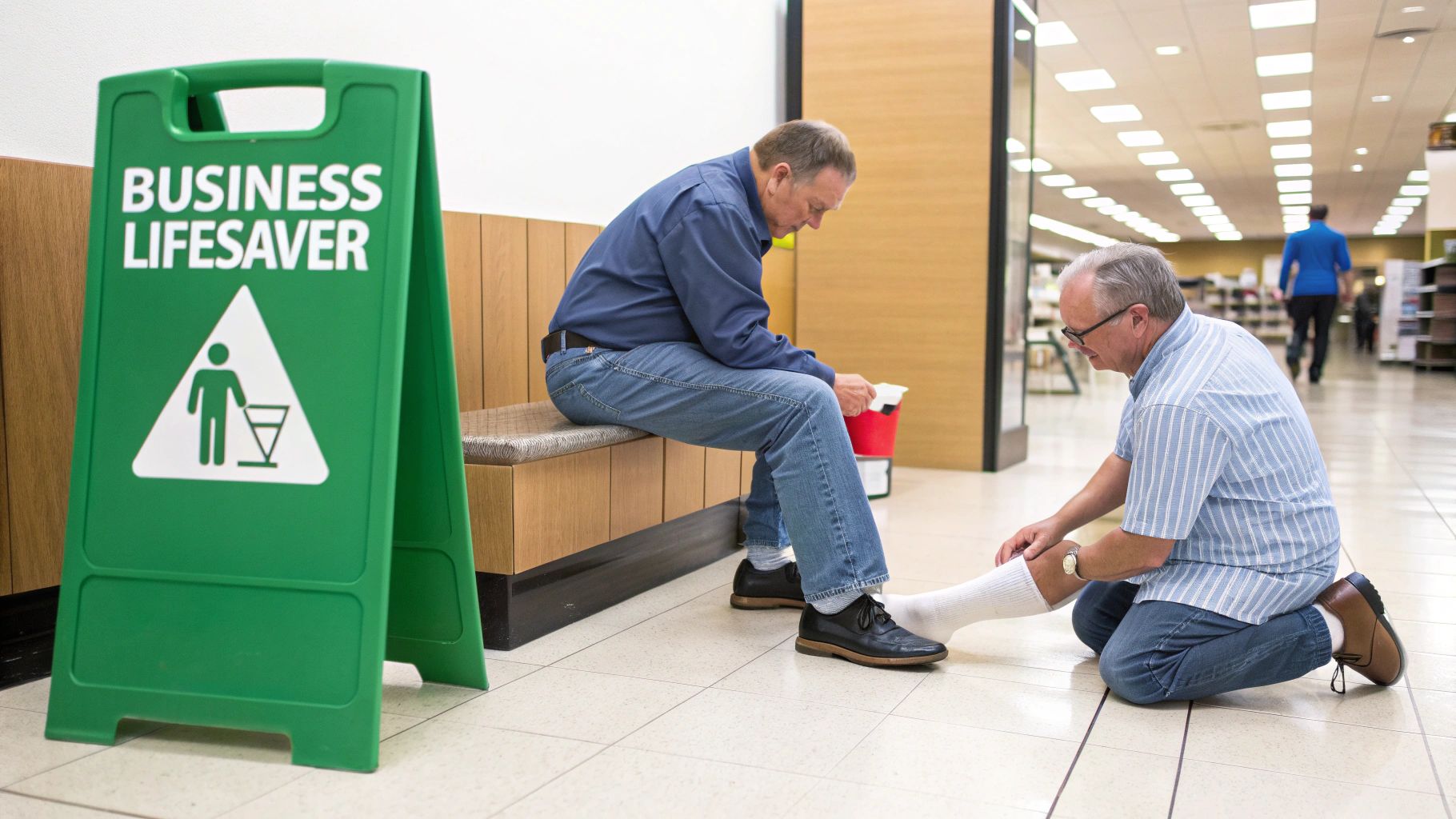
Imagine you own a popular boutique. On a rainy afternoon, a customer slips on a small puddle of water right by the entrance. The fall is awkward, and they suffer a severe spinal injury requiring multiple surgeries and leaving them with a permanent disability.
The customer sues your business for medical bills, lost income, and long-term pain and suffering. After a long legal fight, the court awards them a $2.5 million judgment.
Here's how that plays out:
- Your Primary Policy: Your General Liability policy has a standard $1 million limit per occurrence. It pays out every penny, but you're still left with a huge shortfall.
- The Uncovered Gap: Your business is now on the hook for the remaining $1.5 million. This is a crippling debt that could force you to liquidate assets, sell property, or even shut down completely.
- Umbrella to the Rescue: Thankfully, you invested in a $5 million commercial umbrella policy. As soon as your General Liability is exhausted, the umbrella kicks in to cover the entire $1.5 million balance.
In this scenario, the umbrella policy literally saved the business. It absorbed the financial shock, allowing the company to keep its doors open without draining its hard-earned assets.
The Multi-Vehicle Pile-Up
Here’s another all-too-common situation for any business with company vehicles. One of your best employees, a driver with a flawless record, is making a routine delivery. A split-second distraction on the highway causes a collision, triggering a chain-reaction pile-up involving four other cars.
The aftermath is serious: multiple people are injured, and several high-end vehicles are totaled. The combined claims for medical care, vehicle replacement, and legal fees skyrocket. Your company is ultimately found liable for $3 million.
The Financial Fallout: Your Commercial Auto policy has a liability limit of $1 million. Once that’s paid out, your business is still facing a staggering $2 million in damages.
Without an umbrella policy, this event would be financially devastating. But with one, the process is clean. Your auto policy pays its $1 million limit, and your umbrella policy immediately steps in to cover the remaining $2 million. This kind of protection is crucial, especially when your team is on the road representing your business. It also works hand-in-glove with your hired and non-owned auto insurance for even broader protection.
The Damaging Defective Product Claim
If you manufacture or sell products, you're exposed to the risk of major product liability lawsuits. These claims can easily climb into the millions, far beyond a typical primary policy.
Let's say your company makes a popular kitchen gadget. An unforeseen defect in a single batch causes several units to overheat, resulting in house fires and injuries.
Multiple lawsuits are filed, and the consolidated settlement comes to $4 million. Your General Liability policy includes product liability coverage, but only up to its $1 million limit. That leaves a $3 million gap that would land squarely on your business. An umbrella policy would cover that excess, preventing a single product defect from burning down your company's finances and reputation.
These examples all point to the same critical truth: the need for serious liability protection isn't just for "big business." The insurance market reflects this reality. The umbrella insurance market grew to USD 72.5 billion in 2021 and is projected to hit USD 170.7 billion by 2031, a trend driven by a legal environment where businesses of every size need a stronger financial shield. You can dig into the numbers in the market research from Allied Market Research.
Does Your Business Actually Need Umbrella Coverage?

Not every business faces the same level of risk, so the real question isn't just "what is commercial umbrella coverage," but "does my business need it?" While almost any company could benefit from the extra layer of security, certain types of businesses are far more likely to face a lawsuit that could blow right through their primary insurance limits.
The easiest way to think about it is a simple "what-if" exercise. What if the worst-case scenario happened—a catastrophic event that leads to a multi-million dollar judgment against your company? Would your current liability limits be enough to keep you in business?
High-Risk Business Profiles
Some businesses, just by the nature of what they do, live with a higher chance of a massive liability claim. If your company fits one of these descriptions, an umbrella policy stops being a "nice-to-have" and becomes a critical piece of your risk management plan.
These often include:
- Businesses with High Public Interaction: Think restaurants, retail stores, and event spaces. The constant flow of people dramatically increases the odds of a serious slip-and-fall or other accident happening on your property.
- Companies Operating Vehicle Fleets: The more cars or trucks you have on the road, the higher the probability of being involved in a major auto accident. This is especially true for delivery services, trucking companies, and any business with a mobile sales team.
- Contractors and Construction Firms: Working on active job sites is inherently risky. You're exposed to causing significant property damage or third-party injuries that can easily turn into huge claims.
- Professionals Providing Advice or Services: While this often falls under professional liability, a claim that involves bodily injury or property damage could still hit your general liability policy first. An umbrella provides that extra cushion.
A single, devastating claim can easily exhaust a standard $1 million liability policy. An umbrella policy is the buffer that protects your company’s financial future from being destroyed by one terrible event.
A Practical Risk Assessment Checklist
Instead of guessing, use this checklist for a quick self-assessment of your company's unique risks. If you find yourself answering "yes" to any of these, it’s a strong signal that you should be looking seriously at a commercial umbrella policy.
-
Do customers or the public visit your physical location?
Every single person who walks through your door represents a potential liability risk. The more foot traffic you have, the higher that risk climbs. -
Do your employees drive company-owned vehicles?
Commercial auto accidents are one of the most common sources of catastrophic liability claims. One bad wreck can easily surpass a standard auto policy limit. -
Does your business work on client property or job sites?
Operating off-site, especially in construction or skilled trades, opens you up to claims of property damage or injuring a third party. -
Do your contracts require high liability limits?
It's common for commercial contracts, particularly with large corporations or government entities, to mandate that you carry liability limits of $2 million, $5 million, or even more. -
Do your business assets exceed your current liability limits?
If the value of your equipment, property, and cash reserves is more than your primary policy limits, all of it is on the line in a major lawsuit.
Answering these questions gives you a much clearer picture of what you truly need. As you think through your risk, it’s also smart to look at how different protective measures work together. For example, understanding the difference between business continuity vs. disaster recovery strategies helps you build a more complete safety net.
Once you’ve confirmed the need, the next step is figuring out how much coverage is right. Our guide on how much umbrella insurance you might need can help you drill down on that number.
Understanding Coverage Limits, Costs, and Exclusions
So, you see the value in an umbrella policy. Great. Now comes the practical part: figuring out the numbers and reading the fine print. This is where the idea of a "safety net" turns into a real business decision about coverage limits, costs, and what isn't covered.
First up, you need to decide on a coverage limit. Commercial umbrella policies are typically sold in $1 million increments. The right number for your business isn't a guess—it's a calculated decision based on your unique risks. You have to look at everything you stand to lose, from your building and equipment to cash in the bank, and weigh it against the potential cost of a worst-case-scenario lawsuit.
A small retail shop with light foot traffic might feel comfortable with a $1 million or $2 million umbrella. But a large construction company working on major projects? They’re likely looking at $5 million, $10 million, or even more to properly shield their assets. The goal is to match your limit to your exposure.
Key Factors Driving Your Premium
Of course, this extra protection comes at a cost. Your premium is the price you pay, and it’s not an arbitrary number. Insurers look at a handful of key factors to figure out how risky your business is before they give you a quote.
Understanding what drives your premium helps you see the full picture. Insurers are essentially betting on how likely you are to have a major claim, and these are the variables they look at most closely.
| Cost Driver | Impact on Premium (Low to High) | Example |
|---|---|---|
| Industry Risk | Low to High | A freelance graphic designer has a much lower risk profile than a roofing contractor working at heights. |
| Claims History | Low to High | A business with a history of liability claims will pay more than a company with a clean record. |
| Underlying Policy Limits | High to Low | Higher limits on your primary GL and Auto policies can lower your umbrella premium. |
| Business Size | Low to High | More employees, vehicles, and locations mean more potential for accidents, increasing the premium. |
Ultimately, insurers want to see that you're already managing risk responsibly. Strong foundational policies and a good safety record can go a long way in keeping your umbrella premium down.
Common Exclusions to Be Aware Of
Just as important as knowing what’s covered is knowing what isn't. An umbrella policy is powerful, but it doesn't cover everything, and assuming it does can be a costly mistake. While every policy is different, some exclusions are pretty standard across the board.
Here are a few common risks that are typically not covered:
- Professional Liability: This is for mistakes or negligence related to your professional services, like an architect's design flaw. That requires a separate Errors & Omissions (E&O) policy.
- Workers' Compensation: An umbrella sits over the Employer's Liability part of your workers' comp, but it won’t cover standard employee injury benefits mandated by the state.
- Pollution and Environmental Damage: Liability from pollutants is a specialized risk. You'll almost always need a separate environmental insurance policy to cover clean-up costs or related lawsuits.
It's easy to get confused by the different types of liability coverage. For example, many business owners wonder how an umbrella policy differs from an excess liability policy. We break it all down in our guide comparing excess liability vs. umbrella insurance.
Right now, the market is getting tougher. In the first quarter of 2025 alone, umbrella rates climbed by an average of 9.26% as insurers react to larger and more frequent claims. This trend makes it clearer than ever why having that extra, robust layer of protection is so critical for any business facing today's risks. You can get a better sense of these shifts by reading up on current commercial umbrella insurance market trends.
Answering Your Umbrella Coverage Questions
It's natural to have a few questions as you start to dig into umbrella insurance. Let's tackle some of the most common ones we hear from business owners every day.
What’s the Real Difference Between Umbrella and Excess Liability?
This is a great question, and it's easy to get these two confused. They both offer more coverage, but in very different ways.
Think of excess liability insurance as a simple booster pack for one specific policy. If you add it to your general liability policy, it only extends that policy's limits, following the exact same rules and conditions. It doesn't do anything else.
A commercial umbrella policy, on the other hand, is much broader. It’s like a single, massive canopy that sits over multiple policies at once—your general liability, commercial auto, and even employer’s liability. It not only boosts the limits on all of them but can sometimes cover claims that were excluded by your primary policies, effectively plugging gaps in your protection.
How Much Umbrella Coverage Do I Actually Need?
There’s no magic number here, but a good rule of thumb is to look at your business assets and imagine the worst-case-scenario lawsuit. What could you stand to lose?
Start by considering your industry, how much you interact with the public, and any specific insurance requirements in your client contracts. Many small businesses find that a $1 million to $2 million umbrella is a comfortable starting point. If you have a fleet of vehicles or your work carries a higher risk of serious accidents, you might need $5 million or even more.
The goal is simple: make sure your coverage is high enough to prevent a massive judgment from forcing you to sell off business assets. We can help you run a proper risk analysis to zero in on the right number for you.
Pro Tip: Don't set it and forget it. Your business is growing, and so is your risk. Review your umbrella limits at least once a year to make sure your coverage is keeping pace with your success.
Will an Umbrella Policy Cover a Professional Mistake?
In almost all cases, no. A standard commercial umbrella is built to handle claims for things like bodily injury, property damage, and advertising injuries—the types of events covered by your general liability and auto policies.
Mistakes made in your professional capacity, like giving bad advice or a costly error in your work, fall into a completely different category. That's what Professional Liability or Errors & Omissions (E&O) insurance is for. An umbrella policy is a crucial part of your safety net, but it doesn't take the place of specialized E&O coverage.
Getting the details right on your commercial umbrella coverage is a key part of protecting everything you've built. The experts at Wexford Insurance Solutions are here to help you evaluate your specific needs and secure a policy that lets you focus on your business, not your risks. Find out how we can help.
 Deductible Car Insurance Definition A Complete GuideIs Private Flood Insurance the Right Choice for Your Home?


