

General liability insurance often feels like an abstract concept, a policy filed away until disaster strikes. But for business owners, high-net-worth individuals, and even homeowners, the risks it covers are tangible and ever-present. A simple oversight, a faulty product, or an unforeseen accident can quickly escalate into a financially devastating claim. Understanding the potential for liability is not about fear; it's about preparation and strategic defense.
This guide is designed to move beyond policy jargon and into the real world. We will dissect a comprehensive list of general liability claims examples, providing a clear-eyed view of what can go wrong and how a robust insurance strategy responds. From a slip-and-fall incident in a retail store to complex property damage caused by contracting work, each scenario offers a detailed breakdown of the incident, the potential financial fallout, and the crucial role general liability coverage plays.
By exploring these concrete examples, you will gain practical insights into identifying your own unique exposures. The goal is to transform your understanding of risk from a vague worry into an actionable plan. This knowledge empowers you to not only secure the right coverage but also to implement preventative measures that protect your assets and ensure your long-term stability. Let's examine the real-world situations where general liability insurance proves its essential value.
1. Slip and Fall at Commercial Property
Slip and fall incidents are quintessential general liability claims examples, representing a significant risk for any business with a physical location. These events occur when a visitor, such as a customer or vendor, sustains an injury on the premises due to a hazardous condition the property owner should have reasonably addressed. The legal principles behind these claims often fall under a specific area of tort law. A common type of claim covered by general liability is related to property safety, governed by an understanding of What is premises liability law.
Essentially, if a business knew or should have known about a hazard (like a wet floor or a broken step) and failed to correct it or provide adequate warning, it can be held liable for the resulting injuries.
Incident Analysis and Coverage Response
Imagine a customer in a grocery store who slips on a puddle of leaked milk in an aisle, resulting in a fractured wrist. The claimant will likely seek compensation for medical bills, physical therapy, lost income from being unable to work, and pain and suffering.
-
How General Liability Responds: The business's general liability policy is designed to cover these exact scenarios. The policy's Bodily Injury coverage would respond to the claim, paying for the injured customer's medical expenses and potential lost wages. It would also cover the legal defense costs if the customer files a lawsuit.
-
Potential Settlement Drivers: The final settlement amount is driven by several factors: the severity of the injury, total medical costs, duration of lost work, and the strength of evidence proving the business's negligence. A well-documented history of floor inspections can significantly mitigate the business's liability, while a lack of such records can increase the settlement value.
Strategic Prevention and Response
Proactive risk management is the most effective way to prevent costly slip and fall claims.
- Implement Inspection Protocols: Create and enforce a schedule for employees to inspect floors and walkways. Document these checks in a logbook.
- Train Your Team: Ensure all staff members know the procedures for immediately cleaning spills and placing highly visible "Wet Floor" signs.
- Maintain Your Property: Regularly check for and repair uneven flooring, damaged carpets, or poor lighting in parking lots and entryways.
- Document Everything: If an incident occurs, complete a detailed report immediately. Include photos of the scene, witness contact information, and a narrative of events.
Wexford Pro-Tip: A swift and empathetic response can de-escalate a situation. After ensuring the injured person receives medical attention, documenting the incident thoroughly is your next critical step. This documentation is invaluable for your claims advocate when navigating the claims process with your insurer.
2. Product Liability Claims for Defective Products
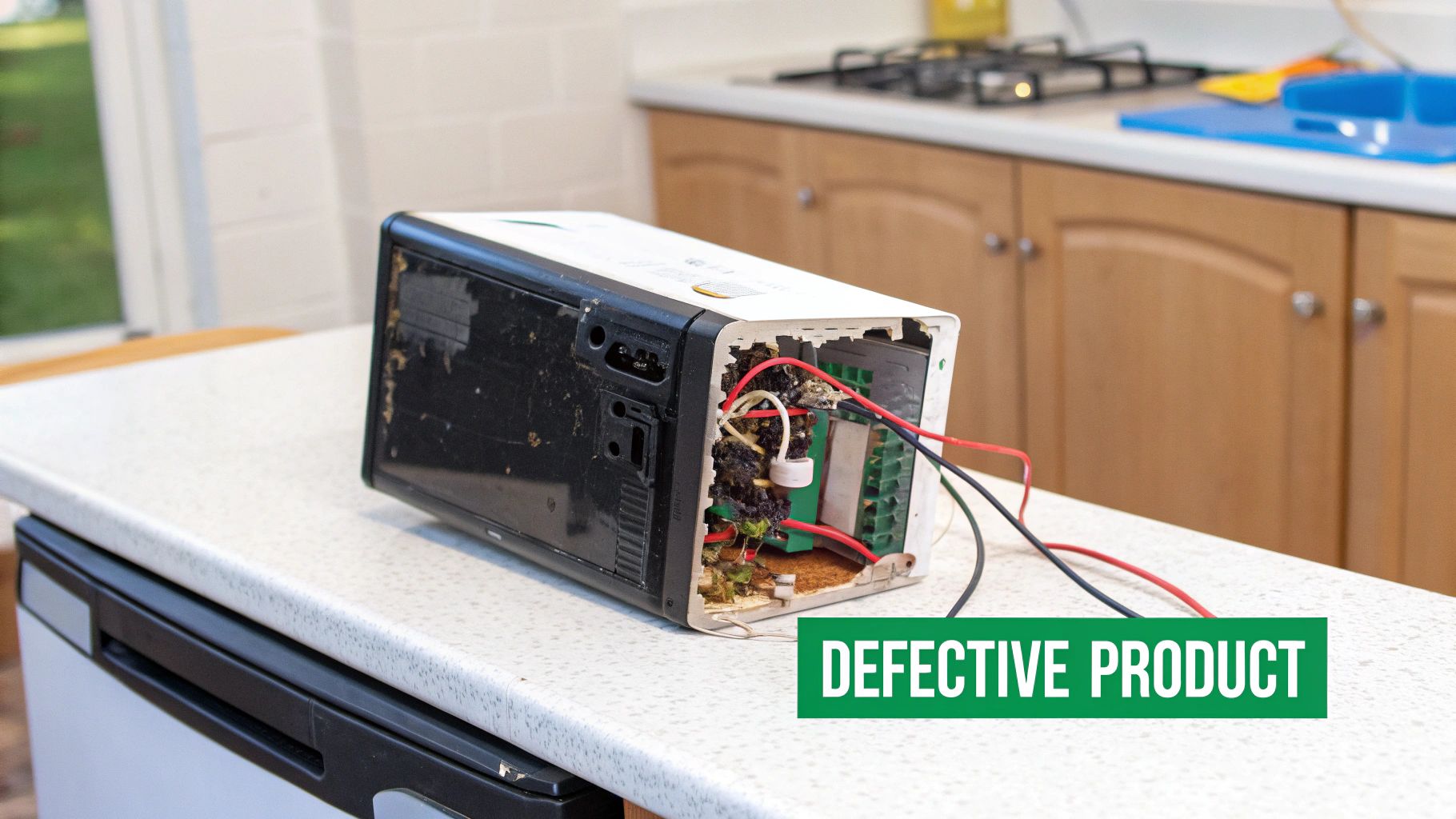
Product liability claims are another critical category of general liability claims examples that businesses must anticipate. These claims arise when a business manufactures, distributes, or sells a product that causes bodily injury or property damage to a consumer due to a defect. The defect could be in the product's design, its manufacturing process, or a failure to provide adequate warnings or instructions. For any company in the supply chain, from manufacturer to retailer, this exposure is significant.
The core issue is strict liability, meaning a business can be held liable even if it wasn't negligent. Understanding the specifics of this coverage is vital, which is why business owners should understand what is product liability insurance.
Incident Analysis and Coverage Response
Consider a furniture manufacturer that sells a line of bar stools. A customer is injured when a stool collapses due to a weak weld, resulting in a back injury and significant medical treatment. The customer sues the manufacturer, the distributor, and the retail store that sold the stool, seeking damages for medical bills, lost wages, and pain and suffering.
-
How General Liability Responds: The "Products-Completed Operations" coverage within a general liability policy is specifically designed for this scenario. This coverage would pay for the injured customer’s medical expenses and other awarded damages. Crucially, it also covers the substantial legal fees required to defend the business against the lawsuit.
-
Potential Settlement Drivers: The settlement amount will be influenced by the severity of the injury, the extent of medical treatment, and the clarity of the defect. If the flaw is a widespread manufacturing error, the claim could expand into a class action lawsuit involving a product recall, dramatically increasing the cost and complexity.
Strategic Prevention and Response
Robust quality control and documentation are the best defenses against product liability claims.
- Implement Quality Control: Establish and document strict quality assurance protocols at every stage of the manufacturing process.
- Provide Clear Warnings: Ensure all products include clear, conspicuous warning labels and comprehensive instruction manuals that address foreseeable misuse.
- Maintain Records: Keep meticulous records of product design, testing, complaints, and returns to demonstrate due diligence and identify potential issues early.
- Establish a Recall Plan: Develop a product recall procedure before an incident occurs so your team can act swiftly and effectively to mitigate harm and limit liability.
Wexford Pro-Tip: Your product’s documentation is your first line of defense. Having a product liability attorney review your warning labels and instruction manuals for adequacy can be a small investment that prevents a multimillion-dollar claim down the road.
3. Bodily Injury from Business Operations or Services
Beyond static property hazards, general liability claims examples often arise directly from a company's core activities. These incidents involve third parties being injured during the normal course of business operations or while a service is being performed. The claim's foundation is often an allegation of negligence, asserting the business failed to uphold a reasonable standard of care in its actions, leading directly to the injury. These claims are central to understanding what commercial general liability is and why it is critical for any service-based enterprise.
Essentially, if your business operations, from hosting an event to performing a service in a client's home, result in bodily harm to a non-employee, your general liability policy is the first line of defense.
Incident Analysis and Coverage Response
Consider a fitness instructor leading an advanced aerobics class. During a complex move, the instructor provides improper guidance, causing a participant to fall and tear a ligament in their knee. The injured client files a claim seeking damages for extensive surgery, rehabilitation costs, lost wages, and compensation for their pain and long-term mobility issues.
-
How General Liability Responds: The fitness center's general liability policy is triggered. The Bodily Injury coverage would address the client’s medical bills and lost income. If the client sues the business for negligence, the policy would also pay for the legal defense, including attorney fees and court costs, up to the policy's limits.
-
Potential Settlement Drivers: The settlement amount will depend heavily on the severity and permanence of the injury, the total medical and rehabilitative costs, and the clarity of the instructor's alleged negligence. The existence of a signed waiver might complicate the claim, but a waiver does not always protect a business from gross negligence.
Strategic Prevention and Response
For service-based businesses, preventing these claims requires a focus on professional standards and clear communication.
- Enforce Professional Standards: Ensure all service-providing employees are properly trained, certified, and licensed for their roles. Regularly update their training on industry best practices and safety protocols.
- Use Client Agreements: Where appropriate, utilize clear service agreements and liability waivers that outline the risks involved. Have legal counsel review these documents to ensure they are enforceable.
- Document Everything: Maintain detailed records of client interactions, services performed, and any safety instructions provided. If an incident happens, document it immediately with a formal report.
- Provide Proper Supervision: For activities like fitness classes or events, ensure adequate and qualified supervision is always present to manage risks and respond to issues.
Wexford Pro-Tip: Comprehensive staff training is your best defense. A well-trained employee who can demonstrate they followed established safety protocols significantly strengthens your position in a claim. Documenting this training is just as important as conducting it.
4. Advertising Injury and Defamation Claims
Advertising injury is a crucial component of general liability claims examples, covering damages that arise from a business's marketing and promotional activities. This category of claims involves offenses such as libel, slander, invasion of privacy, copyright infringement, and misappropriation of advertising ideas. In today's digital-first world, where content is created and shared rapidly, the risk of inadvertently causing an advertising injury has grown significantly.
Essentially, if your business's advertising—whether a social media post, a blog, or a print ad—causes non-physical harm to another person or entity, you could face a costly lawsuit. These claims protect against the intangible damages that can be just as harmful as a physical injury.
Incident Analysis and Coverage Response
Consider a small marketing agency that launches a campaign for a client using a striking photograph found online. The agency assumed the image was royalty-free, but it was copyrighted material. The photographer discovers the unauthorized use and sues both the agency and its client for copyright infringement, demanding statutory damages and legal fees.
-
How General Liability Responds: The agency's general liability policy, specifically its "Personal and Advertising Injury" coverage, is designed for this situation. It would cover the legal costs to defend against the lawsuit and would pay for the settlement or judgment, up to the policy limits.
-
Potential Settlement Drivers: The final cost is influenced by the extent of the image's use, the photographer's licensing fees, and whether the infringement was willful. Proving a lack of intent can help, but ignorance of copyright law is not a complete defense. The clarity of intellectual property law often makes these claims difficult to dispute without strong evidence of proper licensing.
Strategic Prevention and Response
A proactive approach to content creation and advertising is the best defense against these claims.
- Secure Proper Licenses: Never assume an image, song, or piece of text is free to use. Obtain explicit written permission or purchase licenses from reputable stock content websites for all third-party assets.
- Review All Ad Copy: Implement a formal review process for all marketing materials before publication. This check should look for potentially defamatory statements about competitors, misleading claims, and unauthorized use of a person's name or likeness.
- Train Your Marketing Team: Educate staff on the fundamentals of copyright, trademark, and right-to-privacy laws. Create clear social media and content creation guidelines.
- Document Everything: Keep meticulous records of all content licenses, model releases, and permissions. This documentation is your first line of defense if a claim arises.
Wexford Pro-Tip: Advertising injury claims can be complex and move quickly. If you receive a cease-and-desist letter or are served with a lawsuit, contact your claims advocate immediately. Preserving all relevant communications and marketing materials is critical for building a strong defense with your insurer.
5. Property Damage Claims from Business Operations
Property damage claims are another core component of general liability insurance, arising when a business's operations or employees accidentally damage property belonging to a third party. These incidents are especially common for contractors, service providers, and delivery businesses whose work regularly takes them onto client property. Unlike bodily injury, the focus here is squarely on the cost to repair or replace the damaged physical items.
These are prominent general liability claims examples because they highlight the risks inherent in performing services. If your business activities cause unintended damage to a client’s home, vehicle, or inventory, you can be held financially responsible for the restoration costs. For a deeper dive into the process, review this guide on how to file a property damage claim.
Incident Analysis and Coverage Response
Consider a scenario where an HVAC company is installing a new air conditioning unit in a customer's attic. During the installation, a technician accidentally drops a heavy tool, which crashes through the ceiling and damages an expensive antique table in the dining room below. The homeowner will seek compensation for the ceiling repair and the diminished value or replacement cost of the antique table.
-
How General liability Responds: The business’s general liability policy includes Property Damage coverage for this type of incident. The policy would cover the costs associated with repairing the ceiling and compensating the homeowner for the damaged table. It would also cover legal defense expenses if the dispute escalates to a lawsuit.
-
Potential Settlement Drivers: The settlement amount will be influenced by the cost of materials and labor for the ceiling repair, the appraised value of the antique table, and whether a specialized artisan is needed for its restoration. Clear documentation of the damage, including multiple photos from various angles and professional repair estimates, is crucial for a smooth claims process.
Strategic Prevention and Response
Minimizing the risk of property damage requires a combination of careful procedures and thorough staff training.
- Document Pre-Existing Conditions: Before starting any work, take photos or videos of the client's property, especially the immediate work area. This creates a baseline record.
- Use Protective Gear: Train your team to always use protective coverings like drop cloths, floor runners, and plastic sheeting to shield floors, furniture, and other valuables.
- Establish Clear Protocols: Create standardized procedures for moving equipment and materials through a client’s property to minimize the risk of bumps, scrapes, and spills.
- Secure the Scene: If damage occurs, secure the area to prevent further harm. Immediately take detailed photos and write a comprehensive incident report with witness statements.
Wexford Pro-Tip: Transparency is key when property damage occurs. Immediately inform the property owner, express your commitment to making things right, and document everything. A proactive and honest approach can preserve the client relationship and simplify the subsequent insurance claim.
6. Liquor Liability and Dram Shop Claims
Liquor liability claims are a serious risk for any business that sells, serves, or furnishes alcoholic beverages. These incidents arise when an intoxicated patron causes bodily injury or property damage to a third party, and the establishment that served them is held responsible. For businesses that serve alcohol, specific regulations like dram shop laws can impose additional liability, making this a critical area of coverage. A deeper dive into these regulations is essential for proper risk management, such as understanding Florida’s Dram Shop Laws and liability for alcohol-related incidents.
These laws, which vary by state, allow victims of drunk driving accidents or other alcohol-related incidents to sue the business that served the intoxicated individual. This exposure makes liquor liability a distinct and significant component of a comprehensive risk management strategy.
Incident Analysis and Coverage Response
Consider a scenario where a bar continues to serve an obviously intoxicated patron. The patron later attempts to drive home, causing a multi-vehicle accident that severely injures another driver. The injured third party sues the bar, citing its negligence in over-serving the patron contributed directly to the accident. The claim seeks compensation for extensive medical treatments, vehicle replacement, lost earning capacity, and immense pain and suffering.
-
How General Liability Responds: A standard general liability policy often contains an exclusion for liquor liability if the business is in the business of selling or serving alcohol. For this type of claim, a separate Liquor Liability policy is required. This specialized coverage would pay for the third-party bodily injury and property damage, as well as the legal defense costs for the bar.
-
Potential Settlement Drivers: The value of the settlement will be influenced by the severity of the third-party injuries, the blood alcohol content of the intoxicated driver, and evidence of the bar's service practices. Eyewitness testimony, security footage showing the patron being over-served, and a lack of server training documentation can dramatically increase the business's liability and settlement amount.
Strategic Prevention and Response
Vigilant training and strict adherence to internal policies are the best defenses against these potentially devastating claims.
- Mandate Server Training: Require all staff involved in serving alcohol to complete a certified alcohol server training program (e.g., TIPS or ServSafe). Keep certifications on file.
- Enforce Strict ID Policies: Implement and consistently enforce a policy to check identification for all patrons who appear to be under a certain age, such as 30 or 35.
- Establish Service Protocols: Create clear policies against over-serving and train staff to recognize signs of intoxication. Empower them to refuse service and document such incidents.
- Promote Safe Transportation: Encourage designated drivers and have contact information for local taxi or ride-sharing services readily available for patrons.
Wexford Pro-Tip: Documentation is your best defense in a liquor liability claim. In addition to training records, maintain detailed incident reports for every time service is refused or a patron is cut off. This creates a paper trail demonstrating your commitment to responsible service.
7. Contractors' Liability for Completed Work Issues
Contractors' liability for completed work is a critical area of risk that extends long after a project is finished and handed over to the client. These general liability claims examples arise when issues like structural defects, faulty installations, or code violations emerge post-completion. Unlike damage that occurs during active construction, these claims allege that the contractor's finished work failed to meet professional standards, contractual obligations, or legal codes, leading to property damage or bodily injury.
This coverage is essential for general contractors and specialty trades, as the financial impact of a completed-operations claim can be substantial, often involving costly repairs, property damage restoration, and even legal battles. The core of these claims is that the work itself, now completed, was the cause of a subsequent loss.

Incident Analysis and Coverage Response
Consider a scenario where a plumbing contractor repipes an office building. Six months after the project's completion, a poorly sealed joint fails, causing extensive water damage to the drywall, flooring, and computer equipment on the floor below. The building owner files a claim against the plumber for the resulting property damage.
-
How General Liability Responds: The contractor's general liability policy, specifically its "Products-Completed Operations" coverage, is triggered. This coverage would pay for the consequential property damage: the cost to repair the saturated walls, replace the ruined flooring, and fix or replace the damaged computer equipment. It also covers the legal fees to defend the contractor against a lawsuit from the building owner.
-
Potential Settlement Drivers: The settlement's size depends on the extent of the resulting damage, the cost of repairs, business interruption losses for the affected tenants, and the strength of evidence. Clear documentation, like photos and sign-off sheets from the original project, can help define the scope of liability. However, the cost to repair the faulty plumbing joint itself (the contractor's own work) is typically excluded and considered a cost of doing business.
Strategic Prevention and Response
Minimizing completed-operations claims requires meticulous documentation and quality control from start to finish. Having the right coverage is a crucial backstop; see our guide on the best insurance for contractors for more details.
- Document Everything: Maintain detailed project files, including contracts, scope-of-work documents, change orders, supplier information, and photos of the work in progress and upon completion.
- Obtain Written Sign-Off: Always get a formal, written acceptance from the client upon project completion. This "certificate of completion" is a vital piece of evidence.
- Establish Clear Warranties: Provide clear, written warranties that define what is covered, for how long, and the process for making a claim.
- Retain Records: Keep all project documentation for an extended period, as claims can arise years after the work is done, subject to the statute of repose in your state.
Wexford Pro-Tip: Your contract is your first line of defense. Ensure it includes clear dispute resolution procedures and a detailed scope of work. When a claim arises, immediately gather all project documentation and contact your claims advocate to initiate a coordinated and strategic response with your insurer.
8. Aviation and Aircraft-Related Liability Claims
Aviation liability claims are highly specialized general liability claims examples that arise from the ownership, maintenance, and operation of aircraft. These incidents cover a wide range of scenarios, from third-party bodily injury on an airfield to property damage caused by an aircraft on the ground or in flight. Given the high-value equipment and potential for severe injury, these claims are unique and are not covered by standard commercial general liability policies, requiring dedicated aviation insurance.
The core of these claims is negligence related to aircraft operations, such as improper maintenance, pilot error, or inadequate ground-handling procedures. Businesses like flight schools, private owners, and maintenance providers must understand the unique risks and the specialized coverage required, as the financial consequences can be catastrophic. Exploring the different factors helps understand the cost of airplane insurance and the protection it provides.
Incident Analysis and Coverage Response
Consider a scenario where a student pilot at a flight school misjudges a landing, causing the aircraft to veer off the runway and strike a privately-owned hangar. The hangar sustains significant structural damage, and the aircraft itself is heavily damaged. The hangar owner files a claim against the flight school for property damage.
-
How General Liability Responds: The flight school's dedicated Aviation General Liability policy would respond. The Property Damage liability portion of the policy is designed to cover the costs to repair or replace the damaged hangar. Legal defense costs associated with the claim would also be covered, even if the flight school is ultimately not found liable.
-
Potential Settlement Drivers: The settlement will be driven by the appraised cost to repair the hangar, any business interruption losses the hangar owner experienced, and legal fees. The student pilot's training records, the instructor's qualifications, and the aircraft's maintenance history will be scrutinized. A clear record of procedural adherence can help the defense, while gaps in training documentation could increase liability.
Strategic Prevention and Response
Mitigating risk in aviation requires discipline, documentation, and a culture of safety that exceeds regulatory minimums.
- Maintain Meticulous Records: Keep detailed and signed logs for all maintenance, repairs, and inspections. This creates a clear and defensible history of the aircraft's condition.
- Enforce Strict Protocols: Implement and document mandatory pre-flight and post-flight inspection checklists for all pilots and students.
- Invest in Continuous Training: Ensure all pilots, instructors, and ground crew have current certifications and participate in regular safety training and emergency drills.
- Secure Specialized Coverage: Work with an expert to obtain adequate aviation-specific liability insurance. Standard policies will not cover these unique, high-stakes risks.
Wexford Pro-Tip: In aviation, the quality of your documentation is your strongest defense. A well-documented safety and maintenance program is not just for compliance; it is a critical tool for your claims advocate to defend your operation and minimize financial impact in the event of an incident.
8 General Liability Claims Comparison
| Claim Type | Complexity 🔄 | Resource Needs 💡 | Expected Outcome ⭐ / 📊 | Ideal Use Cases | Key Advantages ⚡ |
|---|---|---|---|---|---|
| Slip and Fall at Commercial Property | Medium 🔄 — documentation-driven investigation | Regular maintenance logs, incident reports, CCTV, witness statements, insurer defense | ⭐⭐ / 📊 High frequency; typically low–moderate payouts if well-documented | Retail, hospitality, offices, restaurants | Highly preventable; established defense practices ⚡ |
| Product Liability Claims for Defective Products | High 🔄 — strict liability, technical causation, possible class actions | Design/testing records, QC docs, expert witnesses, recall plans, high defense costs | ⭐⭐⭐ / 📊 Potentially large settlements/recalls; high reputational impact | Manufacturers, distributors, retailers of consumer products | Testing/docs can clearly establish defense; recall mechanisms ⚡ |
| Bodily Injury from Business Operations or Services | High 🔄 — negligence and standard-of-care disputes; expert testimony common | Training/certifications, service records, incident logs, expert witnesses | ⭐⭐ / 📊 Variable; can be substantial for severe or permanent injury | Service providers, fitness studios, medical/cosmetic services, event hosts | Insurance covers defense; industry standards guide liability determinations ⚡ |
| Advertising Injury and Defamation Claims | Medium 🔄 — IP/defamation complexity; coverage disputes frequent | Content approvals, licenses, permissions, legal review, documented consents | ⭐⭐ / 📊 Moderate reputational risk; often resolved via negotiation or retraction | Any business with active marketing, digital/social media presence | Cease-and-desist or content fixes can limit exposure; GL endorsement available ⚡ |
| Property Damage Claims from Business Operations | Medium 🔄 — causation often clear; valuation disputes possible | Pre-service photos, repair estimates, invoices, witness statements | ⭐⭐ / 📊 Usually limited to quantifiable repair/replacement costs | Contractors, delivery services, field service providers | Damages typically measurable and insurable; straightforward valuation processes ⚡ |
| Liquor Liability and Dram Shop Claims | High 🔄 — jurisdictional dram shop law variance; third-party harm risk | ID/serving logs, server training records, incident reports, higher limits | ⭐⭐⭐ / 📊 Potentially catastrophic (e.g., fatal accidents); severe third-party exposure | Bars, restaurants, event venues, any alcohol‑serving business | Specialized coverage exists; staff training and documentation reduce exposure ⚡ |
| Contractors' Liability for Completed Work Issues | High 🔄 — latent defects, multiple parties, statute of repose issues | Project specs, sign-offs, warranty docs, long-term file retention, expert testimony | ⭐⭐⭐ / 📊 Claims can exceed contract value; long-tail liability | General and specialty contractors, construction firms | Detailed contracts and documentation can limit or allocate exposure ⚡ |
| Aviation and Aircraft-Related Liability Claims | Very High 🔄 — specialized regulatory/compliance complexity; catastrophic risk | Meticulous maintenance logs, certifications, pilot training records, specialized insurance | ⭐⭐⭐⭐ / 📊 Very high potential losses; limited carrier market and strict underwriting | Plane owners, flight schools, aviation service providers | Specialized carriers and regulatory frameworks provide clear liability standards ⚡ |
From Examples to Action: Partnering with Wexford for Proactive Protection
The diverse collection of general liability claims examples explored in this article reveals a fundamental truth for any business owner, professional, or individual: risk is multifaceted and ever-present. From a simple slip on a wet floor to complex advertising injury allegations or defects in completed work, the potential for a financially devastating claim is woven into the fabric of daily operations and personal life. These scenarios are not just cautionary tales; they are strategic blueprints for understanding your unique vulnerabilities.
Each example, whether it's a product liability lawsuit or a contractor's faulty installation, highlights that a general liability policy is only the first line of defense. True security comes from a proactive, multi-layered strategy that integrates robust coverage with diligent risk management. The common thread is clear: prevention, documentation, and expert guidance are not optional-they are essential components of a resilient enterprise.
Key Takeaways from These Claim Scenarios
Reflecting on the incidents discussed, several critical lessons emerge. Mastering these concepts is the first step toward transforming your insurance from a mere expense into a strategic asset that protects your bottom line and reputation.
- Premises Liability is Constant: The 'slip and fall' example underscores that every physical space you control, from a retail store to a private hangar, is a source of potential liability. Diligent maintenance, clear signage, and routine safety inspections are non-negotiable.
- Documentation is Your Defense: In almost every claim, from property damage caused by your operations to defending against a defamation suit, the quality of your records can make or break your case. This includes incident reports, maintenance logs, client contracts, and marketing material reviews.
- Coverage Gaps Are Real and Costly: The examples of liquor liability and completed operations demonstrate that a standard general liability policy often has significant exclusions. Understanding what is not covered is just as important as knowing what is, necessitating a thorough review with an expert to identify and fill these gaps with endorsements or separate policies.
- Your Words and Images Carry Financial Risk: Advertising injury claims prove that liability extends beyond physical harm. Your marketing campaigns, social media posts, and even employee statements can lead to expensive lawsuits for defamation, copyright infringement, or misappropriation.
Strategic Insight: The most effective risk management programs are not static. They evolve with your operations, incorporating lessons learned from near misses and industry-wide general liability claims examples to continuously refine safety protocols, training, and insurance coverage.
Your Actionable Next Steps Toward Total Protection
Moving from understanding these examples to implementing a robust defense requires a clear plan. The most successful business owners and high-net-worth individuals don't wait for a claim to happen; they build a fortress of protection with the help of a dedicated partner.
This is the core of our philosophy at Wexford. We recognize that your risk profile is as unique as your business or lifestyle. A flight school's aviation liability needs are vastly different from a restaurant's liquor liability exposure. We don't just provide a policy; we deliver intelligent claims advocacy and a comprehensive risk assessment powered by deep industry knowledge. Our team works to simplify the complexities, ensuring your coverage is precisely tailored to your specific operations and exposures.
By partnering with Wexford, you gain more than an insurance broker. You gain a strategic advisor committed to reducing your total cost of risk and protecting your future. This partnership allows you to shift your focus from worrying about potential liabilities to confidently pursuing growth and success, knowing you have an expert advocate in your corner.
Don't wait for a claim to reveal the gaps in your coverage. Let the experts at Wexford Insurance Solutions conduct a thorough review of your current policies and provide a proactive strategy tailored to your unique risks. Visit us at Wexford Insurance Solutions to learn how our intelligent claims advocacy can protect your assets and provide true peace of mind.
 Your Guide to the Homeowners Insurance Replacement Cost Estimator
 Who Needs Professional Liability Insurance: A Must-Read Guide


