

Property & casualty insurance is really about protecting two critical areas of your life: the things you own and your financial responsibility to others. Let's break that down.
Property coverage is exactly what it sounds like—it protects your stuff. Think of your house, your car, or the equipment in your business. Casualty coverage, on the other hand, kicks in when you're found legally responsible for an accident that injures another person or damages their property.
Your Financial Shield for Physical Assets and Legal Risks
The best way to think about property & casualty insurance—often shortened to P&C—is as a two-part shield. It’s not a single policy but a whole category of insurance designed to cover your physical world and the potential liabilities that come with living in it. This dual protection makes it a cornerstone of financial security for just about everyone, from homeowners to business owners.
A helpful analogy is to picture your life and assets as a castle. The "property" side of P&C insurance protects the castle itself and everything in it. We're talking about your home, your car, your furniture, or, if you're a business, your inventory and office equipment. If a fire, theft, or storm damages your property, this is the coverage that pays to repair or replace it.
Now, think about what happens when you interact with the world outside your castle. That’s where the "casualty" or liability insurance comes in. If you cause a car crash that injures someone, or a client slips and falls in your office, casualty coverage handles the medical bills, legal fees, and settlements you might face. It’s your defense against a lawsuit that could otherwise wipe you out financially.
Why This Coverage Is Essential
At the end of the day, P&C insurance is what stands between an unfortunate event and a full-blown financial disaster. Its entire purpose is to put you back in the same financial position you were in before something went wrong.
This protection is delivered through specific policies designed for different situations:
- For Individuals: You're probably already familiar with the most common types, like homeowners, renters, and auto insurance.
- For Businesses: The scope is much broader, covering everything from commercial buildings and vehicle fleets to general liability. To get a better sense of this, you can learn more about the fundamentals of what commercial insurance covers in our guide.
At its heart, property & casualty insurance provides peace of mind. It allows you to run your business and live your life without the constant worry of a "what if" scenario turning into a financial catastrophe, whether it's a minor fender bender or a major lawsuit.
Breaking Down the Two Sides of P&C Coverage
Think of property & casualty insurance as a coin. It has two distinct sides, and while they both work together to protect you financially, they cover completely different kinds of trouble. Getting a handle on this difference is the first step to building a really solid insurance plan, whether for your family or your business.
Simply put, property insurance covers your stuff, and casualty insurance covers your actions.
The Property Side: What You Own
Property insurance is all about protecting the physical things you own. It's the shield for your tangible assets—your building, your equipment, your inventory, your home, your personal belongings. When something you own is damaged or gone, this is the coverage that kicks in.
Imagine a nasty hailstorm shreds the roof of your office, or a fire in your kitchen makes your house unlivable for a few months. Property insurance is what pays to repair the damage, rebuild what was lost, and get you back to where you were before the incident happened.
It's your go-to coverage for situations like:
- Weather Damage: A hurricane rips the siding off your warehouse or a heavy branch crushes your garage.
- Fire: An electrical short sparks a fire that ruins thousands of dollars in business inventory.
- Theft or Vandalism: Someone breaks into your shop overnight and makes off with your computers and tools.
This coverage is the financial backstop for the physical assets you’ve worked so hard to build. It ensures one bad day doesn’t turn into a catastrophic financial loss.
The Casualty Side: What You Owe
Now, let's flip the coin over to casualty insurance, which you’ll more commonly hear called liability coverage. This side has absolutely nothing to do with your property. Instead, it protects you when you're legally on the hook for injuring someone else or damaging their property.
It’s your financial defense in a lawsuit.
Let’s say a customer slips on a wet floor in your store and breaks an arm. Your casualty insurance is what steps in to handle their medical bills, your legal defense fees, and any settlement or court-ordered judgment if you're found responsible. For a deeper look at this essential business coverage, check out our guide to commercial general liability insurance.
Key Takeaway: Property insurance pays you for damage to your stuff. Casualty insurance pays others for damages you caused. One looks inward at your assets, the other looks outward at your responsibilities.
This is a critical distinction that’s easier to see with a side-by-side view.
Property vs. Casualty Insurance At a Glance
| Coverage Aspect | Property Insurance | Casualty (Liability) Insurance |
|---|---|---|
| What's Protected? | Your tangible assets (buildings, equipment, inventory, personal belongings). | Your finances from legal obligations to others. |
| Who Gets Paid? | You, the policyholder. | The third party you harmed (e.g., the injured person). |
| Why Does It Pay? | Your covered property was damaged, destroyed, or stolen. | You were found legally responsible for injury or damage. |
| Core Purpose | To reimburse you for your direct losses. | To defend and pay on your behalf for your legal liabilities. |
This clear separation helps explain why property and casualty insurance markets can move in different directions. For instance, global property insurance rates recently dropped by around 8%, while casualty rates actually climbed by 3%. This is happening because the cost of litigation and legal settlements, especially in the U.S., keeps going up, pushing liability premiums higher.
A perfect real-world example of casualty coverage is your auto insurance. A key part of understanding what liability insurance covers is seeing how it pays for the other driver's car repairs and medical bills when an accident is your fault.
In the end, P&C insurance gives you a two-layered defense. The property part protects your net worth by keeping your assets safe. The casualty part protects that same net worth from being drained by lawsuits. You truly need both to be financially secure.
Finding the Right Policies for Your Life and Business
Once you understand the difference between property and casualty, the real work begins: building a financial shield that's actually right for you. Smart property & casualty insurance isn’t about buying a policy for every possible what-if. It's about strategically picking the coverages that match the real risks you face, whether that's at home or at your business.
Think of it this way: P&C insurance has two distinct but related jobs—protecting your stuff and protecting you from lawsuits.
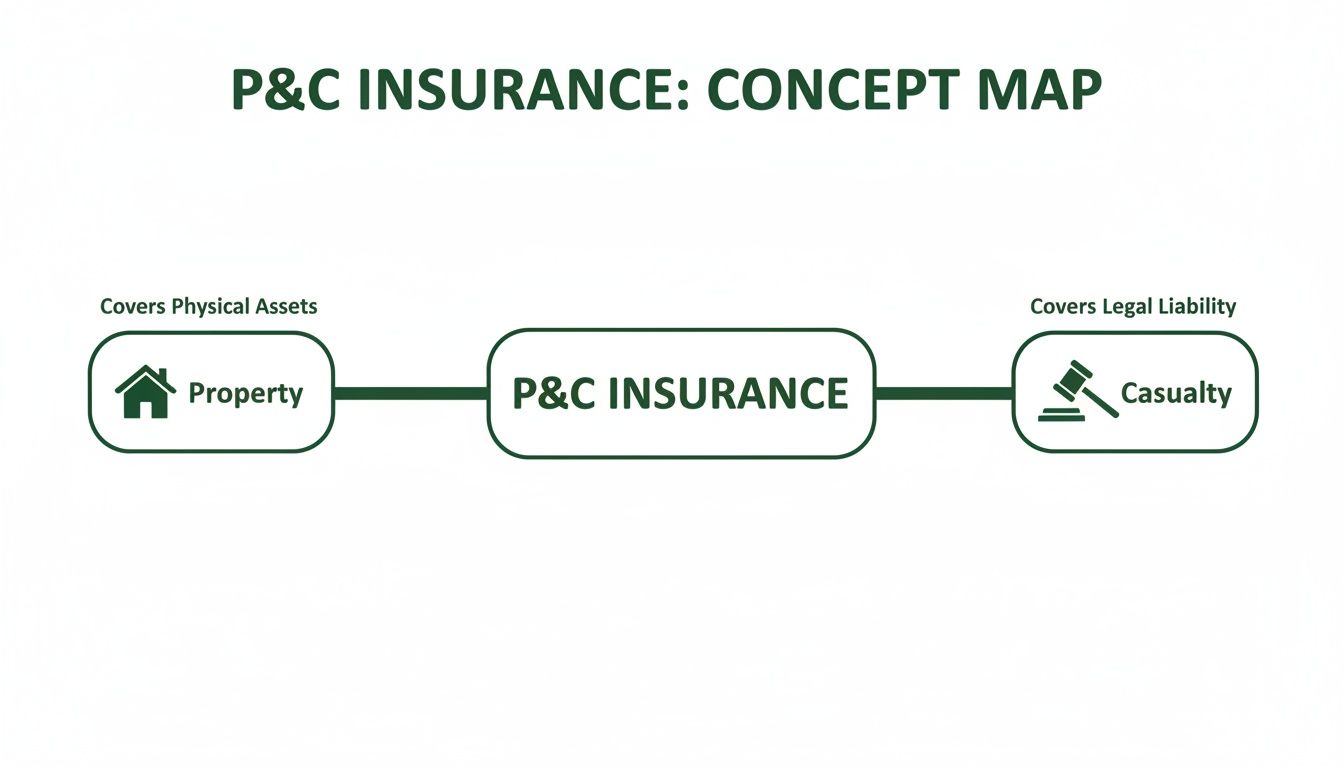
This map shows it perfectly. One side is all about your tangible assets, while the other is focused squarely on your legal responsibilities to others.
Essential Policies for Your Personal Life
For most of us, a strong personal insurance plan is built on a few cornerstone policies. They each have a specific role, but they work best as a team to give you complete peace of mind.
Homeowners Insurance is the one most people know. It’s designed to cover damage to your house and everything inside it from things like a fire, a break-in, or a nasty storm. Just as important, it includes liability protection in case someone gets hurt on your property.
Auto Insurance is another must-have, and it’s required by law in nearly every state. It’s the perfect example of P&C in action, covering both your vehicle (property) and your financial responsibility if you cause an accident (casualty).
What About an Umbrella Policy?
Think of an umbrella policy as a powerful layer of extra liability insurance. It sits "over" your home and auto policies, kicking in only after their liability limits have been maxed out. If you have significant assets to protect, it’s an absolute necessity to shield you from a major lawsuit.
These personal policies are your first line of defense against the everyday risks that could derail your financial future.
Must-Have Coverage for Your Business
When you own a business, the stakes get a whole lot higher and the risks become far more complex. Commercial property & casualty insurance isn't just a good idea—it's a fundamental part of any solid business plan. The right coverage protects your assets, your team, and the future you're working so hard to build.
Here are a few of the non-negotiables for most businesses:
- General Liability Insurance: This is your baseline protection. It covers claims of bodily injury or property damage your business operations cause to someone else, like a customer slipping in your store or an employee damaging a client's property.
- Commercial Property Insurance: This policy is all about protecting your physical stuff—your building, computers, inventory, and furniture—from disasters like a fire, vandalism, or major storm.
- Workers’ Compensation: If you have employees, this is almost certainly required by law. It provides critical benefits for employees who get sick or injured on the job, covering things like medical bills and lost wages.
For many small and mid-sized businesses, bundling these core coverages is the smartest move. A Business Owner’s Policy (BOP) conveniently packages general liability and commercial property into one streamlined policy. To learn more about if this is a good fit for you, take a look at our guide on what is a Business Owner's Policy.
Specialized Policies for Modern Risks
The basics are essential, but they don't cover everything. Many businesses today face unique risks that require specialized policies. Overlooking these can leave you dangerously exposed.
For instance, any business that stores customer information or takes online payments absolutely needs Cyber Liability Insurance. This covers the staggering costs that come with a data breach, from notifying customers and providing credit monitoring to defending against lawsuits.
Similarly, if you provide a professional service—as a consultant, architect, or accountant—you need Professional Liability Insurance, often called Errors & Omissions (E&O). This protects you if a client claims your negligence, a mistake, or subpar work caused them a financial loss.
The P&C market is always evolving. Recently, U.S. premiums grew 6.1% to $561 billion, which is good for creating competition in areas like property and cyber. But with the cost of lawsuits on the rise, casualty lines are feeling the pressure, making specialized coverage like E&O more critical than ever. At Wexford Insurance Solutions, our job is to pinpoint these unique vulnerabilities and put together a plan that truly covers all your bases.
Understanding What Drives Your Insurance Costs
Have you ever looked at an insurance bill and wondered where that number actually comes from? It’s not pulled out of a hat. Insurers are in the risk business, and your premium is a direct reflection of how much risk they believe you represent. Getting a handle on these factors is the first real step toward managing your costs.
At the end of the day, pricing property & casualty insurance is all about a calculated bet on the future. Carriers sift through mountains of data to figure out the odds of you filing a claim and, just as importantly, how much that claim might cost. The riskier your profile looks, the higher your premium will be.
It’s a bit like getting a loan. The bank charges a higher interest rate to someone with a spotty credit history because the risk of default is higher. Insurance works the same way—a policyholder with a higher chance of a loss pays a higher premium. It’s a financial balancing act.
Key Factors That Shape Your Personal Premiums
When we talk about your personal policies—like home and auto insurance—a few key things really move the needle on cost. Some of these you can't change, but others are well within your control.
Your location is a massive one. If your home is in an area known for hurricanes, wildfires, or even just high theft rates, your premium will naturally be higher. For your car, insuring it in a packed city with constant traffic and fender-benders is going to cost more than in a quiet, rural town.
Another big piece of the puzzle is your claims history. If you've filed several claims in the past few years, an underwriter will see a pattern and assume you're more likely to file another one. A clean record, on the other hand, tells them you're a lower risk, which usually translates to a better rate.
Your deductible—the amount you pay out-of-pocket on a claim before the insurance company pays a dime—is the most direct lever you can pull to adjust your premium. Opting for a higher deductible means you're shouldering more of the initial risk, and insurers will almost always reward you with a lower premium.
Finally, the coverage limits you choose matter a lot. A policy with $500,000 in liability protection is going to cost more than one with only $100,000. Why? Because the insurance company is on the hook for a much larger potential payout if something goes wrong.
What Influences Commercial Insurance Costs
For a business, the pricing equation gets a lot more detailed. The core idea of risk is the same, but the factors are tied directly to how you operate and what industry you’re in.
The type of industry you're in is probably the biggest factor. A construction company working with heavy equipment on dangerous job sites is a world away from a small accounting firm in terms of risk. That difference shows up in the cost of everything from general liability to workers' compensation.
How you run your business—your specific safety protocols and operational history—also carries a ton of weight.
- Safety Measures: Do you have formal safety training for your team? A sprinkler system in your warehouse? Good lighting and security cameras? Proving you're actively trying to prevent losses makes you a much more attractive risk to an insurer.
- Claims History: Just like on the personal side, a track record of frequent or costly claims will send your premiums upward. Carriers keep a close eye on this, often using a metric you can learn more about by reading up on what a loss ratio is in insurance.
- Revenue and Payroll: These numbers help an insurer gauge your overall "exposure." A bigger company with more employees and higher sales simply has more opportunities for things to go wrong.
By understanding what drives these costs, you can partner with an expert at Wexford Insurance Solutions to pinpoint where you can improve, strengthen your risk profile, and start taking back control of your insurance expenses.
How to Navigate the Claims Process with Confidence
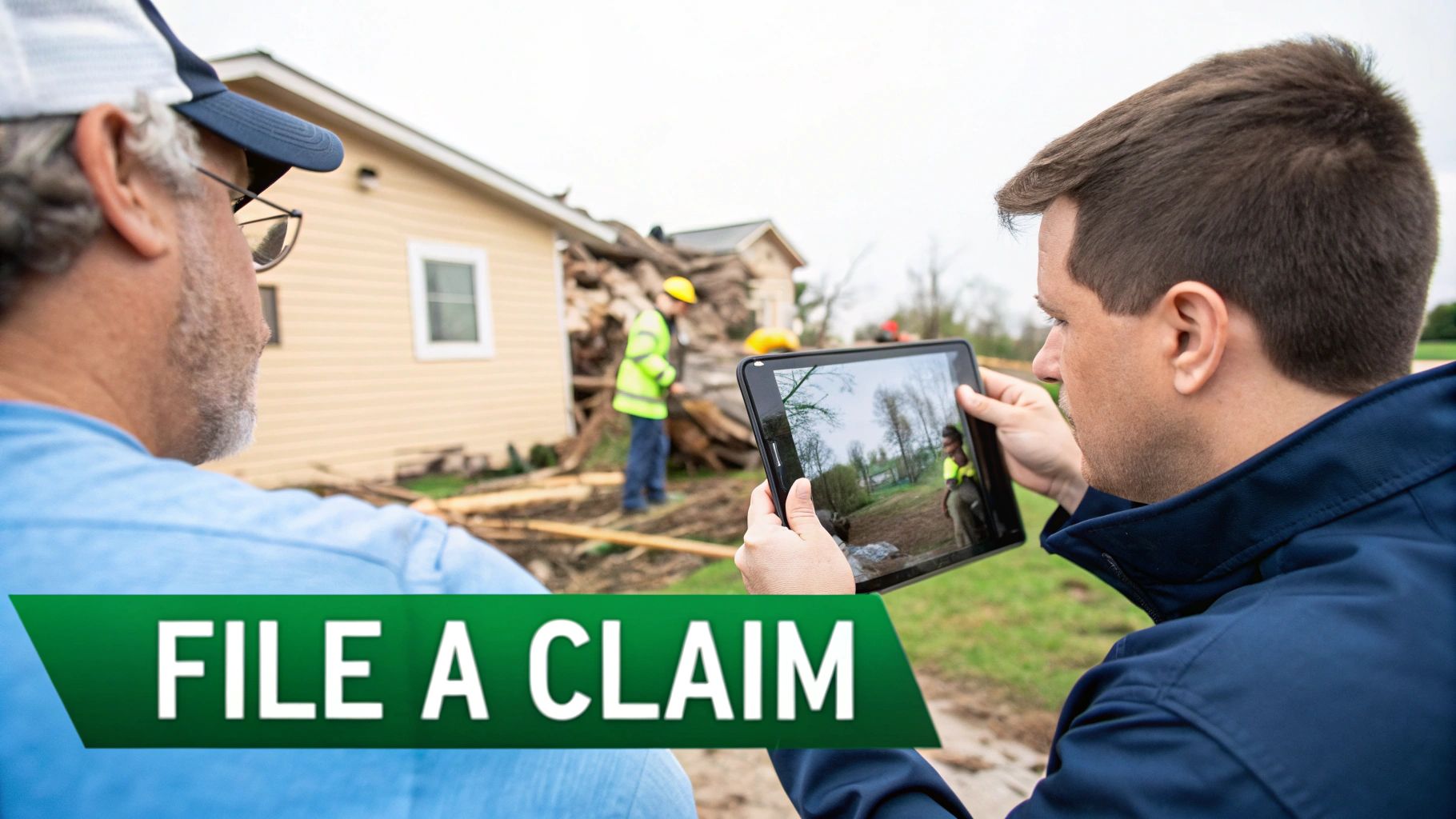
Your insurance policy is really just a promise until the day you need to use it. The claims process is the moment that promise becomes real, turning your property & casualty insurance into the financial backstop it was designed to be. It can feel like a lot to handle, especially right after something has gone wrong, but knowing the steps ahead of time makes all the difference.
When an accident happens—a fender bender, a kitchen fire, a slip-and-fall at your business—things can get chaotic fast. Your absolute first priority is always safety. Make sure everyone is okay and any immediate dangers are handled.
Then, before you do anything else, start documenting. This is single-handedly the most powerful thing you can do to set your claim up for success.
Your First Steps After an Incident
While the details are still fresh, your main job is to gather evidence. This initial legwork gives your insurance company the raw facts they need to get started and protects you throughout the entire process.
Here’s a quick checklist of what to do on the spot:
- Take Photos and Videos: Get pictures and videos from every conceivable angle. Capture wide shots to show the big picture, then zoom in for close-ups of specific damage.
- List Everything That Was Damaged: For property claims, make a running list of every single item that was lost or broken. If you can, jot down brand names, model numbers, and what you think they were worth.
- Collect Key Paperwork: Grab copies of any police reports, get the names and numbers of any witnesses, and save receipts for any emergency repairs you had to make (like tarping a leaky roof).
Laying this groundwork is priceless. It takes your claim from "this happened" to a fully documented event, which almost always helps speed things along. For a more detailed walkthrough, check out our guide on how to file a property damage claim.
Working Through the Claim Timeline
Once you’ve done your initial documentation, it's time to officially report the claim to your insurer. They’ll assign a claims adjuster to your case. Think of the adjuster as the investigator—their job is to assess the damage, figure out what happened, and calculate the value of your loss based on the terms of your policy.
You'll be working closely with the adjuster, providing all the photos and documents you collected and answering any questions they have. It’s a partnership. The more organized and responsive you are, the smoother things tend to go. For more insight into what to expect, especially with your home, this guide on understanding home insurance claims offers some great perspective.
The entire point of a claim is to be made whole again. It's about restoring you to the same financial footing you were on moments before the loss. A fair settlement is one that honors your policy and covers the full extent of the damage.
After the adjuster finishes their assessment, you'll receive a settlement offer. It’s critical to review this carefully. Don't feel rushed to accept the first number, especially if it feels low. And here's a big one: do not begin permanent repairs until the claim is officially approved. Starting too soon can cause major headaches with the assessment.
At Wexford Insurance Solutions, this is where we step in as your advocate. We’ll help you go through the settlement to make sure it’s fair and lines up with your coverage, so you can feel confident closing out the claim and moving forward.
Finding the Right Partner to Navigate Your Insurance
Let's be honest: trying to understand property & casualty insurance on your own can feel like building a complex piece of furniture with confusing instructions. Between picking the right policies, adding the necessary endorsements, and then figuring out how to file a claim, it's easy to make a costly mistake. This is exactly why having a dedicated partner isn't a luxury—it's essential.
An independent advisor is your personal guide through this maze. Their first job is to get to know you and understand your specific risks before they even think about suggesting a policy. Unlike agents who work for a single company, they can tap into a broad marketplace of carriers. This gives them the freedom to shop around and find the perfect blend of coverage and cost for your situation, not just sell you an off-the-shelf product.
Why Expert Advocacy Matters More Than Ever
The property and casualty insurance world is enormous and only getting bigger. It's projected to become an $8.81 trillion industry by 2034, with the North American market already valued at $1.27 trillion. As insurers turn to new tech to manage their own costs, the landscape becomes more complex for consumers. An independent agent's value skyrockets here, as they can cut through the noise to find truly personalized options. You can dive deeper into the growing P&C insurance market on Precedence Research.
This kind of expert support truly shows its worth when you have to make a claim. At that moment, you need someone in your corner. An independent advisor works for you, not the insurance company.
Your advisor becomes your advocate, making sure your claim is handled fairly and quickly. They know how to talk to adjusters and underwriters, guiding you through the process to get the settlement you deserve.
Having that expert take the lead lifts a massive weight off your shoulders, so you can focus on getting back on your feet while they handle the red tape.
Modern Tools That Make Your Life Easier
The best partners today blend that classic personal service with modern, easy-to-use technology. At Wexford Insurance Solutions, we’re firm believers that managing your insurance shouldn't be a hassle. We give our clients the tools to stay in control.
Here’s a glimpse of what that looks like:
- Paperless Onboarding: We get you set up quickly and smoothly, right from the start.
- 24/7 Client Portal: Get secure access to your policy documents, ID cards, and payment info whenever you need it—day or night.
- Intelligent Claims Support: We use data to help manage the claims process, arming us with the information needed to be your strongest advocate.
In the end, working with a partner like Wexford Insurance Solutions goes far beyond just buying a policy. It’s about forging a lasting relationship with an expert who is truly invested in protecting what you've built and giving you real peace of mind.
Got Questions About P&C Insurance? We’ve Got Answers.
Even after you've got the basics down, you're bound to have more specific questions about property & casualty insurance. Let's tackle some of the most common ones that come up. Getting these right can make all the difference in protecting what you've worked so hard to build.
Independent Agent vs. Captive Agent: What’s the Real Difference?
Choosing who helps you buy insurance is one of the biggest decisions you'll make in the process. It really comes down to a simple question: who does the agent work for?
A captive agent is tied to a single insurance company. They know that one company's products inside and out, which can make things straightforward. The catch is, they can only sell you what that one carrier offers, whether it's the best fit for you or not.
An independent agent, like us, works for you. We partner with many different insurance companies. This allows us to do the shopping for you, comparing a wide range of policies to find the one that truly clicks with your needs and budget. You get more options and an expert advisor whose only goal is to find you the right coverage.
Think of it this way: a captive agent works for the store, while an independent agent is your personal shopper. They have access to the whole market, not just one brand.
How Often Should I Really Be Looking at My Insurance Policies?
It's tempting to file your insurance policies away and forget about them, but that's a risky move. The coverage that was perfect for you last year could leave you exposed today.
As a general rule, you should sit down and do a thorough review of your property & casualty insurance policies at least once a year. More importantly, you need to connect with your agent immediately after any major life change.
Be sure to schedule a review if you:
- Get Married or Divorced: Combining or separating assets and households completely changes your insurance needs.
- Buy a New Home or Car: New big-ticket items need to be properly insured from day one.
- Start a Business: This is a big one. Your personal policies will not cover business-related risks.
- Renovate Your Home: If you've added a new room or done a major kitchen remodel, your home's value has gone up, and your coverage needs to match.
Regular check-ins ensure your protection actually keeps up with your life.
What Exactly Is an "Endorsement" or "Rider"?
Imagine your insurance policy is a standard, off-the-shelf suit. An endorsement (sometimes called a rider) is like getting that suit tailored. It's an official modification to your policy that adds, removes, or changes specific coverages to make it a perfect fit for you.
For instance, your standard homeowners policy probably has a pretty low limit for things like jewelry. If you have a valuable engagement ring, you’d add a "scheduled personal property" endorsement to insure it for its full appraised value. Another common one is adding an endorsement to cover equipment for a home-based business, which is almost always excluded from a standard home policy.
Will My Personal Car Insurance Cover Me if I Use My Car for Work?
This is a huge one, and getting it wrong can be financially devastating, especially for anyone in the gig economy. The short answer is almost always no.
Your personal auto policy is written specifically for personal use—your daily commute, grabbing groceries, family road trips. It contains explicit exclusions for commercial activities, meaning things like driving for a rideshare service, delivering food, or hauling materials for a side hustle are not covered.
If you use your car to earn money, you absolutely need a commercial auto policy or, in some cases, a specific endorsement from your carrier. If you have an accident while working and only have personal coverage, your claim will likely be denied. That would leave you on the hook for everything. This is easily one of the most critical distinctions to understand in property & casualty insurance.
Getting these details right is what we do. At Wexford Insurance Solutions, our job is to dive into your unique situation, find any potential gaps, and make sure you have the exact protection you need. Contact us today for a complimentary policy review.
 A Practical Guide to Insurance for Small Business OwnersCyber Insurance Coverage Checklist: Protect Your Business in 2026


