

As a business owner, you're an expert at managing risk, but navigating the complexities of insurance can feel like a full-time job. With countless threats from liability lawsuits and property damage to cyber-attacks and employee injuries, having the right protection isn't just a safety net—it's a core component of your growth strategy. A single uninsured claim can jeopardize everything you've worked to build, making a clear understanding of your options essential for long-term stability and success.
Understanding the different types of commercial insurance coverage is the first step toward building a resilient enterprise. This comprehensive guide is designed to demystify the process, breaking down the 12 most critical policies in plain English. We provide real-world scenarios and actionable advice tailored for a diverse range of business owners, including small-to-medium-sized businesses (SMBs), fleet operators, high-net-worth professionals, and even specialized operations like flight schools.
This listicle will help you identify potential gaps in your current coverage and make informed decisions about your company's risk management plan. We will move beyond simple definitions to explore typical policy limits, claims examples, and bundling recommendations. Once you have your policies in place, managing them effectively and providing proof of coverage to clients or partners becomes the next step. To help with this, you can find useful tools like a Certificate Of Insurance Template to streamline documentation. Let's explore the essential policies that form the foundation of a secure and successful company.
1. General Liability Insurance
General Liability Insurance, often called Commercial General Liability (CGL), is a foundational type of commercial insurance coverage that protects your business from financial loss should you be liable for property damage or personal injury to a third party. This coverage is essential for nearly every business, acting as a first line of defense against claims that can arise from your daily operations, whether on your premises or at a client's location.
It addresses claims related to bodily injury, property damage, and personal or advertising injury, such as libel or slander. If a customer slips and falls in your store or an employee accidentally damages a client's property, CGL covers the subsequent legal fees, medical expenses, and potential settlements or judgments, safeguarding your company’s assets.

Why It's a Must-Have
This coverage is not just a safety net; it's often a requirement for doing business. Landlords, clients, and licensing boards frequently require proof of CGL insurance before entering into a contract or lease. It provides peace of mind and demonstrates your business's commitment to responsible practices.
Actionable Tips for Implementation
- Assess Your Risk: A high-traffic retail store needs higher liability limits than a remote consulting firm. Analyze your public interaction and operational risks to select appropriate coverage amounts, typically starting at $1 million per occurrence.
- Review Exclusions: Be aware of what your policy doesn't cover. Standard CGL policies often exclude professional errors, auto-related incidents, and employee injuries, which require separate policies like Professional Liability, Commercial Auto, and Workers' Compensation.
- Bundle for Savings: Combine General Liability with Commercial Property insurance in a Business Owner's Policy (BOP) for broader protection at a potentially lower premium.
- Document Everything: In the event of an incident, maintain detailed records, including photos, witness statements, and a written report. This documentation is crucial for a smooth claims process.
2. Commercial Auto Insurance
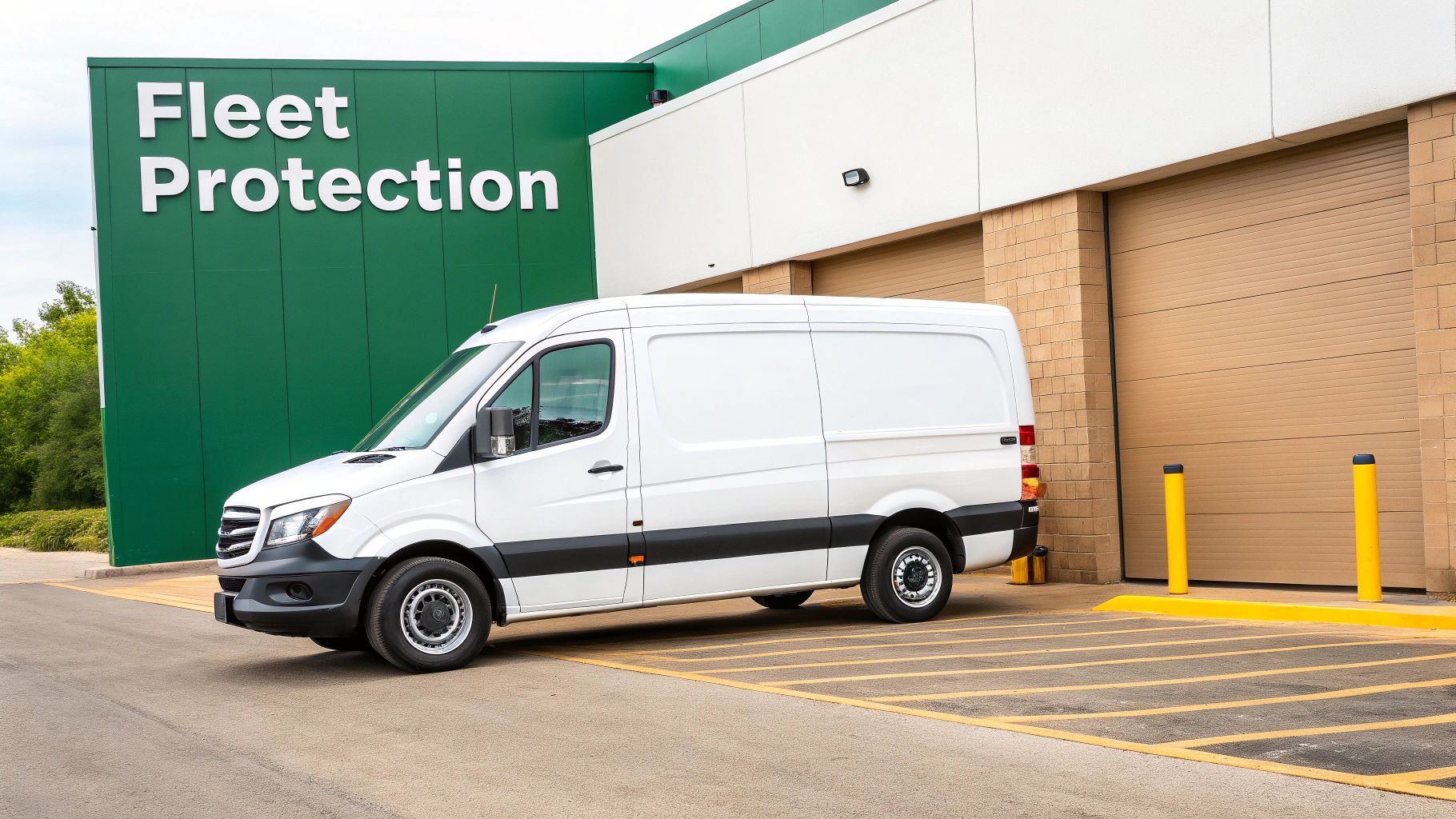
Commercial Auto Insurance provides specialized coverage for vehicles used for business purposes, which are typically excluded from personal auto policies. It protects your company from financial loss resulting from accidents involving company-owned, leased, or hired vehicles. This is a critical type of commercial insurance coverage for any business that relies on transportation, from a single delivery car to an entire fleet of contractor vans.
This policy covers liability for bodily injury and property damage to others, as well as optional coverages like collision, comprehensive, and uninsured/underinsured motorist protection for your own vehicles and drivers. If an employee causes a multi-car accident while driving a company truck, Commercial Auto Insurance covers the legal fees, medical costs for injured parties, and repair expenses, protecting your business from a potentially devastating financial impact.
Why It's a Must-Have
If you or your employees use vehicles for work-related tasks, this coverage is non-negotiable and often legally required. It closes a significant gap left by personal auto policies, which can deny claims if they discover the vehicle was being used for business at the time of an incident. It ensures your operations can continue smoothly even after an on-the-road accident.
Actionable Tips for Implementation
- Implement Driver Safety Programs: Reduce claims and potentially lower your premiums by instituting regular driver safety training, background checks, and a clear policy on distracted driving.
- Utilize Telematics: Install GPS tracking and telematics devices to monitor driving behavior. This data can help correct unsafe habits and may qualify your business for usage-based insurance discounts.
- Maintain an Accurate Vehicle List: Keep your agent updated with a current inventory of all vehicles used for business, including owned, leased, and long-term rentals. Ensure VINs and usage details are correct.
- Review Hired and Non-Owned Coverage: If employees use their personal vehicles for business errands, ensure your policy includes Hired and Non-Owned Auto coverage to protect the business from liability in an accident.
3. Workers' Compensation Insurance
Workers' Compensation Insurance is a state-mandated type of commercial insurance coverage that provides benefits to employees who suffer a job-related injury or illness. This essential policy covers medical care, rehabilitation, and a portion of lost wages, ensuring employees are supported during their recovery. In exchange for these no-fault benefits, employees typically give up their right to sue their employer for negligence.
This coverage is a cornerstone of business responsibility and a legal requirement in nearly every state for companies with employees. Whether an injury is a sudden accident on a construction site or a repetitive strain injury in an office, Workers' Compensation protects your most valuable asset, your people, while shielding your business from potentially devastating lawsuits and ensuring compliance with state law.
Why It's a Must-Have
Beyond being a legal mandate, this coverage is critical for financial stability. A single significant employee injury could lead to hundreds of thousands of dollars in medical bills and legal fees, a cost that could bankrupt an uninsured business. It also fosters a safer work environment by providing a clear process for handling injuries and encouraging safety protocols to keep premiums down.
Actionable Tips for Implementation
- Classify Employees Correctly: Your premium is heavily based on employee job classifications and payroll. Work with your agent to ensure every employee is classified accurately to avoid surprise audits and costly premium adjustments.
- Implement a Safety Program: A documented and enforced workplace safety program, often supported by OSHA guidelines, can significantly reduce incidents and may qualify your business for premium discounts.
- Establish a Return-to-Work Program: A structured program to help injured employees return to work, even in a limited capacity, can dramatically lower the overall cost of a claim and improve employee morale.
- Report Incidents Immediately: Promptly report all workplace injuries to your insurance carrier. Delays can complicate the claims process and may even lead to penalties.
4. Commercial Property Insurance
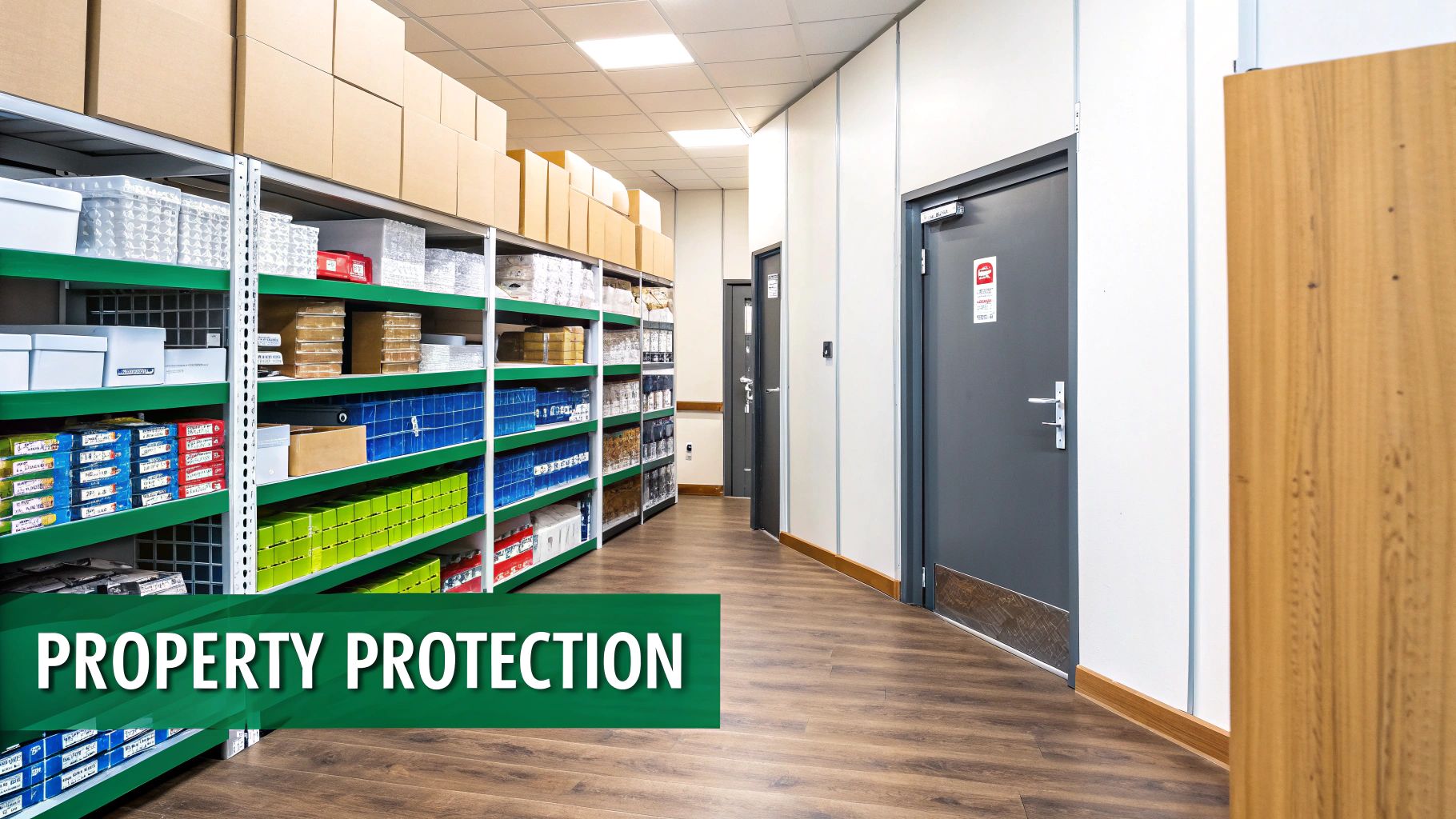
Commercial Property Insurance is a critical type of commercial insurance coverage that safeguards your business’s physical assets. This policy protects your owned or rented building, equipment, inventory, furniture, and fixtures from financial loss due to events like fire, theft, windstorms, and vandalism. It is the financial backstop that allows you to repair or replace essential property after a covered disaster.
From a restaurant’s kitchen equipment to a retail store’s inventory, this coverage ensures that the tangible items vital to your operations are protected. If a fire damages your warehouse or a storm shatters your storefront, this policy provides the funds to rebuild and restock, enabling business continuity and protecting your investment.
Why It's a Must-Have
For any business that owns or leases a physical space and has tangible assets, this coverage is indispensable. Lenders often require it as a condition for a commercial mortgage, and landlords frequently mandate it in lease agreements. Beyond these requirements, it provides the essential capital needed to recover from devastating property damage without liquidating assets or taking on crippling debt.
Actionable Tips for Implementation
- Choose Replacement Cost Value (RCV): Opt for RCV over Actual Cash Value (ACV). RCV pays to replace your damaged property with new items of similar kind and quality, ignoring depreciation, which provides a more complete financial recovery.
- Conduct Regular Asset Inventories: Maintain a detailed, up-to-date inventory of all your business property, including equipment, furniture, and stock. Document values and keep photos or videos off-site to streamline any future claims.
- Consider Business Interruption Coverage: Bundle your property policy with business interruption insurance. This add-on covers lost income and operating expenses if a covered property loss forces you to temporarily shut down your operations.
- Update Your Policy Proactively: As your business grows, so do your assets. Review and update your coverage limits annually or anytime you acquire significant new equipment or inventory to avoid being underinsured.
5. Professional Liability Insurance
Professional Liability Insurance, also known as Errors & Omissions (E&O) insurance, is a crucial type of commercial insurance coverage designed to protect service-providing businesses from claims of negligence or failure to perform their professional duties. It addresses financial losses suffered by clients due to alleged mistakes, omissions, or bad advice given as part of the service you provide.
This policy is essential for any professional whose work can lead to a client's financial harm if an error occurs. For example, if an accountant's tax preparation mistake leads to a client audit and penalties, or a consultant's strategic advice results in a significant business loss, Professional Liability insurance covers the legal defense costs and any resulting judgments or settlements, protecting your business's financial stability.
Why It's a Must-Have
For professionals like attorneys, architects, financial advisors, and IT consultants, this coverage is non-negotiable. Many client contracts and professional licensing boards explicitly require proof of E&O insurance. It safeguards not only your assets but also your professional reputation, showing clients you are accountable for the quality of your work.
Actionable Tips for Implementation
- Maintain Continuous Coverage: Professional Liability is a "claims-made" policy, meaning the policy must be active when the claim is filed. Avoid gaps in coverage, as a claim from a past project could be denied if you are uninsured when it's reported.
- Document Client Communications: Keep meticulous records of all client interactions, agreements, and project milestones. Thorough documentation is your best defense against claims of negligence or miscommunication.
- Understand Your Retroactive Date: When switching policies, ensure your new policy honors the "retroactive date" of your first policy. This date protects you from claims arising from work performed since you were first insured.
- Purchase Tail Coverage: If you are retiring or closing your business, purchase "tail coverage." This extended reporting period allows you to report claims that arise from past work even after your primary policy has expired.
6. Cyber Liability Insurance
Cyber Liability Insurance is a specialized policy designed to protect your business from the significant financial fallout of a data breach or cyber attack. As digital threats like ransomware and business email compromise become more common, this coverage has shifted from a niche product to an essential safeguard for businesses of all sizes that handle sensitive customer or company data.
This policy addresses a wide range of costs associated with a cyber incident, including forensic investigations, business interruption, extortion payments, and legal liability. For instance, if a hacker steals your customer database, Cyber Liability Insurance can cover the costs of notifying affected individuals, providing credit monitoring services, and defending against potential lawsuits, protecting your business's finances and reputation.
Why It's a Must-Have
In today's digital economy, a single data breach can lead to devastating financial losses, regulatory fines (such as for HIPAA violations), and irreparable damage to customer trust. Standard General Liability policies typically exclude cyber-related events, leaving a critical gap in protection. This coverage is vital for any business that stores, processes, or transmits electronic data.
Actionable Tips for Implementation
- Implement Proactive Security: Insurers often require strong security controls. Implement multi-factor authentication (MFA) enterprise-wide, conduct regular employee cybersecurity training, and maintain current, offline data backups.
- Understand Your Coverage: Policies vary greatly. Review sub-limits for specific costs like ransomware payments, business interruption, and regulatory fines to ensure they align with your risk profile.
- Choose a Partner, Not Just a Policy: Select an insurer that offers robust pre-breach services, such as security assessments, and has a dedicated, experienced panel of experts to manage incident response.
- Document Your Protocols: Maintain a clear, written incident response plan. Documenting your security protocols and response procedures is crucial for both preventing incidents and streamlining the claims process if one occurs.
7. Business Owner's Policy (BOP)
A Business Owner's Policy, commonly known as a BOP, is a convenient insurance package that bundles several essential coverages into one streamlined policy. Specifically designed for small to mid-sized businesses, it typically combines General Liability, Commercial Property, and Business Interruption insurance, offering comprehensive protection at a more affordable price than purchasing each policy separately.
This bundled approach simplifies insurance management and is an ideal entry-point for businesses needing foundational protection. For example, a small accounting firm would be covered if a client slips in their office (General Liability), if a fire damages their computers (Commercial Property), and for the lost income while they relocate (Business Interruption). It's a cost-effective way to secure multiple types of commercial insurance coverage in a single, manageable plan.
Why It's a Must-Have
For qualifying businesses, a BOP is the most efficient way to get core protection. Insurers offer it at a premium discount because the bundled risk profile is often more predictable and desirable. It removes the complexity of juggling multiple policies, expiration dates, and payments, allowing business owners to focus on growth rather than administrative tasks.
Actionable Tips for Implementation
- Confirm Eligibility: BOPs are not for everyone. They are designed for lower-risk businesses in specific industries. Work with an agent to confirm your business, such as a small retail shop or consulting firm, qualifies.
- Add Endorsements: Your standard BOP may not cover unique risks. Add specialized coverage riders or endorsements, like data breach or professional liability coverage, to fill any crucial gaps in your protection.
- Review Limits Annually: As your business grows, so do your assets and liabilities. Re-evaluate your property and liability limits each year to ensure they are adequate to cover your company's current value and risk exposure.
- Document Your Assets: To ensure you are properly covered under the commercial property portion, maintain a detailed and updated inventory of all business assets, including equipment, furniture, and inventory. This is vital for a smooth claims process.
8. Umbrella Liability Insurance
Umbrella Liability Insurance, also known as Excess Liability Insurance, provides an extra layer of financial protection that sits on top of your other primary liability policies. It is designed to safeguard your business from catastrophic claims that exceed the limits of your existing General Liability, Commercial Auto, or Employer's Liability coverage. This policy acts as a crucial safety net for high-cost lawsuits that could otherwise jeopardize your company's assets and future.
When a major claim exhausts the limits of an underlying policy, the Umbrella policy kicks in to cover the remaining costs, up to its own much higher limit. For a professional firm facing a multi-million-dollar lawsuit or a contractor responsible for a severe accident, this coverage can be the difference between financial stability and bankruptcy. It is one of the most cost-effective types of commercial insurance coverage for significantly increasing your protection.
Why It's a Must-Have
For businesses with significant public interaction, high-value assets, or high-risk operations, a standard liability policy may not be enough. An Umbrella policy is essential for protecting against worst-case scenarios and is often required for larger contracts. It demonstrates a high level of financial responsibility and preparedness, providing critical peace of mind for business owners.
Actionable Tips for Implementation
- Verify Underlying Limits: Insurers require your primary liability policies (General Liability, Auto, etc.) to have specific minimum limits, often $1 million, before they will issue an Umbrella policy. Confirm you meet these prerequisites.
- Coordinate Policies Carefully: Ensure your Umbrella policy provides seamless coverage over your underlying policies. Any gaps could leave you exposed. Review the terms to understand how and when it activates.
- Assess Your True Exposure: A contractor operating heavy machinery has different catastrophic risk than a small retail shop. Evaluate your potential for large-scale claims to determine an appropriate limit, often starting at $1 million and increasing in increments.
- Review Annually: As your business grows, so does your liability exposure. Re-evaluate your Umbrella coverage limits annually or whenever you expand operations, take on larger projects, or increase your fleet size.
9. Builders Risk Insurance
Builders Risk Insurance is a specialized form of property insurance designed to protect physical assets during the course of construction, renovation, or repair. Often called "course of construction" insurance, it covers the structure being built along with materials, supplies, and equipment on-site, in transit, or stored at a temporary location. This policy is critical for protecting the investment of property owners, developers, and contractors from the unique perils of a construction environment.
It specifically addresses losses from events like fire, theft, vandalism, and certain weather-related damages that can devastate a project's budget and timeline. For example, if a fire destroys a partially completed commercial building or a storm damages roofing materials stored on-site, Builders Risk Insurance would cover the cost to repair the structure and replace the lost materials, allowing the project to get back on track without catastrophic financial loss.
Why It's a Must-Have
For any construction project, the value of labor and materials on-site represents a significant, uninsured financial exposure. Lenders almost universally require this coverage before financing a project. It safeguards the substantial and growing investment from the ground up, ensuring that a single incident doesn't derail the entire endeavor.
Actionable Tips for Implementation
- Coordinate Policies: Ensure the policy is coordinated between the property owner, general contractor, and subcontractors. Designate who is responsible for securing the policy to avoid dangerous coverage gaps.
- Insure to Full Value: The policy limit should reflect the total completed value of the project, including all materials, labor, and overhead, not just its current value. Update the insurer as the project progresses and values change.
- Understand Your Timeline: Policies are written for a specific project term, such as 12 months. If the project is delayed, you must secure an extension before the policy expires to maintain coverage.
- Implement On-Site Security: Reduce your risk of theft and vandalism (and potentially lower your premiums) by implementing security measures like fencing, lighting, and surveillance cameras. Document these measures for your insurer.
10. Equipment Breakdown Insurance
Equipment Breakdown Insurance, often known as Boiler and Machinery insurance, is a critical type of commercial insurance coverage that protects against the sudden and accidental breakdown of machinery and equipment. It covers the cost to repair or replace vital equipment, such as HVAC systems, production machinery, refrigeration units, and computer servers, when they fail due to internal issues like power surges or mechanical failure.
This policy fills a significant gap left by standard Commercial Property insurance, which typically only covers damage from external events like fire or theft. Equipment Breakdown Insurance addresses the financial fallout from internal malfunctions, covering not just the repair costs but often the income lost and expenses incurred while the equipment is out of service. This coverage is essential for any business reliant on powered equipment to operate.
Why It's a Must-Have
A sudden equipment failure can halt operations instantly, leading to significant financial loss and customer dissatisfaction. Protecting essential assets like your commercial freezer or a manufacturing assembly line is non-negotiable. This coverage ensures that a single mechanical failure doesn't cripple your business financially, allowing you to get back to work quickly.
Actionable Tips for Implementation
- Schedule Critical Equipment: Create a detailed inventory of all essential machinery and ensure it is specifically listed on your policy. This prevents coverage gaps for your most vital assets.
- Maintain Your Machinery: Insurers often require a documented preventive maintenance program. Keep detailed logs of inspections and service work to ensure claims are honored and to reduce the likelihood of breakdowns.
- Include Business Interruption: Verify that your policy includes adequate Business Interruption and Extra Expense coverage. This helps cover lost income and temporary operational costs while repairs are underway.
- Coordinate with Property Policy: Understand how your Equipment Breakdown and Commercial Property policies interact. Work with your agent to ensure there are no overlapping coverages or, more importantly, gaps between the two.
11. Employment Practices Liability Insurance (EPLI)
Employment Practices Liability Insurance, commonly known as EPLI, protects your business against claims made by employees, former employees, or even job applicants. This coverage shields you from allegations of wrongful acts arising from the employment process, such as wrongful termination, discrimination, sexual harassment, and retaliation. As one of the more specialized types of commercial insurance coverage, it is crucial for any business with a workforce.
EPLI covers legal defense costs, settlements, and judgments related to employment lawsuits, which can be financially devastating. For instance, if a former employee sues for wrongful termination after a layoff or a current employee alleges discrimination, EPLI helps manage the significant legal expenses, protecting your company’s financial stability.
Why It's a Must-Have
In today's litigious environment, an employment-related lawsuit is a significant threat to businesses of all sizes. Even unfounded claims require a costly legal defense. EPLI is not just for large corporations; small businesses are often more vulnerable as they may lack a dedicated HR department or legal team, making this coverage a critical component of risk management.
Actionable Tips for Implementation
- Establish Strong HR Policies: Create a clear employee handbook that outlines anti-discrimination, anti-harassment, and disciplinary procedures. Consistent enforcement of these policies is your first line of defense.
- Document Everything: Maintain meticulous records of performance reviews, disciplinary actions, and reasons for termination. This documentation is invaluable when defending against a wrongful employment claim.
- Train Your Managers: Provide regular training to supervisors on lawful hiring, firing, and management practices to prevent situations that could lead to a lawsuit.
- Select Appropriate Limits: Your coverage needs will depend on your number of employees, industry, and turnover rate. Consult with an insurance professional to determine adequate limits for your specific risk profile.
12. Commercial Umbrella and Excess Liability Insurance
Commercial Umbrella and Excess Liability Insurance offers an essential layer of protection that sits on top of your existing liability policies, such as General Liability, Commercial Auto, and Employer's Liability. This coverage activates when the limits of these underlying policies are exhausted, protecting your business from catastrophic claims that could otherwise lead to financial ruin. It is a cost-effective way to secure significantly higher limits of liability.
An Excess Liability policy typically extends the limits of a single underlying policy, while an Umbrella policy can broaden coverage across multiple policies. It can also fill gaps by covering claims not included in the underlying policies, subject to a self-insured retention (similar to a deductible). For businesses with substantial assets or high-risk operations, like a large construction firm or a multi-location retailer, this coverage is critical for long-term viability.
Why It's a Must-Have
A single, severe lawsuit can easily surpass the standard $1 million or $2 million limit on a primary liability policy. An umbrella policy provides the extra cushion needed to cover massive legal fees, medical bills, and judgments, ensuring your business's core assets remain protected. It is also often a contractual requirement for larger projects or client engagements.
Actionable Tips for Implementation
- Align with Underlying Policies: Ensure your umbrella policy's start and end dates align perfectly with all your primary liability policies to avoid any gaps in coverage.
- Evaluate Your Total Risk: Consider your business's assets, potential for large-scale accidents, and contractual obligations. A real estate developer, for example, might need a multi-million dollar umbrella to cover potential risks across multiple sites.
- Review "Follow Form" vs. "Stand-Alone": Understand if your umbrella is a "follow form" policy (mirroring the terms of the underlying policy) or a "stand-alone" policy that may offer broader coverage. Clarify any differences with your broker.
- Plan for Growth: Select limits that account for your company's future growth trajectory. It is more efficient to secure higher limits proactively than to be underinsured when a major claim occurs.
12 Commercial Insurance Coverage Comparison
| Coverage | Implementation Complexity 🔄 | Resource Requirements ⚡ | Expected Outcomes ⭐📊 | Ideal Use Cases 💡 | Key Advantages |
|---|---|---|---|---|---|
| General Liability Insurance | Low — standardized underwriting and broad forms | Low — affordable, widely available | High ⭐ — protects against common third‑party injury/property claims | All businesses; lease/contractually required | Affordable foundational protection; legal defense included |
| Commercial Auto Insurance | Medium — vehicle inventories, driver vetting, endorsements | Medium — premiums vary by fleet size and claims | High ⭐📊 — protects vehicles, liability, collision losses | Contractors, fleets, delivery and sales vehicles | Mandatory for business vehicles; fleet discounts; telematics support |
| Workers' Compensation Insurance | Low‑Medium — payroll reporting and state compliance | High — premiums tied to payroll, audits required | High ⭐📊 — medical/wage replacement; reduces employee lawsuits | Any employer with employees (statutorily required) | Legally mandatory; protects employees and employer liability |
| Commercial Property Insurance | Medium — asset schedules, valuation, replacement options | Medium‑High — costs scale with property and contents | High ⭐📊 — restores assets; enables business continuity | Retail, offices, warehouses, landlords, lenders require | Protects buildings/inventory; business interruption options available |
| Professional Liability Insurance (E&O) | Medium‑High — claims‑made terms, retro dates, tail options | Medium — premiums based on revenue and claims history | High ⭐📊 — covers negligence/errors; preserves reputation | Consultants, accountants, architects, lawyers, tech consultants | Essential for service professionals; often contractually required |
| Cyber Liability Insurance | Medium — security assessments and controls required | Medium‑High — rising premiums; security investments expected | High ⭐📊 — breach response, recovery, regulatory support | Any business handling sensitive data or online transactions | Breach response services, forensic/legal costs, regulatory protection |
| Business Owner's Policy (BOP) | Low — bundled underwriting for small/mid businesses | Low‑Medium — cost savings vs separate policies | High ⭐📊 — broad baseline protection at lower cost | Small to mid‑sized businesses needing multiple coverages | Bundled savings; simpler administration; faster implementation |
| Umbrella Liability Insurance | Medium — coordination with underlying policies needed | Low‑Medium — cost‑effective per additional million | High ⭐📊 — extends limits for catastrophic liability | Businesses with significant assets/exposure | Affordable high‑limit layer; fills gaps above primary limits |
| Builders Risk Insurance | Medium — project schedules, value reporting, timelines | Medium — premium based on project value and duration | High ⭐📊 — protects work‑in‑progress and materials | Developers, general contractors, renovation projects | Construction‑phase coverage; lender often requires |
| Equipment Breakdown Insurance | Low‑Medium — schedule critical equipment; maintenance records | Low‑Medium — relatively affordable vs replacement costs | Medium‑High ⭐📊 — covers sudden failures and BI from breakdowns | Facilities with critical machinery, kitchens, servers | Covers age‑independent breakdowns; includes expedited repairs |
| Employment Practices Liability Insurance (EPLI) | Low‑Medium — HR policies, recordkeeping, training integration | Low‑Medium — premiums scale with headcount and history | High ⭐📊 — covers defense/settlements for employment claims | Any employer concerned about wrongful employment claims | HR consulting/training often included; immediate defense coverage |
| Commercial Umbrella & Excess Liability Insurance | High — specialized underwriting; customized terms | High — large limits, SIRs, specialized market placement | Very High ⭐📊 — bespoke, very high‑limit protection | Large, multi‑location, complex operations needing $5M+ limits | Custom high limits, special‑form coverage, fills major gaps |
Simplifying Your Insurance Strategy with an Expert Partner
Navigating the complex landscape of commercial insurance can feel like an overwhelming task. As we’ve detailed, the sheer number of types of commercial insurance coverage available, from General Liability and Commercial Auto to highly specialized policies like Cyber Liability and EPLI, highlights a critical truth: there is no one-size-fits-all solution for protecting your business. Each policy serves a distinct and vital purpose, acting as a specific shield against a particular category of risk that could otherwise jeopardize your financial stability, operational continuity, and hard-earned reputation.
Attempting to piece together this puzzle alone often leads to dangerous gaps or costly overlaps in coverage. A simple mistake, like underestimating your commercial property value or neglecting to secure adequate professional liability limits, can have catastrophic consequences when a claim arises. The real challenge isn't just knowing what each policy does, but understanding how they interact to create a seamless, comprehensive safety net for your unique operational footprint.
Key Takeaways for Building a Resilient Business
To move from understanding to implementation, let's distill the core principles from our exploration of commercial insurance. Mastering these concepts is the first step toward building a truly resilient enterprise.
- Foundation First, Specialization Second: Always begin with foundational coverages. A Business Owner's Policy (BOP) often provides a solid base by bundling General Liability, Commercial Property, and sometimes Business Interruption. From there, layer on specialized policies that address your specific industry risks, such as Professional Liability for consultants or Commercial Auto for a delivery fleet.
- Liability is a Multi-Layered Threat: A single liability policy is rarely enough. A customer slip-and-fall (General Liability), a data breach (Cyber Liability), and a wrongful termination lawsuit (EPLI) represent distinct threats that require separate, dedicated coverage. A Commercial Umbrella policy then acts as a crucial final layer, providing extra protection over all your underlying liability limits.
- Your Policy is a Living Document: Your insurance needs are not static. As your business evolves, so do your risks. Hiring your first employee triggers the need for Workers' Compensation. Purchasing a new building demands a review of your Commercial Property limits. Expanding your services might create new professional liabilities. A proactive, annual review of your coverage is not just recommended; it is essential for sustained protection.
Your Actionable Path to Comprehensive Protection
With this knowledge in hand, the next step is to translate it into a concrete strategy. Don't let the complexity lead to inaction. Instead, follow a structured approach to ensure your business is properly safeguarded.
- Conduct a Thorough Risk Assessment: Go beyond the obvious. Think through every aspect of your operations. What are your biggest revenue drivers and what could interrupt them? Where do you interact with clients, and what could go wrong? What data do you handle? Document these potential risks to create a clear picture of your unique exposure profile.
- Gather Your Current Policy Documents: Collect all existing insurance policies. Review the declaration pages to understand your current limits, deductibles, and key exclusions. This audit will reveal immediate gaps or areas where your coverage may be insufficient for your current business size and scope.
- Engage a Professional Partner: This is the most critical step. The true value of a knowledgeable insurance partner isn't just in selling policies; it's in providing strategic counsel. An independent agent or broker works for you, not the insurance carrier. They can access multiple markets to find the right combination of coverage and cost, and more importantly, they can help you understand the nuances of policy language that can make or break a claim.
Ultimately, mastering the various types of commercial insurance coverage is about more than just buying policies. It’s about strategic risk management. It's about empowering your business to pursue growth, innovate, and serve your clients with confidence, knowing you have a robust framework in place to handle the unexpected. This proactive stance transforms insurance from a mere expense into a powerful strategic asset that fuels long-term success and peace of mind.
Ready to build a truly resilient insurance strategy without the guesswork? The expert advisors at Wexford Insurance Solutions specialize in translating complex risks into clear, comprehensive coverage plans for businesses just like yours. Visit Wexford Insurance Solutions to schedule a complimentary policy review and discover how a dedicated partner can protect and strengthen your business.
 Mastering risk assessment for small business: A practical guideWhat Is a Deductible in Insurance and How Does It Work?


