

So, you're wondering how much engagement ring insurance costs. The good news is, it's probably a lot less than you think. The industry standard rule of thumb is that you can expect to pay anywhere from 1% to 2% of your ring's appraised value each year.
That means for a ring valued at $10,000, you’re looking at an annual premium of about $100 to $200. It's a surprisingly small price for some serious peace of mind.
The True Cost of Protecting Your Engagement Ring
An engagement ring is so much more than just a piece of jewelry—it's a promise, a memory, and a symbol of your future. Protecting that symbol shouldn’t be a source of stress. The simple "1-2% rule" gives you a reliable and straightforward way to estimate your insurance costs right from the start.
Think of it this way: for every $1,000 your ring is worth, you'll likely pay between $10 and $20 a year to protect it from all sorts of mishaps, like loss, theft, damage, or even just vanishing into thin air (what insurers call "mysterious disappearance"). That small annual cost is a world away from the financial—and emotional—hit of having to replace it yourself.
Real-World Price Scenarios
Let's put some real numbers to this. Say you have a gorgeous $10,000 engagement ring. The idea of losing it on vacation or it slipping off your finger can be terrifying. But insuring it is incredibly manageable, typically costing between $100 and $200 per year.
To help you get a better feel for it, here’s how the pricing usually breaks down for different ring values:
- For a $5,000 ring: Expect to pay somewhere between $50 and $100 annually.
- For a $10,000 ring: Your premium will likely be in the $100 to $200 range per year.
- For a $20,000 ring: You're looking at a cost of about $200 to $400 annually.
This predictable pricing makes it easy to fit into your budget. If you're new to this, learning what an insurance premium is helps clarify how this small, regular payment protects such a significant asset.
Visualizing Your Annual Premium
To make it even clearer, this table lays out the estimated annual costs based on that trusty 1-2% rule. Just find your ring's appraised value to see exactly how affordable this protection can be.
Estimated Annual Insurance Premium by Ring Value
This table shows the typical annual cost of engagement ring insurance based on the standard 1-2% rule for different appraised ring values.
| Appraised Ring Value | Estimated Annual Premium (1%) | Estimated Annual Premium (2%) |
|---|---|---|
| $5,000 | $50 | $100 |
| $8,000 | $80 | $160 |
| $10,000 | $100 | $200 |
| $15,000 | $150 | $300 |
| $20,000 | $200 | $400 |
When you look at it this way, you can see that securing your ring often costs less than a monthly streaming service or a few lattes a week.
Key Takeaway: The cost of engagement ring insurance is a small, predictable fraction of its value, offering an affordable way to safeguard against significant financial and sentimental loss.
At Wexford Insurance Solutions, we help clients across New York and Florida find the right coverage. A dedicated valuable items policy is almost always the best route, as it protects your ring for its full appraised value and offers far broader protection than a standard homeowners policy add-on.
What Really Drives the Cost of Your Ring Insurance?
While the 1-2% rule of thumb is a great starting point, the actual price you'll pay for engagement ring insurance isn't pulled out of a hat. It’s a carefully calculated figure based on a handful of key factors. Think of it less like a price tag and more like a puzzle—each piece, from your zip code to the diamond’s setting, fits together to create the final picture of your annual premium.
Knowing what goes into this calculation does more than just satisfy curiosity. It puts you in the driver's seat, helping you understand your quote and even spot ways to save. Let's pull back the curtain on what insurers are really looking at.
Where You Live Matters
Believe it or not, your address plays a huge role. Insurers lean heavily on location-based data to figure out the risk of theft in your specific area. A ring in a bustling New York City apartment building will almost always cost more to insure than the exact same ring in a quiet Florida suburb.
It's not personal; it's purely statistical. Some zip codes simply have a higher frequency of theft claims, and the premium has to reflect that elevated risk. The insurer is just balancing the cost against the local likelihood of a claim.
Your Personal Claims History
Have you had to file insurance claims before? Your past claims history is a major piece of the puzzle. If you’ve filed several claims in recent years, whether for jewelry or other losses, an insurer might see you as a higher risk.
On the flip side, a clean record signals that you're less likely to file a claim, and that can earn you a better rate. Insurers love responsible clients. It's not uncommon for providers to add a small surcharge to your premium for each claim filed within the last few years.
The Ring's Specifics
The ring itself is more than just its appraised value. The nitty-gritty details of its design and materials absolutely influence the premium, as they affect both the risk of damage and how much it would cost to fix or replace. When it comes to the value, understanding natural diamonds and their unique qualities is a critical part of the equation.
Here's what underwriters look at:
- The Setting: A super-secure setting, like a bezel or a classic six-prong design, is considered much safer than a delicate tension setting where the stone is held in by pressure. A riskier design can nudge the premium up slightly because the diamond is more likely to get loose or pop out.
- The Metal: The metal used for the band—platinum versus 14k gold, for instance—impacts the ring's overall toughness and replacement cost. Platinum is incredibly durable but also pricier to repair, which gets factored in.
- Accent Stones: That beautiful band covered in tiny pavé diamonds? It can be more expensive to insure. Those little stones are more prone to falling out over time, and replacing them one by one adds up, increasing the overall risk profile.
Your Chosen Deductible
This one’s a classic. Just like with your car or home insurance, the deductible you choose has a direct line to your premium. A deductible is simply the amount you agree to pay out-of-pocket on a claim before the insurance company steps in. (If you want the full breakdown, we have a simple guide on what a deductible in insurance means.)
By choosing a higher deductible—say, $1,000 instead of $250—you are taking on more of the initial financial risk. In return, the insurer will lower your annual premium.
This is a personal trade-off. It’s all about balancing a lower yearly cost with how much you'd be comfortable paying upfront if something happened.
Security and Storage Measures
How you protect your ring when you're not wearing it can also earn you a discount. Insurers reward proactive steps that reduce the chance of a claim.
Storing your ring in a bolted-down home safe or having a monitored home security system can often shave a bit off your premium. These measures make theft less likely, and insurers are happy to pass some of those savings back to you. Here at Wexford Insurance Solutions, our agents know exactly which carriers offer these discounts, so we can hunt down every opportunity to lower your rate.
Choosing the Right Coverage for Your Ring
When you buy a car, you don't just get "car insurance"; you pick and choose between liability, collision, and comprehensive coverage. Protecting your engagement ring works the same way. Not all policies are created equal, and knowing your options is the only way to get protection that actually comes through when you need it most.
A lot of people make the mistake of assuming their standard homeowners or renters insurance has them covered. It's a common and often costly oversight. These policies are built to protect the big stuff—your house, your furniture—not small, high-value items like jewelry. They usually have surprisingly low coverage limits for valuables, sometimes as little as $1,500, and that's after you pay your main policy deductible. This gap leaves a cherished, significant asset almost completely exposed.
To do this right, you need to look beyond that basic coverage and explore specialized options. You've got three main paths to consider, and each one has its own set of trade-offs.
Understanding Your Three Main Options
Making the right choice really boils down to what you're trying to protect and how. Think of it like this: if you had a priceless painting, would you want a general alarm for the whole house or a dedicated laser grid just for that painting? For something as precious as an engagement ring, that level of detail matters.
The decision tree below maps out the key factors that insurance carriers look at when setting your premium. As you'll see, where you live, your past claims, and the ring's unique details all play a part, which is why picking the right type of coverage is so critical.
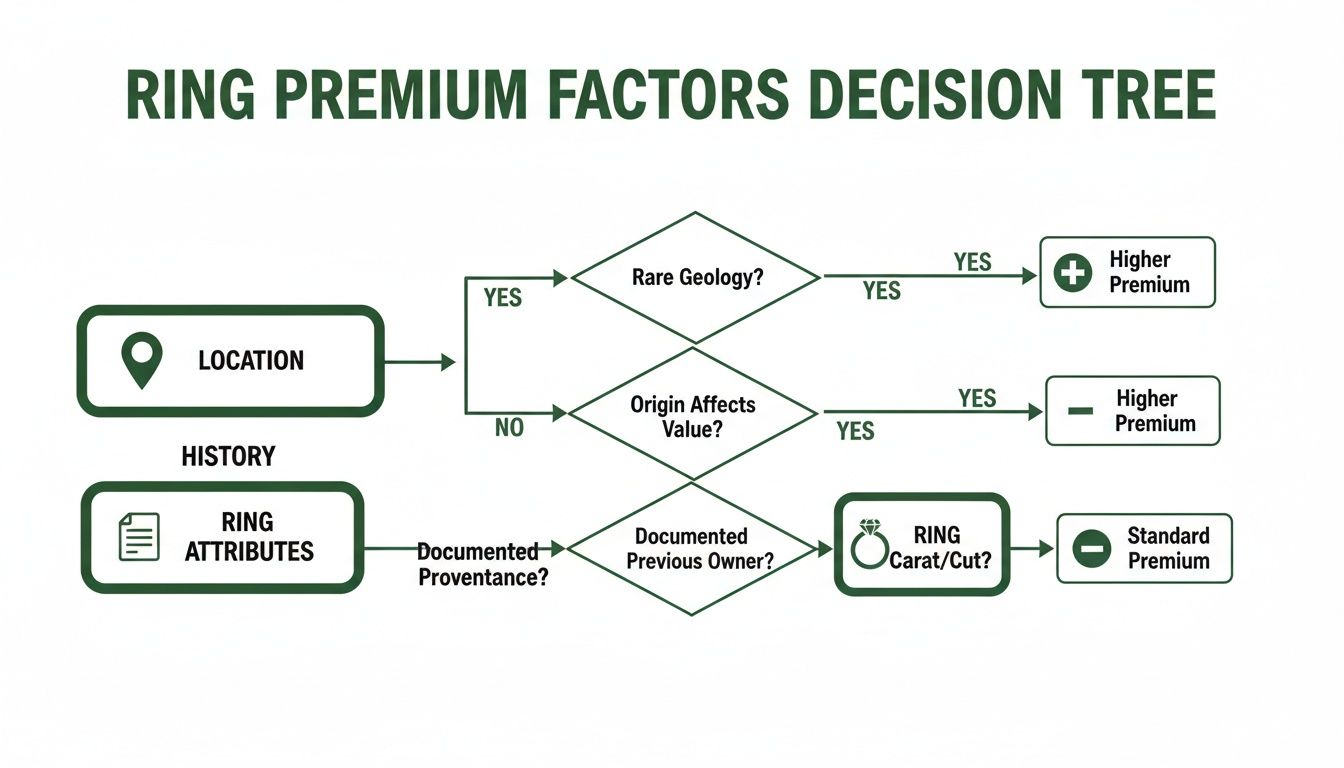
Let's break down the three primary ways you can insure that beautiful ring.
Comparing Ring Insurance Options
To help you decide, here’s a side-by-side look at the three main types of engagement ring insurance. Each approach offers a different balance of convenience, cost, and comprehensive protection, so finding the best fit depends on your specific needs and the value of your ring.
| Feature | Scheduled Policy (Rider) | Blanket Coverage | Standalone Policy |
|---|---|---|---|
| How It Works | An add-on to your home/renters policy for a specific item. | A single, total coverage limit for all your jewelry under your home policy. | A separate, dedicated policy just for your jewelry. |
| Best For | A single high-value ring when you want to keep policies consolidated. | A collection of lower-value jewelry where individual items aren't very expensive. | High-value engagement rings or anyone wanting to keep claims separate from home insurance. |
| Deductible | Often low or $0. | Subject to your main home policy's deductible. | Typically low or $0. |
| Mysterious Loss | Usually covered. | Rarely covered. | Almost always covered. |
| Claim Impact | A claim goes on your home insurance record and can raise future premiums. | A claim impacts your home insurance record. | A claim does not affect your home insurance premiums or claims history. |
| Appraisal Needed | Yes, required to set the coverage amount. | Not usually required for the group, but individual limits apply. | Yes, a detailed appraisal is almost always required. |
Ultimately, the choice between a rider, blanket coverage, or a standalone policy comes down to your priorities. Do you value simplicity, the lowest possible cost, or the most robust protection available? The right answer is different for everyone.
1. Scheduled Personal Property (A Homeowners Policy Rider)
This is probably the most popular and effective route for many people. A "scheduled" policy, often called a rider or a floater, is simply an add-on to your existing homeowners or renters insurance. You're essentially listing—or "scheduling"—your ring as a specific item with its own coverage limit, set at its appraised value.
- The upside: It gives you broad, "all-risk" coverage, which typically includes protection for mysterious disappearance—that heart-stopping moment when your ring is just gone, with no clear sign of theft. Deductibles are also much lower, and sometimes even $0, for scheduled items.
- The downside: Adding a pricey item can sometimes impact your main homeowners policy rates or eligibility. More importantly, any claim you file goes on your home insurance record, which can cause issues down the road. You can learn more about the specifics by exploring our guide on what scheduled personal property coverage is.
2. Blanket Jewelry Coverage
This is another option you can add to your home insurance policy. Instead of listing out individual pieces, blanket coverage gives you a total dollar amount of protection for your whole jewelry collection—say, $10,000 total for everything.
- The upside: It’s simple. You don't need to get individual appraisals for every single item you own.
- The downside: This is where people get into trouble. Blanket coverage almost always has a per-item limit, usually around $1,500 to $2,500. So even if you have $10,000 in total coverage, the policy will only pay out the per-item max for your $8,000 engagement ring, leaving you thousands of dollars short. It also rarely covers mysterious disappearance.
3. Standalone Jewelry Insurance Policy
Just as the name implies, a standalone policy is completely separate from your home insurance. It’s a dedicated contract with a company that specializes in insuring valuables like jewelry.
Expert Insight: For high-value rings, a standalone policy often provides the most robust protection. Because it’s separate, a claim on your ring won't impact your homeowners insurance premiums or claims history, which can be a huge advantage.
These policies are built from the ground up just for jewelry. They almost always cover mysterious disappearance, worldwide travel, and accidental damage. They’re designed by experts who understand the unique risks that come with wearing, storing, and traveling with a valuable engagement ring.
While it might feel like an extra step, this separation provides a clean, focused layer of security for one of your most treasured possessions. At Wexford Insurance Solutions, we often find this is the best route for our clients in New York and Florida who want the highest level of protection without complicating their primary home coverage.
How to Get Your Engagement Ring Insured Step by Step
Alright, now that you know the different ways to cover your ring, let's get down to the practical stuff. Getting your engagement ring insured might sound like a hassle, but it’s actually a pretty simple, four-step process. Think of it as the final, responsible step in protecting a piece of jewelry that means the world to you.
This roadmap will walk you through everything, making it feel less like a chore and more like securing that all-important peace of mind.
Step 1 Get a Professional Appraisal
First things first: before any insurance company can protect your ring, they need to know what it's worth. This is where a professional appraisal comes in, and it's a non-negotiable starting point. It’s the official document that sets the value for your entire policy.
An appraisal is a detailed report from a certified gemologist describing your ring's key features—the 4 Cs of the diamond (cut, color, clarity, carat), the metal, and the setting. This report establishes the replacement value, which is the figure the insurer agrees to cover. If you want to dive deeper, our guide on getting a jewelry appraisal for insurance has more details.
Step 2 Document Everything
With the appraisal in hand, your next job is to gather all the related paperwork and take your own photos. Trust me, if you ever have to file a claim, this documentation will be your best friend.
Get these items together and keep them somewhere safe—both as hard copies and digital files:
- The Original Receipt: Proof of what you paid for it.
- The Appraisal Document: The most important piece, proving its value.
- Clear Photographs: Snap pictures from every angle. Be sure to capture any unique details or markings. A short video is a great idea, too.
Pro Tip: Scan or photograph these documents and save them in a secure cloud service like Google Drive or Dropbox. That way, you can access them from anywhere, even if the originals get lost.
Step 3 Choose Your Ideal Coverage
Now it's time to decide how you'll insure the ring. As we talked about earlier, you’ve got three main paths: adding a scheduled rider to your homeowners insurance, using blanket coverage, or getting a standalone jewelry policy.
Each option has its place, but for an engagement ring, a scheduled rider or a standalone policy is almost always the way to go. They offer much more robust, "all-risk" coverage (which even includes mysterious disappearance) and often come with a $0 deductible.
Step 4 Connect with an Insurance Professional
This is the final step where you bring it all together. Working with an independent insurance agency like Wexford Insurance Solutions can make this part a breeze. Instead of you having to call around and compare quotes, we do all the legwork for you.
We help clients across New York and Florida find the right coverage without overpaying. We’ve built our process for busy people—with paperless onboarding and a 24/7 client portal, getting your policy in place is fast and easy. Just send us your appraisal and documents, and we’ll help you choose the perfect policy and handle the rest. You’ll be left with nothing to do but feel confident that your ring is protected.
Navigating the Claims Process Like a Pro
Let's be honest—nobody buys insurance hoping to use it. But if the unthinkable happens and your engagement ring is lost, stolen, or damaged, you’ll be glad you have a plan. Knowing what to do ahead of time can make a world of difference, turning a potential nightmare into a straightforward process. It's not just about filling out forms; it's about getting back what you lost.
Replacement Cost vs. Actual Cash Value: The Most Important Detail
Before we get into the steps, there's one crucial concept you need to grasp: the difference between Replacement Cost Value (RCV) and Actual Cash Value (ACV).
Think of ACV as the "pawn shop" value. It pays you for what the ring is worth today, after factoring in depreciation. Just like a car loses value the moment you drive it off the lot, some components of jewelry can depreciate, leaving you with a check that’s not nearly enough to buy a similar new ring.
Replacement Cost Value (RCV), on the other hand, is what you actually want. This coverage is designed to give you the full amount needed to buy a brand-new ring of the same kind and quality at today’s prices. For something as precious as an engagement ring, RCV is the only way to truly protect both your financial investment and your peace of mind. At Wexford Insurance Solutions, we make sure our clients' policies are always written for replacement cost.
Your Step-by-Step Claims Journey
Filing a claim might seem intimidating, but it's really just a series of logical steps. Every situation is a bit different, but the general path is pretty consistent. For a deep dive, you can always check out our full guide on how to file an insurance claim.
- File a Police Report (If It's Stolen): This is your first move, no exceptions. If your ring was stolen, contact the police immediately. The insurance company will absolutely require a copy of the official police report to even begin processing a theft claim.
- Call Your Insurance Agent: Get in touch with your agent or insurance company as soon as you possibly can. Have your policy number handy and be ready to explain exactly what happened. This is where having a dedicated agent from Wexford really pays off—we become your advocate from the very first call.
- Gather Your Documents: Remember all that paperwork you saved? Now's the time. You’ll need to provide the appraisal, the original receipt, and any photos you have of the ring. This is your proof of ownership and value, and having it ready will dramatically speed things up.
Expert Insight: The claims process is the moment of truth for your insurance policy. A great agent doesn't just sell you a plan and disappear. They stand with you during the tough times, using their experience to make sure the outcome is fair, fast, and as stress-free as possible.
What to Expect From the Insurance Company
Once you've submitted your claim, the insurer will assign an adjuster to your case. Their job is to review your documents, check the police report, and confirm the details of your coverage. This is where the fine print of your policy really matters—things like whether it covers "mysterious disappearance" will be determined here.
It's also interesting to see how insurance costs and claims are connected to what people are actually spending. For instance, while the average engagement ring cost is projected to be around $6,500, data shows many couples are actually spending closer to $5,200. With premiums at just 1-2% of the ring's value, that means solid protection often costs only $52 to $104 a year. As Liori Diamonds notes, this trend in smart spending makes getting proper insurance an incredibly affordable and wise decision. You can read more about how real couples budget for rings in 2026.
After your claim is approved, your insurer will guide you on the next steps to either repair or replace your ring, often connecting you with a trusted jeweler to ensure the new piece is a perfect match for the original.
Wear Your Ring with Confidence, Not Worry
After all the planning, the perfect moment, and that heartfelt "yes," protecting your engagement ring is the final, crucial step. We've walked through all the details in this guide, and the biggest takeaway is that real protection is surprisingly affordable. For most people, it's just 1-2% of the ring's value each year.
But we've also seen that not all insurance is created equal. The difference between a simple add-on and a dedicated policy can mean the difference between a frustrating claim and a seamless replacement. Making that small investment buys you something far more valuable than the policy itself: genuine peace of mind.
You Don't Have to Figure This Out Alone
Navigating the ins and outs of insurance can feel overwhelming, but it doesn't have to be. For homeowners and private clients, especially those in New York and Florida, the process can and should be simple. Protecting your symbol of love should feel empowering, not complicated.
At Wexford Insurance Solutions, we're not just brokers; we're your partners. Our job is to find coverage that truly fits your life and your budget, because we believe great service and solid protection should always go hand in hand.
If you're ready to safeguard your investment, let's talk. Reach out for a personalized, no-obligation quote from Wexford Insurance Solutions and see just how easy it can be. We're here to help you wear that beautiful ring with nothing but joy.
Your Top Ring Insurance Questions, Answered
Let's be honest, insurance can feel a bit confusing. When it's for something as personal and valuable as an engagement ring, you need clear, simple answers. We get these questions all the time, so let's walk through the most common ones to give you the confidence you need.
Does My Homeowners Insurance Already Cover My Ring?
This is easily the number one question we hear, and the answer is crucial. Technically, yes, your homeowners or renters policy might offer some coverage for jewelry. But in reality? It's not nearly enough.
Most standard policies have a laughably low cap for jewelry theft, usually just $1,000 to $2,000. If your $8,000 ring vanishes, you'd only get that small capped amount back. To make matters worse, you'd still have to pay your main policy's deductible—often $500 or $1,000—out of that tiny payment.
The biggest gap, though, is what these policies don't cover. Accidental loss (like it slipping off at the beach) or the classic "mysterious disappearance" are almost never included. For real protection that actually lets you sleep at night, you need a dedicated jewelry rider or a standalone policy.
Do I Really Need to Get an Appraisal?
Yes, a recent and professional appraisal is non-negotiable. Think of it as the birth certificate for your insurance policy. It's an official document from a certified gemologist that proves what your ring is and what it's worth.
This isn't just a piece of paper with a price on it. It meticulously details the 4 Cs of the main stone, describes the setting and precious metals, and notes any unique characteristics. This is the blueprint your insurer uses to set your coverage amount and calculate a fair premium.
Most insurance companies will ask for an appraisal that's no more than two to five years old. This is a good thing—it ensures your coverage keeps up with the current market for diamonds and gold, so you don't end up underinsured.
What's the First Thing I Should Do If My Ring Is Lost or Stolen?
Realizing your ring is gone is a heart-sinking moment. Panic can set in, but knowing the first few steps to take can make a world of difference for your claim.
If you suspect theft, your very first call should be to the police to file a police report immediately. Your insurance provider will absolutely require a copy of this report for a theft claim, so don't put it off.
Next, get in touch with your insurance agent to report the loss. The sooner you start the process, the smoother it will go. It helps immensely if you have your documents ready to go:
- Your detailed appraisal
- The original purchase receipt
- A few clear photos of the ring
Having this information on hand will help your agent get the ball rolling quickly and take some of the stress off your shoulders.
Are There Any Tricks to Lower My Insurance Premium?
Of course. While ring insurance is already one of the more affordable policies out there, you can definitely take steps to bring the cost down even more.
The most direct way is to choose a higher deductible. If you agree to a $500 deductible instead of a $0 one, you're sharing a bit more of the risk, and your insurer will thank you with a lower annual premium.
Beyond that, always ask about discounts. Insurers love to see that you're proactive about security.
- Home Security: A monitored alarm system in your home often qualifies you for a discount.
- Secure Storage: Keeping the ring in a bolted-down home safe when you're not wearing it can also trim your rate.
- Multi-Policy Bundles: This is a big one. When you work with an independent agency like Wexford Insurance Solutions, we can bundle your valuable items policy with your home or auto insurance, which can lead to some really nice savings.
Your engagement ring is so much more than jewelry; it’s a promise for your future. It deserves protection that lets you wear it freely and without a second thought. At Wexford Insurance Solutions, our specialty is finding the perfect coverage for the things you treasure most. Contact us today for a personalized quote and see just how simple it is to secure your peace of mind.
 Does Homeowners Insurance Cover Mold? A Complete GuideProtect Your Business with commercial umbrella insurance


