

Discovering a major flaw in a new building isn't just an inconvenience—it's a massive financial and legal headache for everyone involved. At its core, a construction defect claim is a formal demand for compensation when a part of a building fails because of poor design, shoddy materials, or subpar workmanship. These claims have become one of the most significant challenges facing the construction industry today.
Why Are We Seeing More Construction Defect Claims?
Imagine the excitement of getting the keys to your new custom home, only to find a web of cracks creeping across the foundation a year later. That sinking feeling is what a growing number of property owners are experiencing. The dream of a perfect new build is too often shattered by defects that are as costly as they are stressful, which is why the world of construction defect claims is more active than ever.
This isn't just a random spike. A few powerful, industry-wide pressures are colliding, creating a perfect storm for errors and the disputes that follow. Getting a handle on these underlying issues is the first step for anyone looking to manage their risk.

The Key Factors Fueling the Surge
This trend isn't driven by one single problem. It's a combination of tough economic and operational challenges that put a strain on every phase of a project, from the first drawing to the final punch list.
Here’s what’s really driving the increase:
- Skilled Labor Shortages: The reality is, the industry is still wrestling with a major shortage of experienced tradespeople. When projects have to rely on less-skilled crews for complex tasks, the chances of workmanship errors—like improperly installed window flashing or faulty wiring—go up significantly.
- Supply Chain Headaches: The volatility we've seen since the pandemic has made getting consistent, quality materials a real challenge. Contractors sometimes have no choice but to use substitute materials that might not hold up as well as the specified ones, leading to failures down the road.
- Increasingly Complex Buildings: Modern designs and stricter building codes require far more advanced techniques and materials than ever before. This complexity raises the stakes. A tiny mistake in a high-performance building envelope can quickly turn into a catastrophic water intrusion problem or even a structural issue.
Today's construction projects are a balancing act. There's immense pressure to finish fast and stay on budget, but that often clashes with the meticulous quality control needed, especially when you can't get the skilled hands or reliable materials you need.
This environment makes being proactive absolutely essential. For contractors and owners alike, solid risk management best practices are no longer just a good idea; they're critical for protecting an investment.
Ultimately, these trends highlight just how important it is to know your rights, your responsibilities, and your options when a defect surfaces. This guide will walk you through it all, giving you the clarity to navigate a construction defect claim with a confident, informed strategy. Once you understand why claims are on the rise, you’ll be much better prepared to handle what comes next if a problem appears on your project.
What Counts as a Construction Defect
Not every hairline crack or leaky faucet is grounds for a construction defect claim. So, what separates a minor annoyance from a serious, actionable problem?
At its core, a construction defect is a failure in how a building or one of its components was designed, built, or made. This failure means the building doesn't perform as it should according to contracts, building codes, or accepted industry standards. Think of it as a promise that wasn't kept—a promise of a safe, functional, and durable structure.
These flaws aren't just random bad luck; they fall into distinct categories that trace back to the very beginning of a project. Understanding these different types of defects in building is the first step to figuring out what went wrong and who is responsible.
Construction defect claims have become one of the biggest hurdles for the U.S. construction industry, right behind worker safety. From massive public works projects to luxury home builds, the complexity of modern construction means more can go wrong.
Common Types of Construction Defects and Examples
To get a clearer picture, it helps to break down where these problems start. The table below outlines the four main categories of construction defects, explaining the source of the issue and giving a real-world example for each.
| Defect Type | Description | Real-World Example |
|---|---|---|
| Design Defects | Flaws embedded in the architectural or engineering plans before construction even begins. | An architect designs a roof with an inadequate slope and drainage system for a rainy climate, leading to pooling water and leaks. |
| Material Defects | Occur when the building materials or components themselves are faulty or fail to meet specified standards. | A supplier provides a batch of pipes with a manufacturing flaw that causes them to burst after installation, resulting in widespread water damage. |
| Workmanship Defects | The most common type, these are errors made by contractors or subcontractors during the actual building process. | A window installer fails to properly install flashing, allowing water to seep into the wall cavity, which causes rot and mold. |
| Subsurface Defects | Problems with the building site's soil or geology that weren't properly addressed before or during construction. | A home is built on expansive clay soil without a specially engineered foundation, causing the foundation to crack as the soil shifts. |
As you can see, the problem can start on a drafting table, in a factory, or right on the job site. Pinpointing the origin is key.
Design Defects: Flaws in the Blueprint
A design defect is an error that’s baked into the plan from the very beginning. It’s a fundamental flaw in the architectural or engineering drawings. In these cases, the contractor could follow the plans to the letter, with perfect execution, and the building would still fail.
Imagine an engineer specifies steel beams that are too weak to support the intended load for a second-story addition. The builder installs them perfectly, but over time, the floor begins to sag dangerously. The builder did their job right; the design itself was defective.
Material Defects: Faulty Components
Here, the problem isn't with the plan or the installation—it's with the stuff the building is made of. Material defects happen when the products or components used in construction are faulty.
A classic example is a manufacturer producing a bad batch of siding that cracks and fades just a couple of years after installation, long before its expected lifespan is up. The siding was installed correctly based on a sound design, but the material itself was substandard.
A construction defect claim isn't just about blaming a single party. It’s about tracing the problem back to its origin, whether it started on a drafting table, in a factory, or with a crew on-site.
Workmanship Defects: Errors in Execution
This is the one most people think of when they hear "construction defect." Workmanship defects are all about poor execution on the job site. The plans might be brilliant and the materials top-notch, but if they aren't put together correctly, problems are inevitable.
These are some of the most common workmanship mistakes we see:
- Improperly installed window flashing, leading to water intrusion, rot, and mold.
- Poorly compacted soil before a foundation is poured, causing settlement and cracking.
- Incorrectly mixed concrete, which can compromise the structural integrity of a building.
Essentially, a workmanship defect is a failure of skill by the hands-on crews.
Subsurface Defects: Hidden Foundation Issues
Finally, subsurface defects are problems that originate below ground. These issues stem from soil and geological conditions that weren't properly identified or handled before construction started, leading to foundation and stability problems down the road.
For instance, building on a steep hillside without adequate retaining walls or soil stabilization is asking for trouble. When the ground eventually shifts, it can take the building’s foundation with it. Because these foundation issues can be so catastrophic and costly, it's crucial for property owners to understand if and when homeowners insurance covers foundation problems. The answer is often more complicated than people think.
How Insurance Policies Respond to Defect Claims
When a construction defect surfaces, figuring out which insurance policy will respond can feel like a tangled mess. It’s a common point of confusion, but the key is understanding that each policy is designed for a specific purpose and a specific phase of a project's life.
Think of your insurance coverage as a team of specialists. Each one has a distinct role, and a defect claim is the event that calls them onto the field. Depending on what went wrong and when the damage occurred, one or more of these policies will step up to handle the financial fallout.
This layered approach is more important than ever. The global construction defect insurance market is already valued at $1.73 billion and is expected to climb to $2.45 billion by 2032. Those numbers tell a clear story: the financial stakes tied to workmanship and design errors are rising, and having the right coverage in place is non-negotiable.
Commercial General Liability (CGL): Your First Line of Defense
For most contractors, their Commercial General Liability (CGL) policy is the backbone of their insurance program. Its primary job is to protect you from third-party claims of bodily injury or property damage that happen because of your completed work.
But here’s the crucial detail everyone needs to understand: a CGL policy is not a warranty for your work. It includes what’s known as a "your work" exclusion, which means it won't pay to fix your own shoddy construction. What it does cover is the consequential damage—the mess your faulty work creates.
Let’s say a plumber installs a pipe incorrectly. The CGL policy won’t pay for the plumber to come back and fix the pipe. But when that faulty pipe bursts and floods the finished basement, ruining drywall, flooring, and a custom entertainment center, the CGL policy is designed to cover the cost of repairing all that resulting damage.
Builder's Risk: The Project's Guardian During Construction
While a project is still a work in progress, a Builder's Risk policy is its primary shield. This is first-party property insurance, meaning it protects the owner’s and contractor’s financial interest in the structure and materials on-site from things like fire, theft, wind, and vandalism.
Its role in a defect claim is very specific and time-sensitive. If a defect causes a physical loss while the project is still under construction, Builder's Risk is the policy that gets the call.
For example, imagine faulty wiring installed by an electrician sparks a fire that destroys an entire wing of a half-built office building. The Builder's Risk policy would step in to cover the costs of rebuilding that damaged section. To learn more, check out our complete guide to Builder's Risk insurance.
Once construction wraps up and the owner takes possession, the Builder's Risk policy expires. From that point forward, other policies like CGL and Commercial Property take over.
Professional Liability (E&O): For Design Professionals
What happens when the problem didn't start with a hammer and nails, but with a pen and blueprint? That’s where Professional Liability insurance, also known as Errors & Omissions (E&O), enters the picture.
This coverage is specifically for design professionals like architects and engineers. It protects them from claims of financial loss caused by negligence, mistakes, or other failures in their professional services.
A construction defect claim often triggers a chain reaction, involving multiple parties and their respective insurance policies. The key is to identify the root cause of the defect—was it a design flaw, a material failure, or a workmanship error?—to determine which policy should respond first.
Think about an engineering firm that miscalculates the load-bearing capacity for a balcony. The contractor builds it exactly to the flawed spec, and it later fails. The contractor’s work was perfect, but the design was defective. The building owner’s claim for the cost to demolish and rebuild the balcony correctly would be aimed squarely at the engineering firm’s E&O policy.
The Construction Defect Claims Process, Step by Step
Filing a construction defect claim can feel like trying to navigate a maze in the dark. But once you understand the map, the path forward becomes much clearer. The process isn't random; it follows a predictable, logical sequence of events.
Think of it as a series of gates. You start at the beginning—the moment you discover a problem—and each step you take either gets you closer to a resolution or opens the next gate, which might lead to a more formal dispute. Knowing what's behind each gate helps you protect your interests, whether you're the property owner with a leaky roof or the contractor who just received a formal notice.
This visual gives you a quick overview of how an insurance claim typically gets started, moving from the initial discovery to a full-blown investigation.
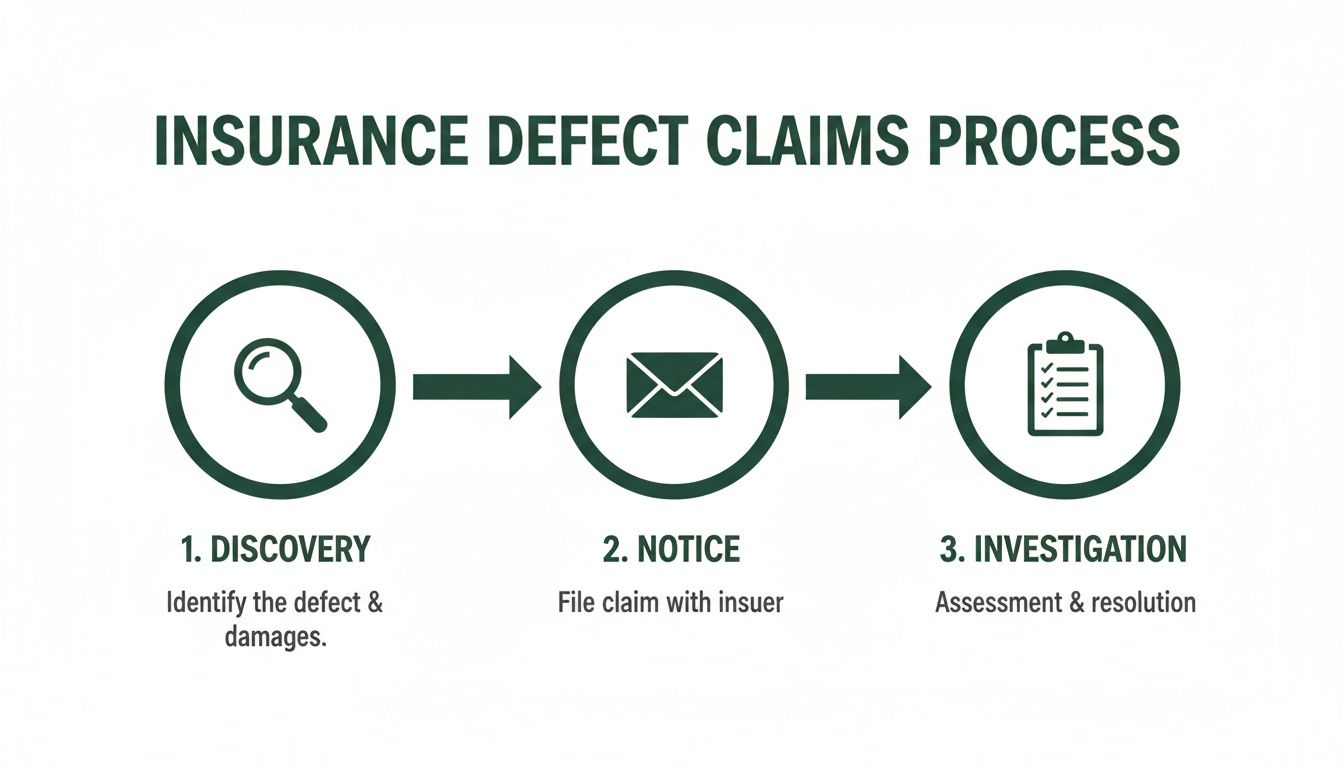
As the infographic shows, the process is a formal one. Discovering an issue, notifying the right people, and kicking off an investigation—each of these steps carries specific legal and insurance weight.
Stage 1: Discovery And Documentation
It all begins the moment someone spots a potential defect. Maybe it's a homeowner who keeps finding water stains on their ceiling or a facility manager who notices unsettling cracks forming in a concrete foundation.
The first thing you do—before a single phone call is made—is document everything. Seriously, everything. This is the single most important action you can take at this stage.
- Photos and Videos: Snap clear, well-lit pictures and videos. Get wide shots to show where the problem is, then get close-ups to capture the details.
- A Written Log: Start a running timeline. Write down the date you first noticed the issue, any changes you see over time, and a note of every conversation you have about it.
- The Paper Trail: Pull together every relevant document you can find. This includes contracts, blueprints, change orders, emails—anything and everything related to the project.
This initial batch of evidence is the bedrock of your claim. Solid documentation shuts down arguments about when the problem started or how bad it really was.
Stage 2: Notifying The Right Parties
With your evidence in hand, it's time to provide formal written notice to the people responsible. This almost always means the general contractor, but depending on the problem, you might also need to include subcontractors, architects, or engineers.
Sending this notice isn't just a professional courtesy; it’s a legal necessity. Most construction contracts include a "notice and opportunity to cure" clause. This gives the contractor the right to come inspect and, if they agree, fix the defect before you can escalate things. Skip this step, and you could seriously harm your chances of recovering any damages later on. For instance, successfully filing an insurance claim for water damage—a frequent result of defects—hinges on following these procedures correctly.
Stage 3: Investigation And Expert Analysis
Once you send that notice, the contractor and their insurance carrier will start their own investigation. You can expect a site visit so they can see the alleged defect for themselves. It's also common for them to bring in their own experts, like an engineer or building consultant, to figure out what went wrong.
This is where you should bring in your own independent expert, too. Getting an unbiased, third-party report does a few critical things: it validates that a defect exists, pinpoints the root cause, and provides a professional estimate for the cost of repairs. This expert analysis can be the key to strengthening your position and getting a fair outcome.
A "battle of the experts" is a classic part of construction defect claims. The credibility and detail in your expert’s report can dramatically shift the balance during negotiations.
Stage 4: The Formal Claim And Negotiation
If the initial notice and investigation don't resolve the problem, things get more formal. The property owner, usually working with an attorney, will submit a formal claim that demands a specific solution—most often, money to cover the cost of repairs.
This officially kicks off a period of negotiation. Lawyers, insurance adjusters, and the parties involved will go back and forth trying to agree on a settlement. Expect offers and counteroffers as everyone works to find a middle ground and stay out of court. For anyone who feels their claim is being ignored, our guide explains in detail how to file a property damage claim.
Stage 5: Mediation, Litigation, Or Arbitration
When direct negotiations stall, the dispute moves into a formal resolution process. There are three main paths this can take:
- Mediation: A neutral third-party mediator steps in to help everyone find a mutually agreeable solution. It's a non-binding process that's usually much cheaper and faster than a lawsuit.
- Arbitration: This is like a private court case. An arbitrator or a panel listens to the evidence and makes a binding decision. It's less formal than a courtroom but the outcome is just as final.
- Litigation: The claim turns into a full-blown lawsuit filed in court. This is the longest, most expensive, and most public option.
The good news is that most construction defect claims get resolved long before they see the inside of a courtroom, typically through a negotiated settlement or mediation. But it's the threat of litigation that keeps everyone at the table and focused on finding a solution.
Building an Airtight Case with Strong Evidence
Winning a construction defect claim isn't about who argues the loudest. It's about who has the best proof. Think of yourself as building a case, piece by piece, where every document, photo, and expert opinion tells a clear story of what went wrong.
Without this hard evidence, even a completely valid claim can fall apart. Your job is to create a rock-solid record that leaves no room for doubt. It's more than just pointing to a crack in a wall; it's about meticulously documenting the entire problem from start to finish.

Your Essential Documentation Checklist
First things first, you need to round up the paper trail. This is the foundation of your claim because it establishes what was promised versus what was delivered.
Your evidence file absolutely must include:
- The Original Contract: This is your North Star. It outlines the scope, timelines, and expected quality standards.
- Blueprints and Specifications: These are the technical plans showing exactly how the project was supposed to be built.
- Change Orders: Any approved changes to the original plan are critical. They show how the project was supposed to evolve, which can be key in pinpointing where things went off track.
- All Written Correspondence: Don't underestimate the power of emails, texts, and formal letters. This communication log shows who knew what and when.
This collection of documents creates the legal backbone for everything that comes next.
Creating a Visual and Chronological Record
Once you have the paperwork organized, it's time to bring the defect to life. In these cases, a picture really is worth a thousand words—and a video can be worth even more.
Keep a detailed photo and video log. Make sure to capture the defect from different angles and distances, and always date your images. This creates a visual timeline that can powerfully show how a seemingly minor issue, like a small water stain, morphed into a major problem like widespread rot and mold.
A well-organized timeline is one of your most powerful tools. It connects specific events—like a heavy rainstorm or a certain phase of construction—to when the defect appeared and got worse, building a clear cause-and-effect narrative.
The Power of an Expert Report
While your photos and documents are vital, the technical opinion of a licensed professional is often what gets a claim over the finish line. An expert report from a qualified engineer, architect, or specialized building consultant provides an unbiased, professional assessment that’s hard to argue with.
Typically, this report will:
- Confirm the Defect: It validates that the issue is a genuine defect, not just normal wear and tear.
- Identify the Cause: The expert will dig into the evidence to pinpoint the root cause—was it sloppy workmanship, a design flaw, or just cheap materials?
- Propose a Solution: Crucially, the report will outline the necessary repairs and provide a credible estimate for the cost to fix it.
This analysis elevates your claim from a complaint to a technically-backed case that insurers and opposing parties have to take seriously. Armed with this level of evidence, you're in a much stronger position. If you still meet resistance, it's important to know how to dispute an insurance claim effectively.
And the stakes are only getting higher. Construction defect claims are driving up dispute values across the globe. North America's average has skyrocketed recently, as post-pandemic chaos—like labor shortages and wild material cost swings—continues to fuel litigation. You can read more about the rising specialty contractor risks on marsh.com.
Proactive Strategies to Prevent Future Defect Claims
The best way to deal with a construction defect claim is to make sure it never happens in the first place. When you shift from a reactive, problem-solving mindset to a proactive one, you’re practicing the ultimate form of risk management. It’s all about building a foundation of quality and clear communication so strong that disputes simply can’t take root.
Of course, no project is ever completely free of risk. But putting a solid prevention framework in place can save contractors and property owners a staggering amount of money, stress, and time down the road. The whole idea is to minimize your liability from day one.
Best Practices for Contractors and Builders
For the folks on the ground doing the building, prevention starts with an ironclad commitment to quality control and total transparency. In the end, a reputation for excellence is your single best defense against future construction defect claims.
Here are a few key strategies that really work:
- Implement a Strict Quality Control Program: This is so much more than a final punch list. It means getting into a rhythm of regular, documented inspections at every critical stage of the build—from the moment the foundation is poured to the day the last window is installed.
- Maintain Meticulous Documentation: Document everything. I mean everything. Daily logs, project photos, every single change order, and all your communications with the client. This builds an undeniable, objective record of the project’s journey and the decisions made along the way.
- Foster Clear and Consistent Communication: Keep your clients in the loop with regular updates. When you openly discuss challenges and solutions as they pop up, you build trust. That trust is what stops small misunderstandings from snowballing into massive disputes.
Smart Steps for Property Owners
Property owners aren't just bystanders here; they play a huge part in preventing defects, too. Protecting your investment means taking a hands-on, informed approach when selecting and overseeing your construction team.
The initial vetting process is a property owner’s most powerful preventative tool. A thoroughly researched contractor and a detailed, unambiguous contract can eliminate the vast majority of potential conflicts before a single nail is hammered.
Here’s how property owners can get ahead of the curve:
- Thoroughly Vet All Contractors: Don't just jump at the lowest bid. Make the calls, check references, look at their past projects, and confirm they are properly licensed and insured for the full scope of your project.
- Demand a Detailed Written Contract: Your contract needs to be crystal clear. It should spell out the exact scope of work, the specific materials to be used, a realistic project schedule, and the payment milestones. Ambiguity is the enemy of a successful project.
- Conduct Periodic Site Inspections: You don't have to be a construction expert, but visiting the site regularly gives you a chance to ask questions and spot potential issues early on. If something doesn't look or feel right, it’s always better to speak up immediately.
When both sides work together and make quality the top priority right from the start, they set the stage for a successful project. More importantly, they dramatically reduce the odds of ever facing a costly and contentious defect claim in the future.
Got Questions About Defect Claims? We’ve Got Answers.
Even when you have a good handle on the basics, the reality of facing a potential construction defect claim brings up a lot of specific, practical questions. Getting straight answers is key to making the right moves and not accidentally giving up your rights.
Let’s tackle three of the most common questions we hear from property owners and contractors.
How Long Do I Have to File a Claim?
This is, without a doubt, the most critical question. The answer comes down to two legal clocks that are always ticking: the statute of limitations and the statute of repose.
Think of the statute of limitations as a stopwatch that starts the moment you discover a defect—or when you reasonably should have discovered it. In most states, you typically have two to four years from that point to file your claim. It’s designed to prevent someone from finding a problem and then sitting on it for a decade before taking action.
The statute of repose, on the other hand, is more like a final, non-negotiable deadline. It sets a hard cutoff for how long a builder or designer can be held responsible after the project is substantially complete, no matter when you find the defect. For example, in California, that cutoff is 10 years.
The statute of repose is the absolute end of the line. If a hidden defect surfaces in year eleven, but the state has a 10-year statute of repose, your chance to file a claim has almost certainly vanished.
Can I Really Sue Over a Minor Issue?
Legally speaking, you can try to sue for just about anything. But in the real world, it’s not practical or likely to succeed for minor cosmetic flaws. The key legal concept here is materiality. Does the defect actually harm the property's value, safety, or your ability to use it as intended?
A single tile that’s slightly crooked? Annoying, yes, but probably not a material defect. Widespread water leaks coming from improperly installed windows? That absolutely is.
It’s also important to remember that most contracts and state laws give the contractor a "right to cure." This means you have to officially notify them of the problem and give them a fair shot to come inspect and fix it before you can run to the courthouse. Skipping this step is a good way to get your case thrown out.
What's the Difference Between Mediation and Litigation?
When you and the other party can't work things out on your own, you’ll hear these two terms a lot. They represent two very different roads to a resolution.
- Mediation: This is a guided negotiation. A neutral third-party mediator sits down with both sides to help them talk through the issues and find a solution they can both live with. It’s confidential, faster, much less expensive, and non-binding—you only agree if you want to.
- Litigation: This is the formal, adversarial process of a lawsuit. You’re in a courtroom, presenting evidence to a judge or jury who will make a final, binding decision. Litigation is public, can drag on for years, and racks up significant legal bills.
The vast majority of construction defect claims never see the inside of a courtroom. Most are settled through direct negotiation or, more often, mediation. Litigation is truly the last resort when all else fails.
Navigating the complexities of construction defect claims requires more than just knowledge—it requires the right protection. At Wexford Insurance Solutions, we provide the expert advocacy and tailored insurance products needed to manage these risks effectively. Let us help you build a solid defense. Explore your coverage options today.
 What Is Subrogation in Insurance Explained in Simple Terms


