

Completed operations coverage is your business's safety net for the work you've already finished. It’s the insurance that steps in to protect you from claims of property damage or bodily injury that happen after you’ve packed up your tools and left the job site. Think of it as protection against ghosts of projects past—mistakes or defects that don't surface until months, or even years, later.
This coverage ensures one faulty project doesn't threaten your entire company long after you've cashed the check.
Understanding Your Lingering Liability

Let's say you're a contractor who just built a beautiful new deck for a client. The final invoice is paid, your crew is gone, and you’re already focused on the next job. For many business owners, this feels like the end of their responsibility. The reality, however, is that your liability doesn't just vanish when the project is done.
What happens if, six months down the road, a railing you installed gives way and injures a guest at the homeowner's party? Or what if a subtle waterproofing mistake leads to slow, hidden rot that causes a structural failure two years later? These are the exact scenarios where completed operations coverage proves its worth.
Completed Operations Versus Ongoing Operations Coverage
A common point of confusion is how this differs from the coverage that protects you while you're still working. Your standard general liability policy covers "ongoing operations"—accidents that happen during the project. Completed operations is for what happens after.
Let's break it down.
| Coverage Type | When It Applies | Example Scenario |
|---|---|---|
| Ongoing Operations | During the construction or service period, before the job is finished and put to its intended use. | A roofer accidentally drops a hammer from the roof, damaging a car parked below. |
| Completed Operations | After the work is finished, handed over to the client, and put to its intended use. | A year after a new roof is installed, faulty flashing leads to a major leak, causing significant water damage inside the house. |
This distinction is crucial. Without specific completed operations coverage, you'd be protected while on-site but dangerously exposed the minute you drive away.
Real-World Stakes and Financial Protection
The financial fallout from a post-completion incident can be absolutely devastating.
Imagine a roofer in Florida finishes a job on a Miami beachfront home. The work looks perfect. But six months later, a hurricane tears through, and the roof fails spectacularly, causing $250,000 in water damage to the home's interior. This is precisely when completed operations coverage, which is typically part of a Commercial General Liability (CGL) policy, kicks in for claims of bodily injury or property damage arising after your work is done.
Your liability for a project doesn’t end when you cash the final check. It extends for years into the future, making completed operations coverage a non-negotiable shield for your business’s long-term health.
Without this protection, that roofing contractor could be facing a lawsuit big enough to sink their entire business. It highlights a critical truth: your company remains exposed to risks from every single job you've ever completed.
How This Coverage Fits Within Your General Liability Policy

It’s easy to get tangled up in insurance terminology, and one of the biggest points of confusion is where "completed operations" coverage actually lives. Many business owners assume it’s a separate, standalone policy they have to go out and buy.
Good news: it’s usually not. This vital protection is almost always built directly into your Commercial General Liability (CGL) policy. A CGL is the bedrock of business insurance, designed as a broad shield against claims from third parties for injuries or property damage.
Think of your CGL as covering the full timeline of your work. It protects you in two distinct phases:
- Ongoing Operations: This is the "during" part of the job. It’s what covers you while your team is on-site and the project is in full swing. If a ladder topples onto a client’s car or a dropped tool injures a passerby, this is the coverage that kicks in.
- Completed Operations: This is the "after" part. This protection activates after you’ve packed up, the project is finished, and the client has signed off. It’s your defense against problems that surface weeks, months, or even years later.
This two-pronged approach ensures you’re covered from the moment a project starts until long after it’s a memory, addressing the complete lifecycle of your liability.
The Two Halves of Post-Project Protection
Dig into your CGL policy, and you’ll find a specific section called the "Products-Completed Operations Hazard." The name itself is a dead giveaway—it’s a dual-purpose shield, covering both the things you make and the work you do.
Let's break that down:
- Products Hazard: This piece covers bodily injury or property damage caused by a product you’ve manufactured, sold, or even just distributed. The critical factor is that the incident happens after the product is out of your hands and in the customer's.
- Completed Operations Hazard: This is the other side of the coin, focused on your services. It covers injury or damage that pops up because of work you performed, but only after that work is totally done and being used as intended.
Grasping this distinction is key. Whether you're building a deck or manufacturing a widget, the risk that a hidden flaw could cause harm down the road is very real.
How It Plays Out in the Real World
Imagine a small manufacturing company in New York that produces playground equipment. Two years after selling a swing set to a park, a structural failure causes it to collapse, injuring two children. The resulting lawsuit seeks $1.2 million. The "products" part of their coverage would respond because the claim is tied to a physical product they sold. This isn't a far-fetched scenario; product liability claims have averaged $178,000 per case in recent years, with a huge chunk tied to finished work in manufacturing and installation.
Now, let's flip to a service-based example. An electrician completely rewires a historic home's kitchen. A year later, a faulty connection in the wall overheats and sparks a major fire. This is a textbook "completed operations" claim. The damage wasn’t caused by a faulty breaker he sold, but by the service he performed.
The Products-Completed Operations Hazard is your defense against these long-tail claims. It’s the policy's way of acknowledging that your responsibility doesn't just vanish when you cash the final check—it follows your work into the future.
These two coverages are designed to work in tandem. They even share their own, separate limit within your CGL policy, often called the "products-completed operations aggregate." Understanding these limits is the next crucial step, and you can learn more about how aggregate limits work in our detailed guide.
For some businesses, completed operations coverage is a nice-to-have. For others, it’s the only thing standing between a past mistake and future ruin.
In certain lines of work, the potential for an error to pop up long after you’ve packed up your tools isn’t just a remote possibility—it's a constant, lingering risk. For these high-stakes professions, operating without this specific protection is like walking a tightrope with no net.
The heart of the issue is what we in the industry call long-tail liability. This is where the consequences of your work don't show up for months, or even years. A project that looks perfect today could trigger a massive lawsuit down the road. This is especially true for any trade where your work becomes a permanent part of a client's property or daily life.
The Highest-Risk Industries
Some professions simply carry a heavier burden of post-completion risk. If your business falls into one of these categories, completed operations coverage isn't just a good idea—it's absolutely critical for staying in business.
Let's break down the professions where this coverage is non-negotiable.
General Contractors: As the project's captain, the GC is at the top of the risk pyramid. You're ultimately on the hook for the entire finished product, including the work of every single subcontractor you hire. Even with the best general contractor estimating software to keep things organized, a structural flaw caused by a sub’s mistake might only surface two years later. When it does, you can bet the lawsuit will be aimed directly at the general contractor.
Electricians: Faulty electrical work is a disaster waiting to happen. A loose connection or an improperly grounded circuit might seem fine at first. But months later, that hidden flaw could overheat and cause a devastating fire, leading to total property loss and, tragically, potential loss of life.
Plumbers and HVAC Technicians: Water and gas lines are buried in walls and floors, which means any failure can be incredibly destructive. A tiny, slow leak from a poorly sealed pipe can go unnoticed for years, causing widespread mold, rot, and structural decay. An incorrectly installed HVAC unit might leak carbon monoxide a year later, creating a life-or-death situation for the occupants.
Roofers: A roof is a building's first line of defense. A small installation error might not be apparent until the first major storm rolls through, which could be a season or two after you’ve cashed the check. The resulting water damage can destroy ceilings, walls, and personal belongings, quickly racking up a massive claim.
For contractors in these fields, every finished job adds another layer to their total risk. A single faulty project from five years ago can easily threaten the business you've worked so hard to build today.
Risk Profile By Industry
To make this crystal clear, here’s a quick look at common claims scenarios across different professions. This table helps illustrate how a completed operations event could play out for your specific trade.
| Industry/Profession | Common Completed Operations Claim Example |
|---|---|
| General Contractor | A deck collapses a year after construction due to improper footing installation, injuring guests. |
| Electrician | A fire starts from an overheated electrical panel 18 months after it was upgraded. |
| Plumber | A slow-leaking pipe behind a wall causes $50,000 in mold and rot damage, discovered two years post-installation. |
| Roofer | The roof installed last year fails during a heavy storm, causing extensive interior water damage. |
| HVAC Technician | An improperly vented furnace leads to a carbon monoxide leak the following winter, causing bodily injury. |
| Masonry Contractor | A brick facade begins to crumble and fall off a building three years after completion, posing a public hazard. |
Seeing these real-world examples makes it obvious: your liability doesn't end when you leave the job site. It follows you.
Real-World Scenarios Unpacked
Abstract risks are one thing, but seeing how these situations play out in real life really drives home the need for coverage.
Imagine an HVAC technician who installs a new furnace in a home during the fall. It runs perfectly all winter. The next year, a tiny, undetected crack in the heat exchanger—caused during the install—widens and starts leaking carbon monoxide. The family suffers from CO poisoning, leading to a major bodily injury lawsuit against the HVAC company. The incident happened over a year after the job was marked complete. This is a textbook completed operations claim.
Or, think about a plumbing contractor hired for a kitchen remodel. Six months after the job is finished, the homeowner finds their brand-new hardwood floors warped from standing water. An expert discovers that a supply line fitting was overtightened during installation, causing a slow, persistent leak. The claim for $50,000 in water damage and floor replacement would fall squarely under the plumber's completed operations coverage. Without it, that plumber is paying out-of-pocket for a mistake made half a year earlier.
These examples show that the most dangerous risks are often the ones you can no longer see or control. You can get a better handle on these issues by reviewing the insurance requirements for independent contractors in our comprehensive guide.
Getting to Know Your Policy Limits and Common Exclusions
Having completed operations coverage is a great first step, but the real protection comes from knowing its boundaries. Let's move past the theory and dig into the practical side of things—the numbers and the fine print that define what your policy will actually do for you when you need it most.
Every policy has a cap on how much it will pay. For completed operations, two key figures work together to create your safety net.
For certain professions, especially in the skilled trades, getting these numbers right is absolutely critical.
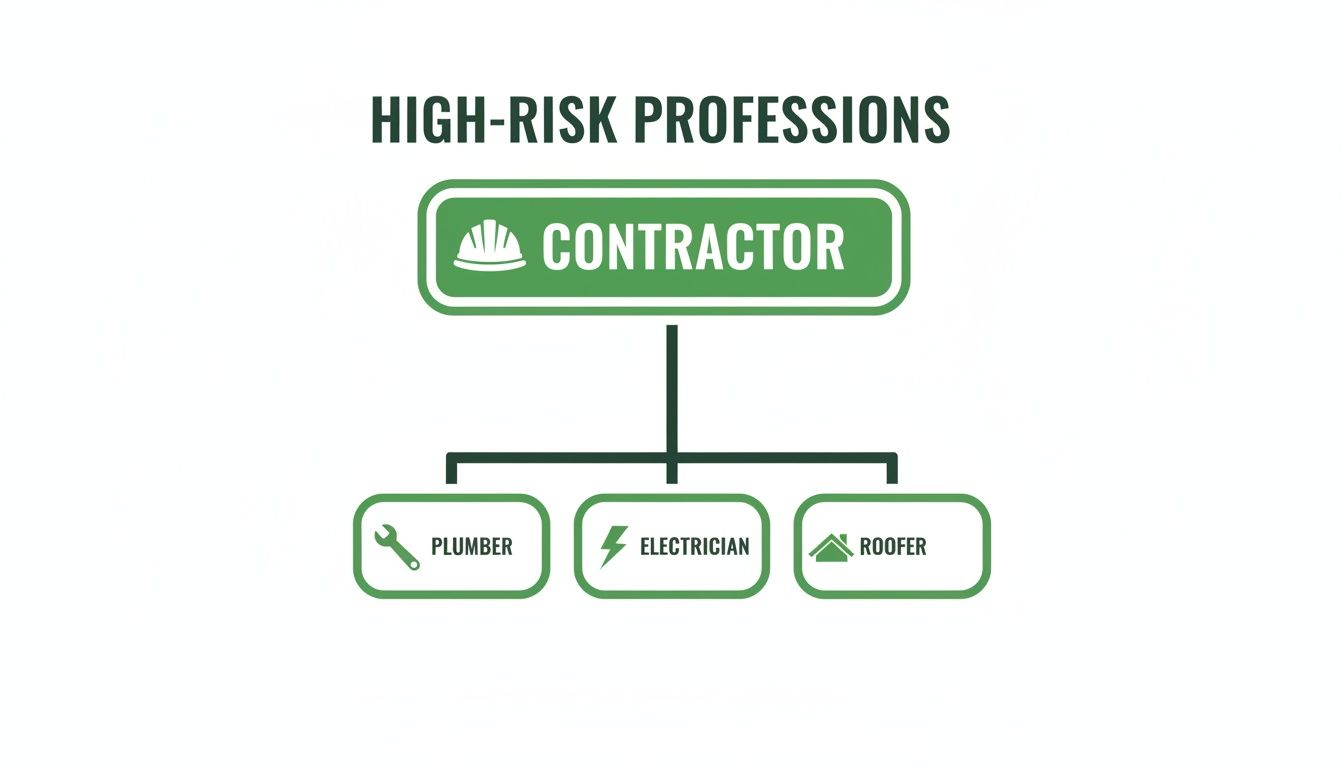
As you can see, general contractors oversee a number of high-exposure trades like plumbing, electrical work, and roofing. Each one carries its own set of risks that can pop up long after the job is done.
Per Occurrence vs. Aggregate Limits
First, you have the "per occurrence" limit. This is the absolute maximum your insurance company will pay out for a single incident. If faulty wiring you installed leads to a fire, this limit is the ceiling for all the damages related to that one fire.
Next is the "products-completed operations aggregate" limit. Think of this as the total pot of money available for all your completed operations claims over the entire one-year policy term. It’s the grand total your policy will pay, no matter how many separate incidents occur.
Here's the bottom line: Your aggregate limit is a hard stop. You might have a high per-occurrence limit, but once the aggregate is used up by one or more claims, your completed operations coverage for the rest of that policy year is gone.
This two-limit structure is standard, but it really underscores why you need to have a realistic grasp of your potential exposure, especially if you're taking on larger, more complex projects.
Shining a Light on Critical Exclusions
Just as important as knowing what's covered is knowing what's not. Exclusions are specific situations your policy won't pay for. They aren’t buried in the fine print to trick you; they are a fundamental part of the insurance contract.
One of the most important ones to understand is the "your work" exclusion.
- What it means: Your policy won't pay for you to redo or replace your own faulty work.
- What it does cover: It is designed to pay for the damage your faulty work causes to other property or people.
Let’s make this real. A plumber installs a new sink, but a bad connection springs a leak, completely ruining the client’s brand-new hardwood floors. Completed operations coverage would step in to pay for the $10,000 floors (the resulting damage), but it would not cover the $50 pipe fitting and the time it takes to fix the original mistake (your work). Getting this distinction is crucial for managing expectations, particularly when dealing with large construction defect claims.
On bigger jobs, the stakes get much higher. Imagine a general contractor completes a $5 million office building. A year and a half later, a poorly installed HVAC system causes a major mold outbreak, leading to $800,000 in cleanup and legal battles. This is precisely what completed operations coverage is for. On major projects, this coverage is often extended for 36-120 months post-completion to align with state statutes of repose.
Securing The Right Coverage For Your Business
Trying to navigate business insurance can feel like you’ve been handed a map written in a foreign language. With so many policies and so much jargon, it’s tough to know if you're making the right choice. The real goal isn't just to check a box and buy a policy; it's to build a shield that genuinely protects everything you've worked for.
This isn’t about chasing the lowest price tag. A cheap policy with a critical gap can end up costing you everything in the long run. Real peace of mind comes from a methodical approach—understanding your unique risks and then carefully crafting a plan to cover them.
Your Blueprint For Effective Protection
Finding the right coverage always starts with a deep dive into how your business actually works. There's no such thing as a one-size-fits-all policy that truly fits anyone. The first step is to get honest about your specific exposures, from the day-to-day services you offer to the fine print in the contracts you sign.
We follow a proven process to make sure our clients are properly protected. It breaks down into three key stages:
- Comprehensive Risk Analysis: We start by getting to know your business inside and out. We look for potential liabilities you might not even see, especially those tricky completed operations risks that can pop up years after a job is done.
- Existing Policy Review: Next, we put any insurance you currently have under a microscope. We're hunting for dangerous gaps, unnecessary overlaps, or hidden exclusions that could leave you exposed right when you need help the most.
- Strategic Carrier Sourcing: Once we have a crystal-clear picture of your needs, we go to work. We source competitive options from our network of A-rated carriers and lay them out for you, explaining the pros and cons of each in plain English.
This structured approach ensures the policy you end up with is a solid fit, built specifically to protect the business you’ve poured your heart into.
Partnering With A Trusted Advisor
Let’s be honest—insurance policies are dense and confusing. They're filled with legal jargon and fine print that can make it nearly impossible to figure out what you’re actually paying for. This is precisely where having an expert advisor in your corner makes all the difference. A great agent does more than sell you a policy; they act as your translator and your advocate.
They should take the time to break down complex terms, so you understand what your policy covers and, just as crucially, what it doesn’t. For full protection, it's vital to research not only general policies but also specialized needs. For example, a contractor might need to understand the specifics of finding the essential insurance for a window cleaning business and how different coverages apply to that trade.
The right insurance partner is committed to protecting your hard-earned success. They provide clarity in moments of confusion and act as your first line of defense when a claim arises, helping you manage the process from start to finish.
Ultimately, securing the right coverage is about finding a true partner dedicated to your long-term security. It’s an investment in peace of mind, knowing that whatever happens, you have a solid plan and an expert team ready to go to bat for you.
Your Questions About Completed Operations Coverage Answered
After digging into the details of completed operations coverage, it's completely normal to have a few lingering questions. Let's tackle some of the most common ones we hear from business owners every day. Think of this as your quick-reference guide to help you make smart decisions.
How Long Does Completed Operations Coverage Last?
This is probably the most important question of all, and the answer gets right to the heart of how these policies work. Your coverage isn’t like a lifetime warranty on your work; it's only active for a specific policy period.
Most Commercial General Liability (CGL) policies, which include your completed operations coverage, are written on an "occurrence basis." Getting a handle on this concept is absolutely critical.
An occurrence basis policy is triggered by when the damage or injury happens, not when you did the work. The policy in force at the moment of the incident is the one that has to respond.
Let's say you finished a big project in 2022, but a mistake you made causes someone to get hurt in 2024. It’s the policy you have in 2024 that will be called on to handle that claim. This is exactly why maintaining continuous coverage is non-negotiable for contractors and service professionals. Any gap in your insurance history is a massive blind spot you can’t afford.
The other piece of the puzzle is something called the statute of repose.
This is a law, which varies by state, that puts a hard deadline on how long someone has to sue you for issues related to faulty construction or design. It’s different from a statute of limitations because its clock starts ticking the moment the project is substantially finished, not when an injury is discovered. These deadlines can be anywhere from 4 to 10 years, and sometimes even longer.
This legal reality means you need to think long-term. You have to keep your completed operations coverage in place for years after a job is done—at least until that statute of repose runs out. Canceling your policy right after a project wraps up could leave you completely exposed to a huge lawsuit years down the road, with no insurance safety net to catch you.
Does It Cover the Cost of Redoing My Faulty Work?
This is a common point of confusion, but the answer is a straightforward no. Completed operations coverage isn't a workmanship warranty.
Your policy is there to pay for the damage your mistake causes to other people or their property. It's not designed to pay you to fix your own flawed work. This is handled by a standard clause in most policies called the "your work" exclusion.
Here's an easy way to think about it:
- Covered: The consequential damage your mistake causes.
- Not Covered: The cost to fix the mistake itself.
Let’s look at a real-world example. A plumber installs a new sink during a kitchen remodel. Six months later, a bad connection fails and causes a massive leak. The water ruins the homeowner's brand-new cabinets, expensive hardwood floors, and the drywall, leading to $50,000 in damage.
- The completed operations coverage would pay the $50,000 to replace the floors, cabinets, and drywall.
- The policy would not pay for the plumber's time and materials to go back and fix the original faulty sink connection.
Understanding this difference is key to having the right expectations for your coverage. It's a liability shield, not a quality-control program for your business.
What Happens If a Claim Is Filed After My Policy Expires?
This question brings us right back to the importance of that "occurrence basis" policy structure. It’s a common worry—what if you’ve switched insurance carriers or even retired by the time a claim is filed?
Thankfully, an occurrence policy has you covered. The critical date isn't when the lawsuit is filed; it’s when the damage or injury actually happened.
As long as the incident occurred while your policy was active, the claim should be covered, no matter how much later it’s reported. To really nail this down, it helps to see the difference between policy types. You can get a much deeper look into the differences between claims-made vs. occurrence coverage in our detailed guide.
Let's walk through a simple timeline:
- Year 1: You rewire an office building. You’re covered by Policy A.
- Year 2: A hidden flaw in your wiring shorts out, causing a small fire that damages the company's server room. This happens while Policy A is still active.
- Year 3: You switch to a new insurance carrier, and you're now covered by Policy B.
- Year 5: The business owner finally traces the server damage back to your electrical work and files a lawsuit against you.
Even though the claim comes in during Year 5 when you're with a new insurer, it would be Policy A—the one you had when the fire actually happened—that steps in to handle the claim. This is a perfect example of why keeping good records of all your past insurance policies is such a smart business practice.
Navigating the complexities of completed operations and general liability insurance can be challenging, but you don't have to do it alone. The expert team at Wexford Insurance Solutions is here to provide clarity and build a coverage plan that protects your business for the long haul. Contact us today for a comprehensive review of your insurance needs.
 Trade Credit Insurance Your Guide to Safer Business GrowthA Guide to Commercial Auto Insurance Coverage


