

Before you can figure out how much it would cost to rebuild your home, you have to get one thing straight: replacement cost is not the same as market value. This is the single most important concept to grasp, and it's where a lot of homeowners go wrong. What you could sell your house for today has almost nothing to do with the cost of rebuilding it from scratch after a disaster.
Understanding this difference is the foundation for getting your insurance coverage right.
Why Your Zillow Estimate Doesn't Matter for Insurance
It’s a common mistake. Homeowners look at their property’s Zillow estimate or a recent appraisal and assume that’s the number they need for their insurance policy. But that’s a dangerous and often expensive assumption that could leave you massively underinsured.
The two figures are apples and oranges—they measure completely different things and are driven by totally separate economic forces.
Think of it this way: your home's market value is what a willing buyer would pay for the whole package. It's the structure, the land it sits on, the neighborhood, the quality of the schools, and how close you are to a good coffee shop. It's a real estate number, plain and simple, dictated by supply and demand.
On the other hand, replacement cost is purely a construction number. It’s the current price of lumber, concrete, roofing, and drywall. It's the cost of paying skilled carpenters, electricians, and plumbers to put it all back together exactly as it was. It completely ignores what your land is worth or how desirable your neighborhood has become.
To put it in perspective, here's a quick breakdown of how these two values are calculated and what they really represent.
Replacement Cost vs Market Value Key Differences
| Factor | Replacement Cost | Market Value |
|---|---|---|
| Primary Goal | To calculate the cost to rebuild a structure | To determine the price a property would sell for |
| What's Included | Materials, labor, permits, contractor overhead | Land, structure, location, amenities, market trends |
| Influenced By | Construction industry costs, material supply chains | Real estate market, interest rates, neighborhood appeal |
| Land Value | Excluded | A major component of the final price |
The bottom line is that these are two distinct figures used for two different purposes. One is for buying and selling property; the other is for making you whole after a disaster.
What Actually Drives Each Value
The confusion between these two values is what leads to big, unexpected gaps in insurance coverage. Let's dig a little deeper into what moves the needle for each one:
-
Factors That Drive Market Value:
- The value of the land itself, which can be huge in desirable areas.
- Neighborhood quality, school districts, and crime rates.
- Curb appeal, views, and professional landscaping.
- The current state of the local real estate market—is it a buyer's or seller's market?
-
Factors That Drive Replacement Cost:
- Up-to-the-minute prices for building materials like lumber, copper, and shingles.
- Local labor rates for skilled tradespeople.
- The expense of demolishing and clearing away debris after a fire or storm.
- Custom features, architectural complexity, and quality of finishes.
For example, a charming 1,500-square-foot bungalow on a tiny lot in a hot urban neighborhood might sell for $750,000. But the actual cost to rebuild that exact same house could be just $400,000. If you insure it for its market value, you're paying for way more coverage than you could ever use. The reverse can also be true, especially in rural areas where land is cheap but construction costs are high.
Real-World Scenarios and Why This Matters
This isn’t just a technicality—it has massive financial implications. Insurers use sophisticated software to get this number right, often estimating reconstruction costs to within 5% accuracy. Getting it wrong yourself can be a disaster after the disaster.
This is also where other policy terms come into play. It's essential to understand the difference between replacement cost and what is actual cash value, because an ACV policy will subtract depreciation, leaving you with even less money to rebuild.
Your home insurance policy is designed to rebuild your house, not buy back your property. The land will still be there after a fire, but the structure won't be. Replacement cost coverage is what gives you the funds to make that structure whole again.
Calculating Your Base Cost with the Square Footage Method
One of the most practical ways to get a handle on your home's replacement cost is the square footage method. It's a foundational calculation that gives you a solid, reliable baseline before you start digging into the unique details of your property. At its heart, the logic is pretty straightforward.
The basic formula is simple: you take your home’s livable square footage and multiply it by the average local construction cost per square foot. This gives you a starting number—a realistic estimate of what it would cost to build a similar structure from the ground up in your area today.
This visual helps clarify the key difference between market value and replacement cost, which is exactly what we're focused on here.
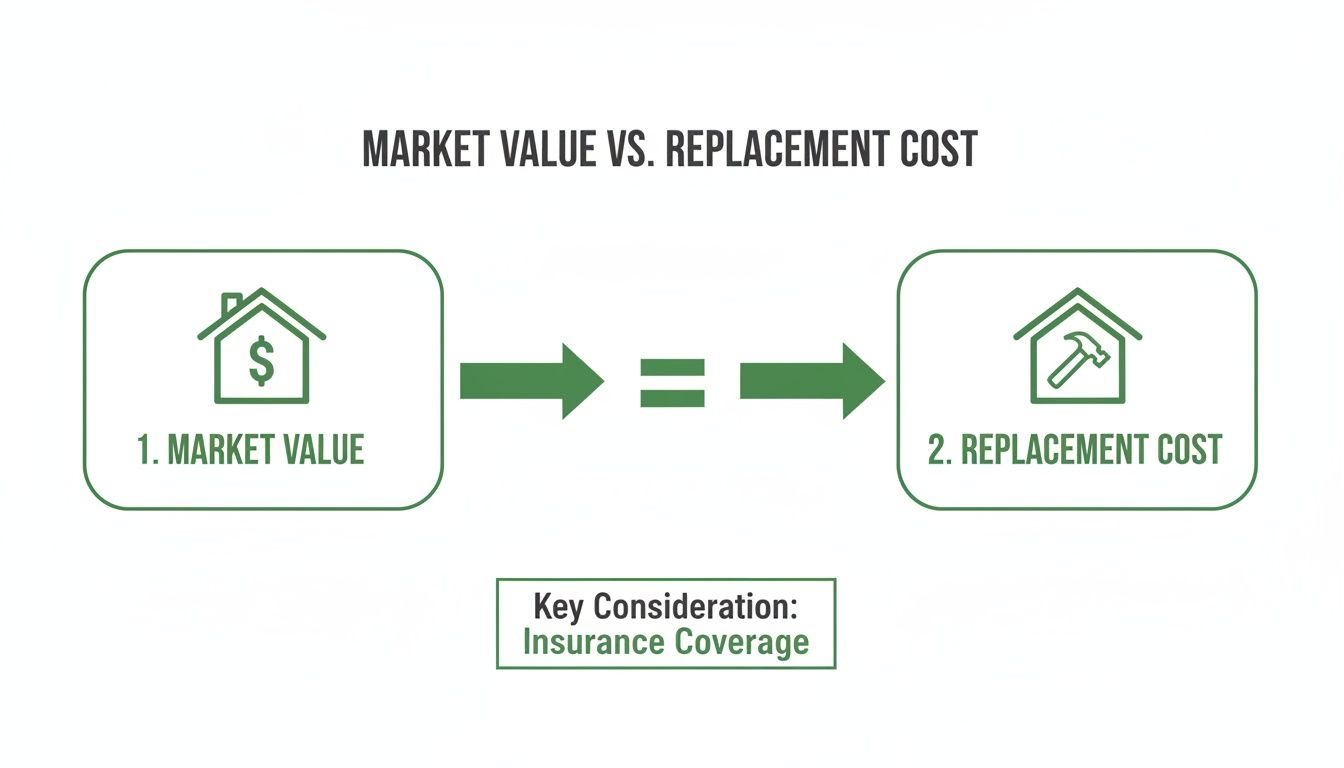
As you can see, the market price is about what your property could sell for, while replacement cost is purely about the money needed to rebuild the house itself.
Finding Your Key Numbers
To get rolling, you need two critical pieces of information: your home's accurate square footage and the current building cost in your specific region. Nailing these numbers is the most important part of getting a reliable estimate.
First up is your home's livable square footage. This isn't just the total footprint; it only includes finished areas that are heated and cooled. It's crucial to exclude spaces like:
- Unfinished basements or attics
- Attached or detached garages
- Screened-in porches or open patios
- Exterior storage sheds
You can usually find this figure on your original property appraisal, county tax records, or the blueprints if you have them. If you’re really not sure, you might have to break out the tape measure and calculate it room by room.
Next, you'll need the average construction cost per square foot for your zip code. This number can vary wildly depending on local labor rates, material availability, and even regional building codes. A great resource for this is your local builders' association, as they often publish this kind of data. You can also get a good feel for it by talking with local real estate agents or residential contractors. Understanding how to calculate cost per square foot is the fundamental first step here.
Putting the Formula into Action
Once you've got both figures, the math is simple multiplication. For example, if contractors in your area are charging an average of $150 per square foot and your home is 2,000 square feet, your baseline replacement cost is $300,000.
Let's walk through a more detailed scenario to see how it works in the real world.
Example Scenario
- Home Size: A 2,200 square foot home (livable space).
- Local Cost: The average building cost in your suburban town is $185 per square foot.
- Calculation: 2,200 sq. ft. x $185/sq. ft. = $407,000.
This $407,000 becomes your base replacement cost. Think of it as the starting point for rebuilding a standard home of that size in your neighborhood.
Expert Tip: The square footage method gives you a strong initial estimate, but remember, it’s just a baseline. It doesn't yet account for the specific quality, unique features, or architectural style of your home—and that's where the real cost can hide.
Adjusting for Quality and Finishes
Now it's time to refine that base number. After all, not all 2,200-square-foot homes are built the same. The quality of your finishes and construction materials can make a huge difference in the final replacement cost.
Think about what makes your house your house. Does it have a chef’s kitchen with granite countertops and custom cabinets? Solid hardwood floors instead of standard laminate? These premium features cost a whole lot more to replace than builder-grade materials.
To account for this, you'll need to adjust your base calculation. Here’s a practical way to approach it:
- Standard Grade: If your home has builder-grade finishes (laminate counters, basic carpet, standard fixtures), your base calculation is probably pretty close.
- Mid-Grade: For homes with some nice upgrades like stone countertops, better flooring, or higher-quality windows, you should probably add 10-20% to your base cost.
- Custom or High-End: If your home is fully custom with luxury finishes, complex architecture, or premium materials, you may need to increase the base cost by 30% or even more.
Another critical factor to consider is building code compliance. If you have an older home, rebuilding it today would mean bringing everything up to current standards, which can add significant and often surprising costs. For a deeper dive, check out our guide on Ordinance or Law Coverage, which is an insurance endorsement designed to handle these exact situations.
Creating a Detailed Inventory of Your Home's Features
An accurate replacement cost calculation is only as good as the data you feed it. While starting with square footage gives you a ballpark figure, the real cost to rebuild is hidden in the details—the specific materials, unique systems, and custom finishes that make your house a home.
Think of it like creating a "spec sheet" for your property. This detailed inventory is your single most important tool for moving from a rough guess to a number you can actually rely on. It takes a bit of detective work, but it’s absolutely essential for getting your insurance coverage right.

Starting from the Ground Up
Let's begin with your home's core structure. These big-ticket items have a huge impact on reconstruction costs, so getting them right is key.
Start at the very bottom: the foundation. Is your home built on a concrete slab? Or do you have a crawlspace or a full basement? A finished basement, for example, adds a significant amount to the rebuild cost compared to a simple slab.
Now, let's look at the exterior. You'll want to jot down the following:
- Siding: What’s on the outside? Is it brick, vinyl, stucco, stone veneer, or wood? Each one comes with a very different price tag for materials and the labor to install it.
- Roofing: Look up. Do you have standard asphalt shingles, or the more durable architectural kind? Maybe it's metal, tile, or even slate. The cost gap between basic asphalt shingles ($5-$8 per sq. ft.) and slate ($15-$30+ per sq. ft.) is massive.
- Windows and Doors: Are they standard vinyl windows, or did the builder use high-end wood or composite frames? Don't forget to note any custom doors, skylights, or bay windows.
Documenting Interior Systems and Finishes
Once you've cataloged the shell of your home, it's time to move inside. The quality of your interior is what often separates a "builder-grade" house from a "custom" one, and this is where many homeowners accidentally underestimate their true rebuilding costs.
Your home's mechanical systems are a major cost center. The HVAC (Heating, Ventilation, and Air Conditioning) system alone can run anywhere from $5,000 to $20,000 to replace, depending on its complexity. Note the specifics of your heating, plumbing, and electrical systems—things like a tankless water heater or an upgraded electrical panel all add to the total.
Beyond the systems, the finishes define your living space. Go room by room and make a list.
- Kitchen: Are the countertops laminate, granite, or quartz? Are the cabinets stock from a big-box store or custom-built? Note the quality of your appliances, too.
- Bathrooms: Document the tile work (is it standard ceramic or pricey marble?), the quality of the fixtures, and any special features like a jetted tub or a steam shower.
- Flooring: What's under your feet? Wall-to-wall carpet, laminate, engineered hardwood, or solid hardwood? The cost difference per square foot can be pretty substantial.
This detailed inventory of your home's structure and finishes is critical for your dwelling coverage. For everything inside, like furniture and electronics, it’s also wise to understand what is personal property coverage and how that works alongside your main policy.
Where to Find the Information
The good news is you don't have to guess on all these details. Most of this information is available if you know where to look.
To help you get organized, I’ve put together a checklist you can use to gather all the necessary data.
Home Features Data Collection Checklist
| Home Component | Details to Record | Where to Find Information |
|---|---|---|
| Foundation | Type (slab, crawlspace, full/partial basement), finished or unfinished | Original building plans, pre-purchase inspection report |
| Exterior Walls | Siding material (brick, vinyl, stucco, stone, wood) | Visual inspection, original real estate listing |
| Roof | Material (asphalt shingle, architectural, metal, tile, slate), age | Purchase documents, roofing contractor receipts |
| Windows & Doors | Type (vinyl, wood, composite), energy efficiency, custom features | Manufacturer labels on windows, closing documents |
| HVAC System | Type (central air, heat pump, furnace), age, size (tonnage/BTUs) | Unit labels, HVAC service records, owner's manual |
| Plumbing | Pipe material (copper, PEX, PVC), special features (tankless water heater) | Inspection report, plumber invoices |
| Electrical | Panel amperage (e.g., 100A, 200A), any major upgrades | Electrical panel label, electrician invoices |
| Kitchen | Countertops, cabinet type (stock vs. custom), appliance quality | Visual inspection, receipts for any renovations |
| Bathrooms | Tile material, fixture quality, special features (jetted tub, steam shower) | Visual inspection, renovation records |
| Flooring | Type by room (hardwood, carpet, laminate, tile), quality | Real estate listing, receipts from installation |
| Special Features | Fireplaces, built-in shelving, decks/patios, attached garage size | Original building plans, visual walk-through |
The original building plans or blueprints are the gold standard, giving you exact specifications. But don't overlook your property's closing documents or the original real estate listing—they often contain great descriptions of key features. Your local county or municipal records office is another good source for permits and property cards.
And if you’re ever unsure about a material, don't be afraid to consult a local contractor for their opinion. Snapping photos and videos as you go is also a fantastic way to create a visual record for your insurer.
Getting an Accurate Number: Calculators vs. Professional Appraisals
Once you’ve inventoried your home's key features, it's time to turn that raw data into a real number. This is where the rubber meets the road, moving from simply listing what you have to estimating what it would all cost to rebuild. Thankfully, you don't have to start from scratch. There are plenty of tools out there, from quick online calculators to the sophisticated software insurance pros rely on.
But it's crucial to know what you're working with—each tool has its place, and its limitations.
The Role of Online Replacement Cost Calculators
Free online replacement cost calculators are a fantastic first stop. They give you a quick, ballpark figure to get your bearings. You typically just plug in your home's square footage, zip code, and a few basic details, and it spits out an estimate.
But—and this is a big but—they have their limits. These tools often work with broad regional averages, which means they can't possibly account for the specific details that make your home unique.
- Pros: They are fast, free, and give you an immediate baseline.
- Cons: They often miss hyper-local cost differences, can’t tell the difference between builder-grade and high-end finishes, and don’t factor in recent changes to local building codes.
Think of an online calculator as a rough draft, not the final report. For more complex properties, like a commercial building, you'll need something more robust, like a dedicated commercial property insurance calculator, to get closer to the mark.
Insurers use much more powerful platforms, like 360Value, to generate precise estimates. Here's a glimpse of what that looks like:
This kind of software digs deep, analyzing specific property characteristics against up-to-the-minute local cost data to create a truly detailed reconstruction report. It’s worlds away from the free online tools.
The Gold Standard: A Professional Appraisal
For the most accurate, reliable number, nothing beats a professional appraisal that is specifically focused on replacement cost. This is the undisputed gold standard. A standard appraisal estimates market value for a sale, but a replacement cost appraisal is built for one purpose: getting your insurance coverage right.
An appraiser will conduct an on-site inspection, meticulously documenting all the features you’ve already listed and probably many you never even thought of. They measure every room, identify the specific materials used, and assess the quality of the construction with a trained, expert eye.
A professional appraisal delivers an impartial, data-driven valuation that holds up under pressure. It’s a smart investment in your financial security, ensuring you aren't just guessing when it comes to protecting your home.
This detailed, in-person assessment is what makes a professional appraisal so much more reliable than any DIY calculation. For $300 to $500, these experts give you a number you can count on. They factor in local building codes and ordinances—which can easily inflate rebuilding costs by 10-20% after a disaster—and other nuances that online tools completely miss.
Why an Appraiser's Insight Is Worth Every Penny
So, is an appraisal always necessary? Not always, but for certain homes, it’s a must. If your property fits any of these descriptions, I’d strongly recommend bringing in a professional:
- Custom-Built Homes: Unique architectural designs, high-end materials, and non-standard features are things a generic calculator just can't value correctly.
- Historic or Older Homes: Recreating historic craftsmanship or bringing an old home up to modern code requires specialized labor and materials. An appraiser knows how to price that.
- Homes in High-Cost or High-Risk Areas: In places with expensive labor or frequent natural disasters, local costs can swing wildly. An appraiser will have the most current data on hand.
Ultimately, an appraisal takes the guesswork out of the equation. For a complete picture of the finances involved, resources like this guide to the true cost of building your own home can be incredibly helpful. That small upfront cost for an appraisal buys you invaluable peace of mind, knowing your insurance coverage is built on a solid, expert-verified foundation. It’s the best way to protect yourself from being dangerously underinsured when you need that coverage the most.
Making Your Calculation Count for Your Insurance Policy

This is where the rubber meets the road. All that effort you put into measuring, researching, and inventorying your home is about to pay off in the form of real-world financial protection. The number you’ve landed on for your home’s replacement cost isn't just an exercise—it’s the foundation of your homeowners insurance policy.
This figure directly sets the limit for your dwelling coverage, which you'll typically see listed as Coverage A on your policy declarations page. It represents the maximum amount your insurer will pay to rebuild the physical structure of your home after a total loss. Getting this number right is, without a doubt, the single most important step in making sure you can actually recover after a disaster.
The 80% Rule and the High Cost of Being Underinsured
Most insurance carriers operate on what’s known as the 80% rule. Think of it as a coinsurance clause built into your policy. In plain English, it means you’re required to insure your home for at least 80% of its full replacement value. If you don't, you could face a serious penalty on a claim, even for partial damage.
Let's see how this plays out. Say your home’s true replacement cost is $500,000, but you’ve only insured it for $350,000, which is just 70% of its value. If a kitchen fire causes $50,000 in damages, you might assume you’re covered. But because you didn't meet the 80% threshold, your insurer could apply a penalty and pay out far less, leaving you holding the bag for thousands of dollars.
It’s crucial to understand the finer points of how these policies work. For a more detailed breakdown, it's worth reading up on what is replacement cost coverage to see how it’s designed to make you whole again.
Being underinsured is one of the most common—and devastating—mistakes a homeowner can make. The 80% rule isn’t just a friendly guideline; it’s a contractual term that can drastically slash your claim payout if ignored.
Guarding Against Post-Disaster Price Spikes
Your replacement cost calculation is a snapshot in time. But what happens if a widespread disaster like a hurricane or wildfire tears through your region? The demand for building materials and skilled labor goes through the roof, and so do the costs.
This is called demand surge, and it can easily inflate rebuilding costs by 20-30% almost overnight. Suddenly, your carefully calculated estimate might not be enough to get the job done. This is exactly why a couple of key policy add-ons are so important.
When you talk to your agent, make sure to ask about these endorsements:
- Extended Replacement Cost: This is a popular and valuable option that adds a safety buffer, usually 25% to 50%, on top of your dwelling limit. If your home is insured for $400,000 with 25% extended coverage, you’d actually have up to $500,000 available for a rebuild.
- Guaranteed Replacement Cost: This is the gold standard of protection. It agrees to pay the full cost to rebuild your home to its previous state, no matter what your policy limit is. While it's more expensive and not every company offers it, this endorsement provides complete peace of mind.
These riders act as a critical financial backstop, protecting you from the volatile economic fallout that often follows a community-wide disaster.
Your Next Step: An Informed Conversation with Your Agent
Now that you’re armed with a detailed inventory and a solid replacement cost estimate, you’re ready to have a truly productive conversation with your insurance agent. You can confidently walk through your policy and make sure your dwelling coverage is where it needs to be.
This is about more than just buying insurance—it’s about buying the right insurance. Your own research empowers you to ask smart, specific questions and make informed choices about add-ons like extended replacement cost.
The goal here is to secure a policy that doesn't just check a box, but truly protects your biggest asset. The work you’ve put into figuring out how to calculate home replacement cost transforms you from a passive buyer into an active partner in your own financial security. When you meet with a professional, like an agent at Wexford Insurance Solutions, you'll be prepared to build a policy that lets you sleep soundly at night.
Answering Your Top Questions on Home Replacement Cost
Even with a solid calculator, a few common questions always seem to pop up when homeowners are trying to nail down their replacement cost. Getting these details right is the difference between a good estimate and one that truly protects you. Let’s walk through some of the things that trip people up.
Does the Age of My Home Matter?
It absolutely does, but maybe not in the way you'd expect. The age of your home can dramatically increase the cost to rebuild it for a couple of key reasons.
First, older homes were often built with materials and techniques that are now considered specialty work. Think about things like true plaster walls, detailed custom millwork, or vintage hardwood floors. Replicating that kind of craftsmanship today costs a lot more than using modern drywall and standard trim.
Second, and this is a big one, building codes evolve. If your 50-year-old home were to burn down, you can't just rebuild it as it was. It has to be brought up to all of today's codes for electrical, plumbing, structural integrity, and energy efficiency. These mandatory upgrades can add a surprising amount to the final rebuilding tab.
What About My Detached Garage and Shed?
This is a detail that often gets overlooked. Your main homeowner's policy, known as Coverage A, is for your house itself. Any other structures on your property that aren't attached to the house—like a detached garage, a workshop, or even a fancy shed—fall under a different part of your policy. This is usually called Coverage B – Other Structures.
Most policies automatically set your Coverage B limit at 10% of your main dwelling coverage. So, if your home is insured for $400,000, you’d typically have $40,000 available for all your other structures combined. If you have a custom-built workshop that would cost $70,000 to replace, that standard 10% just isn't going to cut it. You'll need to talk to your agent about increasing that specific coverage.
Key Takeaway: Don't assume your detached buildings are automatically covered for their full value. Check your policy's "Other Structures" limit and make sure it’s enough to rebuild everything you have.
Should I Re-Calculate My Replacement Cost Every Year?
Yes, without a doubt. Think of your replacement cost as a moving target, not a number you can set once and forget. The cost of lumber, labor, and materials can change dramatically from one year to the next thanks to inflation and supply chain issues.
A quick annual review is one of the smartest things you can do as a homeowner. When your policy renewal comes around, take a few minutes to re-evaluate the cost to rebuild. This simple check-in ensures your coverage actually keeps up with the real-world costs in your area, so you're never caught underinsured.
It's these kinds of nuances that make a huge difference in having the right protection. If you're ready to get a professional valuation and ensure your policy is built to truly protect your home, the team at Wexford Insurance Solutions is here to help. Contact us today for a comprehensive review and get the peace of mind you deserve.
 Business Owner Policy vs General Liability Comparison GuideWhat Is Experience Modification Rate and How Does It Affect Your Costs?


