

It really boils down to one simple distinction: General liability insurance handles claims of physical harm, like someone getting hurt or property getting damaged. Professional liability insurance, on the other hand, deals with claims of financial loss that happen because of your expert services or advice.
The easiest way to remember it? General liability is your "slip-and-fall" shield, and professional liability is your "bad advice" shield.
Unpacking The Core Difference in Business Insurance
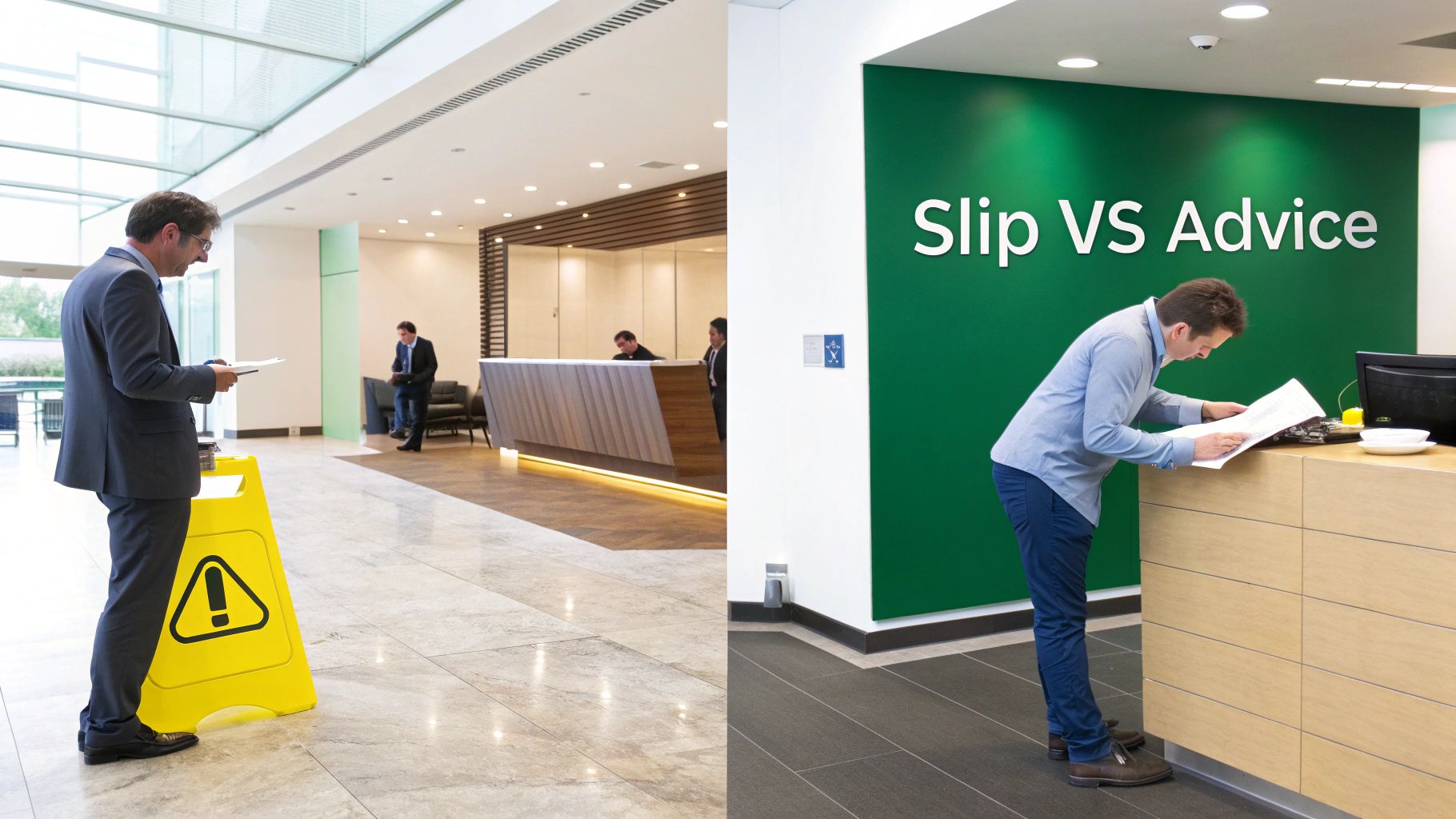
Getting a handle on the difference between professional liability and general liability is one of the first things every business owner needs to do. These two policies are built to protect you from completely different types of risk, and mixing them up can leave your business wide open to a lawsuit you thought you were covered for. They aren't interchangeable; think of them as two critical parts of a complete safety net for your operations.
General liability is all about the physical, tangible world. It kicks in when your business operations, your office space, or even your products cause bodily injury to someone or damage their property. This is the policy that responds when a client slips on a freshly mopped floor in your entryway or when one of your team members accidentally knocks over and breaks a client’s server during an on-site visit.
Professional liability, which you'll often hear called Errors & Omissions (E&O) insurance, is designed to cover intangible harm. It protects your business from the financial fallout when your professional advice or services allegedly cause a client to lose money. This could be due to a mistake, a perceived oversight, or an accusation of negligence.
A Tale Of Two Risks
Let’s say you run a small consulting firm. A client could trip over a power cord in your conference room, leading to a nasty fall and a potential lawsuit. That's a general liability risk. Separately, a piece of strategic advice you gave that client could lead to a disastrous product launch, causing them to lose millions. That's a professional liability risk.
This is the reality of running a business—you face both kinds of threats. You can find more examples of this crucial distinction from the team at Huneycutt Group.
Key Takeaway: General liability covers what your business does (its physical actions and presence), while professional liability covers what your business knows or says (its expertise and advice).
Without the right coverage, a simple accident could bury you in medical bills and legal defense costs. Likewise, a single unhappy client could sue you for financial damages stemming from the service you provided, forcing you to defend your work even if you feel you did everything right.
Quick Look: Professional Liability vs. General Liability
To make it even clearer, here's a simple side-by-side look at what each policy is built to handle.
| Coverage Aspect | General Liability (CGL) | Professional Liability (E&O) |
|---|---|---|
| Primary Focus | Bodily injury & property damage from business operations. | Financial loss due to professional errors or negligence. |
| Type of Risk | Physical risks and tangible harm. | Intangible risks from services, advice, or expertise. |
| Typical Claim | A client slips and falls at your office. | Your advice causes a client to lose money. |
| Also Known As | Commercial General Liability (CGL) | Errors & Omissions (E&O) Insurance |
This table neatly sums it up: one policy is for physical mishaps, the other is for professional mistakes. Understanding this is the first step to building a truly resilient business.
Breaking Down General Liability Insurance Coverage

Think of Commercial General Liability (CGL) as the bedrock insurance policy for nearly any business. While professional liability focuses on the financial fallout from your services, CGL handles the real-world, physical risks you face every day. It's your first line of defense when your business operations cause harm to someone else or their property.
At its core, general liability is designed to protect your business from claims made by third parties—anyone who isn't an employee. It's a must-have policy that addresses the common, tangible mishaps that can happen anytime, whether in your office, at a client's site, or even through your advertising.
Bodily Injury and Property Damage
This is the part of general liability that most people think of first. It’s all about accidents that cause physical harm. If your business is found responsible for injuring a person (who isn’t on your payroll) or damaging something they own, this coverage kicks in. It’s essential whether customers visit your location or you work on-site for clients.
Let's look at a few classic examples:
- A client comes to your office, trips on a frayed carpet, and breaks their arm.
- Your consultant is working at a client’s headquarters and accidentally knocks over a laptop, destroying it.
- A heavy windstorm blows your company sign down, and it smashes the window of the business next door.
In all these cases, your CGL policy is there to handle the costs. That means paying for medical bills, covering the repair or replacement of the damaged property, and, crucially, funding your legal defense if you get sued.
Key Insight: General liability is your shield against the "slip-and-fall" incidents and property damage claims that can happen in the physical world. It covers the operational mishaps that can quickly turn into costly lawsuits.
Personal and Advertising Injury
General liability goes beyond just physical accidents. A vital, but often misunderstood, component of CGL is coverage for "personal and advertising injury." This protects you from claims related to non-physical harm stemming from your business communications and marketing efforts.
This part of your policy typically covers allegations like:
- Libel or Slander: You're accused of damaging another person's or company's reputation through false statements.
- Copyright Infringement: Your marketing team unknowingly uses a photo or song in an ad without getting the proper license.
- Malicious Prosecution: You're sued for wrongfully filing a lawsuit against someone else.
- Wrongful Eviction or Invasion of Privacy: A claim is filed related to leasing or occupying a property.
If you want to get into the nitty-gritty of these coverages, our guide answering "What is commercial general liability?" breaks down each component in more detail.
Understanding Key Exclusions
Knowing what your policy doesn't cover is just as important as knowing what it does. This is where the line between professional liability and general liability becomes crystal clear. CGL policies have very specific exclusions, which is precisely why you need other types of insurance to fill the gaps.
A general liability policy will almost always exclude:
- Professional Errors: It won't cover a client's financial losses caused by a mistake you made in your professional work. That's squarely the job of professional liability insurance.
- Employee Injuries: If one of your team members gets hurt on the job, that’s a workers' compensation claim, not CGL.
- Auto Accidents: Any injuries or damage caused by a vehicle you use for business falls under a commercial auto policy.
- Intentional Acts: CGL won't defend you if you or an employee intentionally cause harm or damage.
Seeing these boundaries helps you understand how different insurance policies fit together. General liability is the critical piece that protects the physical side of your business, leaving your professional services to be protected by E&O.
What Professional Liability Insurance Actually Protects

While general liability insurance handles claims of tangible harm—like bodily injury or property damage—Professional Liability Insurance tackles a completely different kind of risk. You'll often hear it called Errors & Omissions (E&O) insurance, and it's built to protect you from the financial fallout of your professional expertise.
This coverage is the backbone of risk management for any business that offers specialized services, advice, or skilled work for a fee. It’s what stands between you and a client who claims your work (or lack thereof) cost them money, shielding your assets from potentially devastating lawsuits.
At its core, E&O is your defense against claims of negligence, misrepresentation, or simple mistakes. Even if a lawsuit is completely unfounded, the cost to defend yourself can be crippling. This is where professional liability insurance steps in, covering legal fees, settlements, and judgments so you can protect your reputation without draining your bank account.
Shielding Against Professional Negligence
"Professional negligence" is a broad term, but it essentially means you failed to uphold the standard of care expected in your industry, and that failure led directly to a client's financial loss. This is the bright line that separates professional from general liability.
Let's look at a few real-world examples:
- An architect's blueprint contains a critical design flaw, causing structural problems that require expensive rework during construction.
- A software consultant deploys new code with a bug that takes down their client’s e-commerce site during a holiday sale, wiping out revenue.
- A financial advisor recommends an investment that tanks, and the client sues, arguing the advice was inappropriate for their stated risk tolerance.
Notice a pattern? No one was physically hurt, and no property was damaged. The harm was entirely financial, and it stemmed directly from the professional services provided. This is precisely the gap that E&O insurance is designed to fill.
The numbers show just how critical this coverage is. In the medical world, 1 in 3 physicians will face a malpractice lawsuit at some point in their career. In the legal field, malpractice claims have jumped 13% in the last five years, often tied to simple judgment errors or poor communication.
Understanding Claims-Made Policies
One of the most important things to understand about professional liability is that most policies are written on a "claims-made" basis. This is a crucial distinction. A claims-made policy only covers claims that are both made against you and reported to the insurer while the policy is active.
It doesn't matter when the mistake actually happened.
Key Takeaway: With a claims-made policy, maintaining continuous coverage is non-negotiable. If you let your policy lapse and a client from three years ago decides to sue, you're on your own. This is why professionals often purchase "tail coverage"—an Extended Reporting Period (ERP)—when they retire or sell their business.
This policy structure exists because professional risks have a long tail. An accountant's tax mistake might not surface for years until the IRS comes knocking. A marketing firm’s slogan could face a copyright infringement claim long after the campaign has ended. That’s why you need to think of E&O not just as project-based protection, but as a career-long shield. You can explore a deeper analysis of this topic in our article on professional liability insurance coverage.
Comparing Real-World Scenarios and Policy Responses
The definitions of professional and general liability are one thing, but seeing how they work in the real world is where it all clicks. The true test comes when a crisis hits your business. By looking at a few tangible scenarios, we can cut through the insurance jargon and see exactly which policy steps up to protect you and when.
Let's walk through the experiences of three different businesses—an accounting firm, a marketing agency, and a general contractor—as they handle different kinds of claims. These practical examples will show you the critical differences and why having the right coverage for the right risk is absolutely essential.
Scenario 1: The Accounting Firm
An accounting firm, "Precision Tax Pros," gets hit with two completely different incidents in the same week. Each one triggers a separate insurance policy, perfectly highlighting the divide between professional and general liability.
The Incident: A Client Slips in the Lobby
A longtime client arrives for their annual tax meeting, but the floors have just been cleaned, and a small, unseen patch of water remains near the entrance. The client slips, falls, and fractures their wrist. Suddenly, the firm is facing medical bills and the threat of a lawsuit.
- Type of Harm: Bodily Injury. The harm is physical and happened right there on the business premises.
- Policy Response: General Liability Insurance. This is a classic "slip-and-fall." The firm’s CGL policy is designed for this exact situation. It would step in to cover the client's medical expenses and the legal fees needed to defend against a lawsuit claiming they failed to maintain a safe environment.
The Incident: A Costly Tax Error
Later that week, another client calls in a panic. An audit revealed that Precision Tax Pros made a major error on their corporate tax return last year. The mistake resulted in $80,000 in back taxes, penalties, and interest. The client holds the firm responsible and sues to get that money back.
- Type of Harm: Financial Loss due to professional negligence. The damage is purely monetary and tied directly to the accounting services provided.
- Policy Response: Professional Liability (E&O) Insurance. The CGL policy is useless here because no one was physically hurt. The E&O policy, however, is built for this. It covers legal defense costs and any settlement or judgment that comes from the professional mistake.
The Key Differentiator: It all comes down to the nature of the damage. General liability handles physical harm to people or their property. Professional liability is there for financial harm that stems from your professional advice or services.
Scenario 2: The Marketing Agency
A creative marketing agency, "Brand Builders Inc.," finds itself dealing with two claims that really underscore the subtle but crucial line between physical operations and professional services.
The Incident: Damaged Equipment at a Client's Office
During an on-site strategy presentation, a Brand Builders employee accidentally knocks a cup of coffee onto the client's high-end video editing computer. It shorts out, destroying the equipment. The client demands that the agency pay for a replacement, which costs thousands.
- Type of Harm: Property Damage. The agency’s actions caused direct physical damage to someone else's property.
- Policy Response: General Liability Insurance. This policy covers property damage caused by you or your employees. The CGL policy would pay to replace or repair the workstation, stopping a small accident from turning into a big financial fight. For more situations like this, you can check out these common general liability claims examples.
The Incident: A Failed Ad Campaign
Brand Builders launches a huge digital ad campaign for a new e-commerce client, promising a great return on their investment. But due to poor targeting and weak creative, the campaign is a total flop. It wastes the client's entire $150,000 budget. The client sues, claiming the agency was negligent and didn't deliver what they promised.
- Type of Harm: Financial Loss because the professional services didn't perform as expected.
- Policy Response: Professional Liability (E&O) Insurance. The client wasn't physically harmed; they lost money because the agency's professional work fell short. The E&O policy would kick in to cover the legal costs to defend Brand Builders against that negligence claim.
Scenario 3: The General Contractor
Even for a business like "Solid Foundations Construction," which is all about physical work, understanding the difference between these two policies is critical.
The Incident: A Supplier Trips Over Tools
A lumber delivery driver is dropping off materials at a job site. He trips over a power tool left in a walkway by a Solid Foundations employee and ends up with a severe ankle injury.
- Type of Harm: Bodily Injury. The injury happened at the contractor's worksite because of their operations.
- Policy Response: General Liability Insurance. This is a straightforward premises liability claim. The contractor’s CGL policy would respond, covering the driver's medical bills and any related legal claims.
The Incident: A Major Structural Defect
Six months after finishing a home addition, the homeowner discovers a serious structural problem. A flaw in the contractor's building plans caused the roof to sag, and an engineer confirms it will cost $100,000 to fix. The homeowner sues Solid Foundations to recover that cost.
- Type of Harm: Financial Loss caused by a professional error in design and execution.
- Policy Response: Professional Liability (E&O) Insurance. Even though the defect is physical, the root cause was a professional error in the contractor's work, not a job site accident. This kind of problem falls outside of a CGL policy and is precisely what a contractor's E&O policy is designed for.
Real-World Claim Scenarios and Policy Response
To make the distinction crystal clear, here’s a table that lays out how these different claims play out and which policy comes to the rescue.
| Claim Scenario | Type of Harm | Responding Insurance Policy | Business Outcome |
|---|---|---|---|
| A client slips on a wet floor in your office. | Bodily Injury | General Liability | Medical bills and legal defense costs are covered, protecting business assets. |
| Your accounting error causes a client a $80,000 tax penalty. | Financial Loss (due to professional negligence) | Professional Liability (E&O) | Your policy covers the legal fight and settlement, preventing a catastrophic loss. |
| An employee spills coffee, ruining a client's laptop. | Property Damage | General Liability | The cost to replace the client's equipment is covered, preserving the relationship. |
| Your marketing campaign fails, wasting a $150,000 budget. | Financial Loss (due to failure to perform) | Professional Liability (E&O) | Defense costs for the negligence lawsuit are covered, protecting the agency's finances. |
| A structural flaw you designed requires a $100,000 repair. | Financial Loss (due to a professional error) | Professional Liability (E&O) | The policy covers the claim for faulty work, which a GL policy would exclude. |
These examples show that it’s not about which policy is "better"—it's about which one matches the specific risks your business faces every day. For most companies, the answer isn't one or the other; it's both.
How to Determine if Your Business Needs Both Policies
When it comes to professional liability vs. general liability insurance, business owners often think it's an either/or decision. In reality, that’s a false choice. For most businesses today, the question isn’t which one you need, but why you almost certainly need both. The lines between physical risk and professional mistakes are blurrier than ever, and having a gap in your coverage is a gamble you don't want to take.
Think about it: nearly every business that provides a professional service also has a physical presence, even if it’s just visiting a client’s office. On the flip side, most businesses with a physical location, like a retail store, offer some form of advice or expertise. A thorough risk assessment is the only real way to see your unique vulnerabilities and build the right insurance safety net. It starts with understanding the stages of risk management from a broader perspective.
A Quick Risk Assessment Checklist
To get a clearer picture of your needs, run through these simple questions. Your answers will quickly show you where your greatest risks are hiding and probably point toward needing both policies. If you find yourself answering "yes" in both categories, that's a huge sign you need dual coverage.
Assessing Your General Liability Exposure:
- Do clients, vendors, or the public ever come to your office, shop, or worksite?
- Do you or your team ever work from a client’s location or any other off-site property?
- Does your business make, sell, or distribute any physical products?
- Do you have a company sign or other property that could potentially fall and damage someone else’s property?
- Are you running marketing campaigns that name or allude to your competitors?
Assessing Your Professional Liability Exposure:
- Do you charge a fee for providing expert advice, consulting, or other specialized services?
- Could an error in your work directly cause a client to lose money?
- Are you responsible for handling sensitive client data or their intellectual property?
- Do your client contracts ever require you to carry Errors & Omissions (E&O) insurance?
- Does your profession have a recognized "standard of care" you're expected to uphold?
Why Most Businesses Need Both
It's easy to see the overlap. If you're a consultant who meets clients at your office, you're exposed to both professional risks (your advice) and general liability risks (your physical space). If you're a contractor who designs and then builds a structure, you're on the hook for both the professional work (the design) and the general liability hazards of the construction site. This isn't the exception; it's the rule.
Key Insight: Sticking with just one policy creates a predictable—and very expensive—gap in your protection. A lawsuit that targets an uncovered risk can be financially crippling, especially when you consider that legal defense costs alone can soar into the tens of thousands of dollars.
For small businesses, the stakes are even higher. The data shows that companies earning $1M or less face about $35 in civil liability lawsuits for every $1,000 of revenue. That's a burden seven times greater than what larger corporations face.
This decision tree helps visualize how different types of claims—physical harm versus financial loss—trigger one policy or the other.

As the graphic shows, it’s the nature of the damage that ultimately decides which policy kicks in to cover a claim. For a complete look at building your coverage, check out our guide on the best insurance options for small business.
Let Wexford Insurance Solutions Help You Find the Right Coverage
Knowing the difference between professional liability and general liability is a great start. But the real key to protecting your business is turning that knowledge into the right insurance plan. Instead of wading through dense policy documents on your own, working with an expert ensures your coverage is a perfect fit for your specific risks. This is where we come in.
At Wexford Insurance Solutions, we don't just sell policies; we start with a conversation. We take the time to really understand your business—your client interactions, the services you provide, your physical space, and your day-to-day workflow. This deep dive allows us to build a protection plan that actually addresses the risks you face, not just some off-the-shelf solution.
A Custom Strategy, Not a Standard Policy
As an independent agency, we work for you, not a single insurance carrier. That freedom is a huge advantage. It means we can shop the market to find the best policies and piece them together into a seamless coverage strategy, combining strong general liability with sharp professional liability. The goal is simple: no expensive gaps.
Here’s what that process looks like for you:
- Personalized Risk Analysis: We’ll pinpoint your unique vulnerabilities to recommend the right coverage limits and deductibles for your budget and risk tolerance.
- Access to Top Carriers: Our independence gives you more choices, which translates into better coverage at a better price.
- Integrated Protection: We make sure your policies fit together like puzzle pieces, preventing overlaps or, worse, critical gaps. We’ll also see if you need extra layers of protection, like those we cover in our guide to what is commercial umbrella coverage.
Our goal at Wexford Insurance Solutions is to be more than just your insurance agent. We want to be your risk management partner, giving you the clarity and confidence to focus on what you do best—running your business.
Modern Tools Make It Easy
Managing your insurance shouldn't feel like a chore. We give you a modern, secure client portal with 24/7 access to your policy information, documents, and support channels. You get the best of both worlds: expert human guidance when you need it and easy-to-use tech to handle the rest.
Don’t leave your business’s future to chance. Let our team at Wexford Insurance Solutions take a professional look at your current coverage. We’ll help you build a comprehensive insurance plan that protects you from all angles, so you can operate with true peace of mind.
Ready to get started? Contact us today.
Your Questions Answered
When you're sorting out professional liability and general liability, a lot of practical questions come up. Let's tackle some of the most common ones we hear from business owners.
Can I Just Add Professional Liability to My Business Owner's Policy?
That’s a great question, but the answer is almost always no. A standard Business Owner's Policy (BOP) is a fantastic package deal for general liability and commercial property insurance, but it's built to exclude professional liability risks.
Think of it this way: professional liability is highly specialized. The risks an architect faces are completely different from those of a software developer or a financial consultant. That's why Errors & Omissions (E&O) is sold as a separate, standalone policy that can be fine-tuned to the specific services you provide.
What’s the Real Cost Difference Between These Two Policies?
You'll almost always find that general liability is the more affordable of the two. Its price is tied to tangible, physical risks—things like how much foot traffic your office gets, the physical nature of your work, and your location. A retail store has more physical risk than a home-based consultant, and its premium reflects that.
Professional liability, on the other hand, is priced based on your professional risk. The premium is influenced by your industry, the financial impact your work can have, your years of experience, and any past claims. An engineer designing a bridge has a much higher financial risk profile than a graphic designer, so their E&O policy will naturally cost more.
Key Insight: Don’t let the cost of one policy mislead you about the other. A consultant working from a home office might pay very little for general liability but needs a robust professional liability policy because their advice could make or break a client's multi-million dollar project.
How Much Coverage Do I Actually Need for My Small Business?
There’s no magic number here; it all comes down to your unique risk exposure. For general liability, think about a worst-case scenario. What would a severe slip-and-fall injury on your property cost in medical bills and legal fees? For many small businesses, a $1 million per occurrence / $2 million aggregate limit is a solid starting point.
For professional liability, the calculation is different. You need to estimate the maximum financial damage a mistake on your part could inflict on a client. If you’re a consultant whose advice impacts a client's entire revenue stream, you'll need higher limits than someone whose errors are less costly to fix. It's also worth noting that many corporate clients won't even consider working with you unless you can show proof of at least $1 million in E&O coverage.
Does E&O Cover a Client Who’s Just Unhappy with My Work?
This is a really important distinction to understand. Professional liability insurance is designed to cover claims of actual or alleged negligence or errors that cause a client financial loss. It's not a "customer satisfaction guarantee."
If a client simply doesn't like the final outcome but can't point to a specific error or negligent act that cost them money, the policy won't pay their claim. Here’s the crucial part, though: if that unhappy client decides to sue you anyway, your E&O policy will step in to cover your legal defense costs. That feature alone can be a business-saver.
Getting these insurance decisions right is fundamental to protecting everything you've built. At Wexford Insurance Solutions, our job is to help you understand your specific risks and put the right protection in place. If you're ready for expert guidance on a coverage plan that truly fits your business, let's talk. You can learn more and get in touch with our team at https://www.wexfordis.com.


