

When you think about your homeowners or renters insurance, you probably picture your house or apartment building. But what about everything inside? That's where personal property insurance comes in. It's the part of your policy that protects your stuff—the things that make a house a home.
From your furniture and electronics to your clothes and kitchen gadgets, this coverage is designed to be a financial backstop if your belongings are damaged or stolen due to events like a fire, theft, or windstorm.
Your Guide to Personal Property Insurance

Think of it like an invisible shield around all your possessions. In the insurance world, you'll often hear it called Coverage C, and it’s a standard feature in most policies. What many people don't realize is that this protection isn't just limited to your home. It follows you. So, if your laptop is stolen from your car or your luggage disappears on vacation, your personal property coverage can step in.
This financial shield is crucial for pretty much everyone. If you're a homeowner, it complements the insurance that covers the physical structure of your house. If you're a renter, this is your main line of defense, since you don't own the building itself. Without it, you’d be on the hook for replacing everything you own out of pocket after a disaster.
Why This Coverage Matters So Much
Take a quick mental inventory of your home. Your TV, computer, sofa, bed, clothes, dishes… it all adds up, and usually to a much higher number than you'd expect. A serious fire or a major burglary could easily cost you tens of thousands of dollars in lost items.
Personal property insurance is what keeps a personal catastrophe from turning into a full-blown financial crisis. Its entire purpose is to help you get back on your feet and replace what you lost without wiping out your savings.
To give you a clearer picture, let's break down the core components of this coverage.
Personal Property Insurance at a Glance
This table offers a quick summary of what personal property insurance is all about.
| Coverage Aspect | What It Means for You |
|---|---|
| What It Is | A key part of your homeowners or renters insurance, often called Coverage C. |
| What It Covers | Your personal belongings (furniture, electronics, clothes, etc.) against specific risks. |
| Where It Protects | Inside your home, in a storage unit, and even when you're traveling. |
| Why It's Essential | It provides the funds to replace your possessions after a covered loss. |
Ultimately, understanding these basics is the first step toward making sure you have the right protection in place.
In essence, personal property insurance answers a critical question: If everything I own was gone tomorrow, how would I recover financially? This coverage provides the answer by offering a path to rebuild your life without depleting your savings.
Getting this part of your policy right is vital. To see how it fits into the larger puzzle of protecting your home, check out our guide on how to choose homeowners insurance. It’ll help connect the dots and show you how to build a truly comprehensive safety net.
What Your Personal Property Policy Actually Covers
So, we've talked about the concept of a "shield" for your belongings. But what does that shield actually stop? In real-world terms, your personal property coverage is designed to protect almost everything you own that isn't physically part of your house's structure.
Think of it as the insurance for the contents of your life. It covers the big things, the small things, and all the stuff in between that you've worked hard to acquire.
The Scope of Your Coverage: What Items Are Protected?
Let's get specific. When we talk about "personal property," what are we really talking about? Your policy is meant to cover the items that make your house a home.
Here’s a quick breakdown of what’s typically included:
- Furniture and Decor: Your couch, beds, dining table, chairs, bookshelves, rugs, and even the art on your walls.
- Electronics: We're talking about TVs, computers, tablets, gaming systems, speakers, and all those other gadgets.
- Appliances: While a built-in oven might be part of the house, your policy covers portable appliances like microwaves, blenders, and coffee makers.
- Clothing and Personal Effects: This is a big one. It's your entire wardrobe—shoes, coats, accessories—plus your books, sporting gear, and hobby equipment.
A good rule of thumb is this: if you could flip your house upside down and shake it, everything that falls out is probably considered personal property. For renters, this coverage is the absolute heart of their insurance policy.
Understanding Covered Perils: The "Why" Behind a Claim
Knowing what is covered is only half the battle. You also need to know when it's covered. Insurance policies protect your stuff from specific events, which the industry calls "perils." A standard policy won’t cover every imaginable disaster, but it’s built to handle the most common ones.
Think of your policy as a bodyguard for your belongings. It’s trained to jump in and defend against specific threats like a fire or a break-in, but it’s not going to intervene for everyday scuffs or general wear and tear.
These "named perils" usually include major events like:
- Fire and lightning
- Windstorm and hail
- Theft and vandalism
- Damage from aircraft or vehicles
- Explosions
- Certain kinds of water damage (think burst pipes, not slow leaks)
But here’s a crucial detail that trips a lot of people up: sub-limits. Even with great overall protection, policies often have lower, specific limits for certain high-value items.
For example, your policy might cover $50,000 in total personal property, but place a cap of just $1,500 on jewelry. If your expensive engagement ring is stolen, you’d only be reimbursed for that $1,500—a fraction of its actual worth. The same often goes for firearms, fine art, and collectibles. This is why it's absolutely essential to read the fine print and know your policy's limits inside and out.
Getting Paid After a Claim: Replacement Cost vs. Actual Cash Value
When it comes time to file a claim, the most pressing question on anyone’s mind is: how much will I actually get paid? The answer isn't always straightforward. It all comes down to how your policy values your lost or damaged belongings.
This is where the fine print really matters. Your insurer will use one of two methods to calculate your payout: Actual Cash Value (ACV) or Replacement Cost Value (RCV). Grasping the difference between these two is crucial for ensuring you can get back on your feet financially after a loss.
The Depreciation Dilemma: Actual Cash Value
Actual Cash Value, or ACV, is the most basic reimbursement method. It pays you what your item was worth the moment before it was destroyed, and that calculation includes one very important factor: depreciation.
Think of it like selling a used car. A five-year-old sofa, no matter how well-maintained, isn't worth what you paid for it new. Its value has gone down over time. ACV applies this exact logic to everything you own, from your TV to your toaster. If you want to dive deeper, our article explains in detail what is actual cash value and how the numbers are crunched.
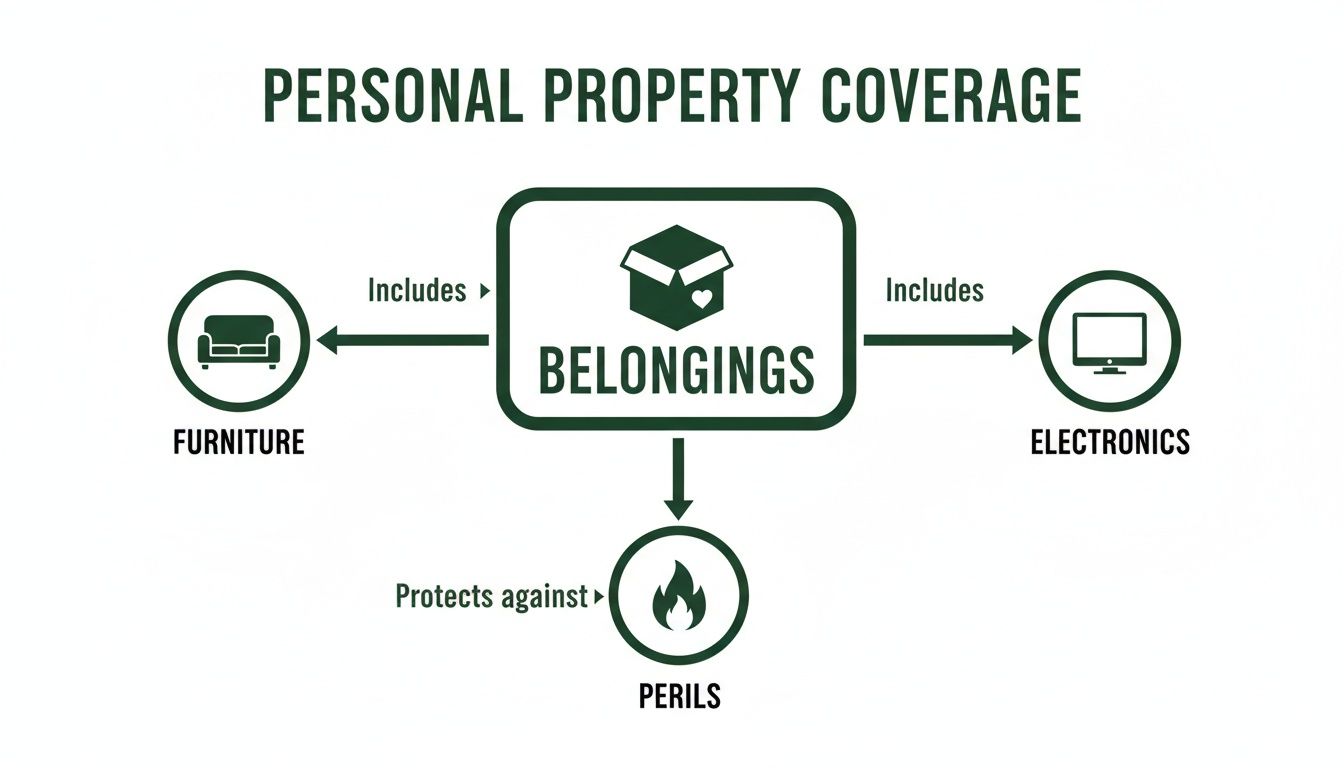
As you can see, the policy acts as a shield, but the strength of that shield—how much it pays out—depends entirely on your valuation method.
Making Yourself Whole: Replacement Cost Value
Replacement Cost Value (RCV) is what most people hope they have when they file a claim. Instead of subtracting for wear and tear, an RCV policy gives you the full amount needed to buy a brand new, similar item at today's prices.
Let's look at how this plays out with a destroyed laptop.
ACV vs. RCV Payout for a 5-Year-Old Laptop
| Valuation Method | Original Cost | Payout Amount (Example) | What It Buys You |
|---|---|---|---|
| Actual Cash Value (ACV) | $1,200 | $250 | A used, refurbished, or budget model. |
| Replacement Cost (RCV) | $1,200 | $1,300 | A brand new, comparable model today. |
As the table shows, the difference is stark. ACV leaves you with a significant financial gap to fill, while RCV truly helps you replace what you lost.
RCV coverage is designed to restore you to the same financial position you were in before the loss, allowing you to replace your belongings without dipping into your savings. While policies with RCV coverage have slightly higher premiums, the payout difference during a claim is substantial.
If you ever run into trouble getting the compensation you deserve, remember you have options. When facing a denied or undervalued claim, seeking legal counsel for a denied insurance claim can be a necessary step to advocate for the full value you're owed.
How Your Policy Type Shapes Your Coverage
Personal property insurance isn't something you buy on its own. It’s one of the most important parts of a bigger package, like your homeowners, renters, or condo insurance policy. The kind of protection you actually get for your belongings depends entirely on the type of policy you have.
Think of it like this: your main insurance policy is the car, and your personal property coverage is the engine. The model of the car you choose—be it a standard sedan or a high-performance sports car—determines how powerful and reliable that engine is.
Different Policies, Different Levels of Protection
For homeowners, the most common policy out there is the HO-3. It does a great job protecting the structure of your house, but it usually covers your personal belongings on what’s called a "named perils" basis. This is a crucial distinction. It means your stuff is only covered if it’s damaged or stolen by one of the specific risks listed—or named—in your policy, like a fire or a break-in.
Then there’s the HO-5 policy, which is a significant step up. This policy typically provides "open perils" (or "all-risk") coverage for both your house and your belongings. Instead of listing what is covered, it covers everything except for a short list of specific exclusions. It’s a much broader and more comprehensive safety net.
You can dive deeper into these differences in our guide to homeowners insurance coverages explained.
Of course, if you're a renter (HO-4) or own a condo (HO-6), your policy is built differently. Since you aren't insuring the entire building, personal property coverage becomes the star of the show.
The bottom line is simple: not all policies are the same. An HO-5 is the gold standard for protecting your possessions, while an HO-3 provides good, but more restrictive, coverage. Knowing the difference is the first step toward making sure your valuables are truly safe.
The need for quality insurance isn't slowing down. In the first half of a recent year, U.S. property and casualty insurers saw premiums climb 6.1% to $561.0 billion, with personal insurance lines growing at a healthy 6.9%.
Watch Out for the Hidden Danger: Sub-Limits
Beyond just the policy type, you have to get into the details of your coverage limits. Your overall personal property limit is usually calculated as a percentage of your home's insured value—often between 50% and 70%. So, if your home is insured for $400,000, you might have $200,000 of coverage for your stuff.
Sounds like a lot, right? Here’s the catch.
Buried in the fine print of that $200,000 are special limits, or "sub-limits," for specific categories of high-value items. These caps are often shockingly low and can leave you exposed.
Here are a few common examples:
- Jewelry, Watches, and Furs: Often capped at just $1,500 in the event of theft.
- Cash and Money: Your policy might only cover $200.
- Firearms: A typical limit is around $2,500 for theft.
- Business Property at Home: Coverage might max out at $2,500.
Imagine your $10,000 engagement ring is stolen. Even with $200,000 in total coverage, if your policy has a $1,500 sub-limit for jewelry, you’d be left with an $8,500 bill to replace it. This is why you can't just look at the big number on your policy—you have to dig into the details to see if the standard coverage is truly enough.
Protecting High-Value Items with Floaters and Endorsements
Your standard personal property coverage is perfect for most of what you own—your couch, your TV, your kitchenware. But what about the really special stuff? Most policies have surprisingly low payout limits for valuables, often capping theft coverage for things like jewelry at just $1,500.
If your engagement ring, art collection, or vintage guitar is worth more than that, you've got a serious coverage gap. That's a painful financial hit to take if something happens.
Luckily, there’s a straightforward way to close that gap. You can add specific protection for your most prized possessions, making sure they’re covered for what they’re actually worth. This is done with something called an endorsement, which is just a fancy term for an add-on to your existing policy.
The most common and effective type for valuables is scheduled personal property.
Scheduling Your Valuables for Full Protection
"Scheduling" an item is exactly what it sounds like: you list it individually on your policy, complete with a professional appraisal of its value. This simple act pulls the item out from under those restrictive general limits and protects it for its full worth.
Think of it like giving your most valuable players a spot in the starting lineup instead of leaving them on the bench. They get the special attention and protection they deserve.
An endorsement for scheduled personal property does more than just raise the coverage amount. It also broadens the protection, often to an "all-risk" basis. This means the item is covered for a much wider range of scenarios, including accidental loss—like dropping your ring down the drain. As an added bonus, these endorsements often come with a $0 deductible.
This approach is ideal for specific, high-value items. You can dive deeper into the benefits in our guide on what is scheduled personal property coverage.
Understanding Floaters for Entire Collections
What if you have a whole collection of valuables? For those situations, a personal articles floater might make more sense. A floater is a separate, standalone policy designed to cover an entire category of items, like an extensive stamp collection or a full set of inherited silverware.
It essentially "floats" apart from your main homeowners or renters insurance, giving your collection the dedicated protection it needs.
This is a powerful tool for serious collectors. For highly specialized and valuable collections, like rare coins, you may even need a policy built just for that asset. It's often worth checking out resources like specialized coin insurance guides to see what's out there.
Whether you go with a scheduling endorsement or a floater policy, the goal is the same: making sure your most cherished belongings are properly protected. It’s a small step that provides huge peace of mind, ensuring you won’t face a devastating financial loss when you can least afford it.
Creating a Home Inventory to Simplify Your Claims Process
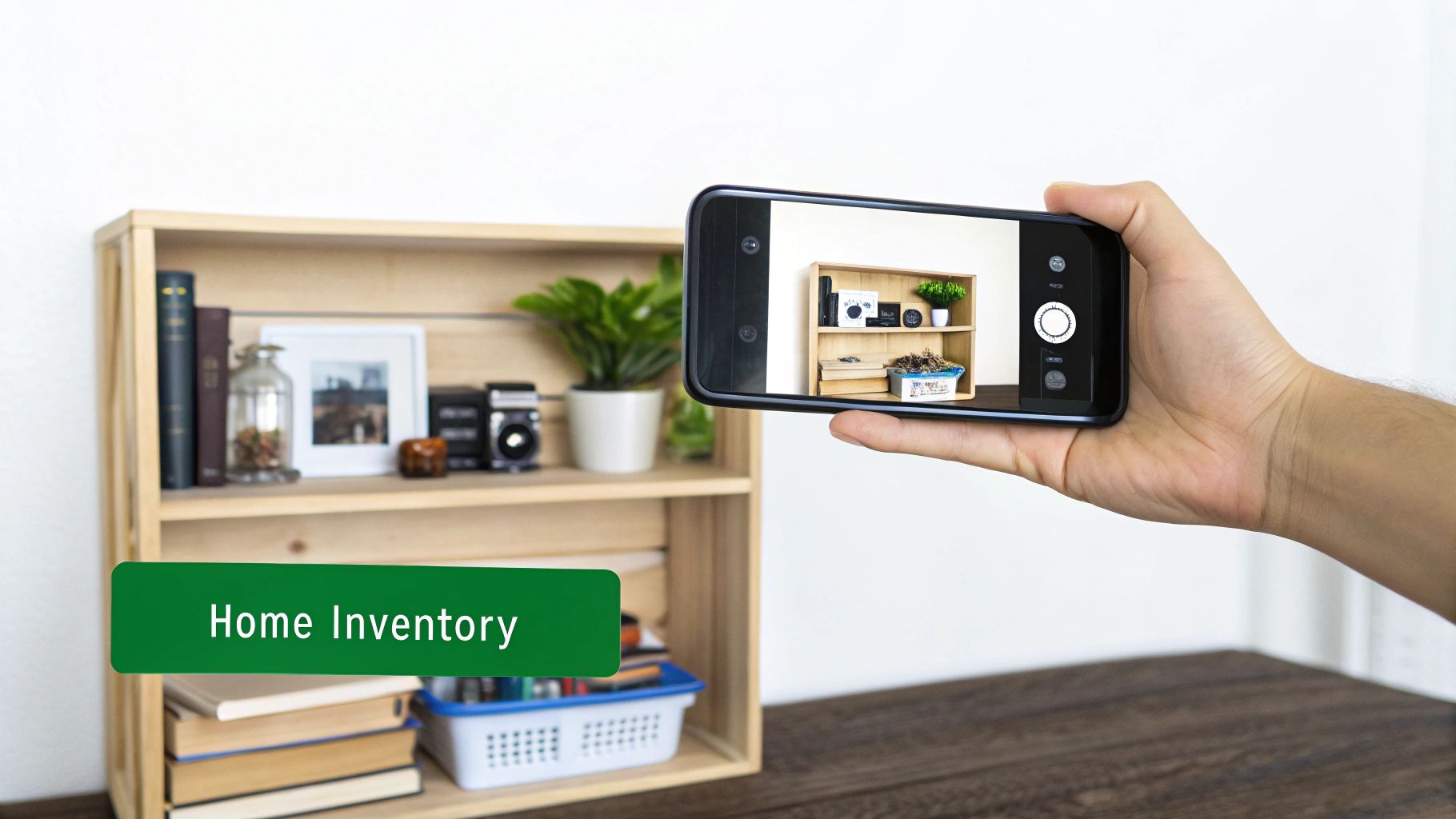
Let’s be honest. If your house burned down tomorrow, could you list everything you own from memory? Every book, every kitchen gadget, every piece of clothing? Probably not. That's a huge task for anyone, especially when you're dealing with the stress of a major loss.
This is exactly why a home inventory is one of the most important things you can do for yourself. Think of it as your personal proof of ownership. It’s a detailed record of your belongings and what they’re worth, and it’s the key to making a property claim go smoothly.
Without an inventory, you’re stuck trying to remember everything, which almost guarantees you’ll forget things. That guesswork can drag out your claim and might even lead to a smaller settlement. A good inventory puts you in the driver's seat.
Simple and Effective Inventory Methods
The good news is that creating a home inventory doesn't have to be a monumental project. Thanks to the smartphone in your pocket, it’s easier than ever.
Here are a few practical ways to get it done:
- The Video Walkthrough: This is my go-to recommendation for getting started quickly. Just walk through your home with your phone, recording a slow, steady video of each room. Open up closets, cabinets, and drawers. Narrate what you’re seeing, calling out specific items, especially valuable ones.
- The Photo Album: If you prefer still images, go room by room and snap photos. Take wide shots to capture the overall space, then get detailed pictures of individual items like electronics, jewelry, artwork, and furniture. Don't forget to get shots of serial numbers on TVs and computers.
- Inventory Apps: For those who like to be super organized, there are apps designed specifically for this. They let you categorize items, upload photos, scan barcodes, and even attach digital receipts.
No matter which method you pick, the real trick is to keep it up to date. I usually suggest people review their inventory once a year or anytime they make a big purchase, like a new sofa or TV.
And whatever you do, store your inventory somewhere safe and accessible. A cloud service like Google Drive or Dropbox is perfect because you can get to it from anywhere—even if your phone and computer are gone.
A home inventory transforms your insurance from a general safety net into a precise recovery plan. It takes the ambiguity out of the claims process and replaces it with clear, documented facts, which is the fastest route to getting your life back on track.
Documenting your belongings is the crucial first step. When you're ready to learn about what comes next after a loss, our guide on how to file a property damage claim walks you through the entire process.
Common Questions About Personal Property Insurance
Curious about how your belongings are protected when you’re away from home? These FAQs tackle the details that often trip people up. You’ll walk away with clear, practical answers so you can feel confident in your coverage.
Is My Laptop Covered If It Is Stolen From My Car?
In most cases, the answer is yes. Your homeowners or renters policy includes off-premises protection—it travels with your belongings, whether you’re at a café, a friend’s house, or your parked car.
Key points to remember:
- Coverage limit away from home is typically 10% of your total personal property limit.
- Any payout is subject to your policy’s deductible.
That means if your laptop vanishes from the back seat, you’ll file under your personal property section—auto insurance doesn’t step in here.
Does Personal Property Insurance Cover Flood Damage?
No—this is a crucial exclusion. Standard home or renters policies do not cover flooding from storm surges, overflowing rivers, or heavy rainfall that seeps in.
To bridge that gap, you’ll need a separate flood insurance policy. Options include:
- National Flood Insurance Program (NFIP) plans
- Private flood insurance from specialty carriers
And while you’re at it, remember that earthquake damage also requires its own policy.
How Do I Know How Much Personal Property Coverage I Need?
The most reliable gauge is a detailed home inventory. Insurance companies often default to 50%–70% of your dwelling coverage for possessions—but that estimate can fall short.
Here’s a quick approach:
- Walk each room and list items with make, model, and replacement cost.
- Snap photos or video for proof.
- Total everything at today’s prices, not what you originally paid.
Most people discover their true replacement cost is higher than expected. A thorough inventory helps prevent underinsurance and gives you peace of mind.
—
Navigating these nuances is where expert guidance shines. The team at Wexford Insurance Solutions can help you review your current policy and ensure your coverage aligns with your lifestyle. Start your personalized insurance review today!
 Your Guide to Business Auto Insurance for Company FleetsA Guide to Certificates of Insurance for Your Business


