

Think of a Certificate of Insurance (COI) less like an insurance policy and more like a snapshot of one. It’s the go-to document that proves a business or contractor is carrying the right insurance coverage at a specific point in time. In a world of business partnerships and contracts, it’s your first line of defense against someone else’s risk.
Why Do I Need a Certificate of Insurance?
Let's get practical. Imagine you're a general contractor hiring a new electrical subcontractor for a big project. You ask them if they have insurance, and they say, "Of course!" But words aren't enough when thousands, or even millions, of dollars are on the line.
If that subcontractor accidentally causes a fire that damages the building, who pays? Without proof of their insurance, the financial burden could fall squarely on your shoulders. The COI is the document that shifts that liability back to where it belongs—with the subcontractor and their insurance carrier. It’s not just a piece of paper; it's a vital risk management tool that builds a foundation of trust before any work begins.
Key Parties Involved in a Certificate of Insurance
To really get a handle on how a COI works, you first need to know the cast of characters. Every certificate involves three distinct parties, each with a specific job to do.
| Party | Role | Primary Responsibility |
|---|---|---|
| The Insured | The policyholder | This is the vendor, subcontractor, or business that actually owns the insurance policy. They're responsible for keeping their coverage active and requesting the COI from their insurer to give to you. |
| The Certificate Holder | The requesting party | That's you. You're the one hiring the vendor or leasing the space, and you need proof they are properly insured before you sign a contract or let them on your property. |
| The Insurance Company | The policy issuer | This is the carrier (or their authorized representative, the "Producer") who provides the insurance coverage. They issue the COI, officially confirming that the policy details are accurate as of that date. |
This relationship is built on verification. As the certificate holder, you're relying on the insurance company's word that the insured has the coverage they claim to have. For any business owner, knowing these roles is the first step, but it's just as crucial to understand your own company's broader insurance needs. You can learn more by checking out our guide on insurance for small business owners.
A Pillar of Modern Business
The demand for COIs has shot up, especially in high-stakes industries like construction, logistics, and professional services—all areas where Wexford Insurance Solutions has deep expertise. Today’s volatile market only makes them more critical. For example, global property catastrophe reinsurance rates jumped by a staggering 37% in early 2023, the biggest hike since 1992.
When the market gets "hard" like that, insurance becomes more expensive and harder to secure. That makes a COI—verifiable, undeniable proof of coverage—an absolutely essential tool for protecting your financial interests.
A Certificate of Insurance is all about managing risk before it becomes a problem. It turns the verbal promise of "don't worry, we're covered" into a documented fact, giving you the peace of mind to move forward with a business partnership.
By simply requesting and reviewing a COI, you’re creating a financial safety net. You’re making sure that if something goes wrong, a legitimate insurance policy is ready to respond, shielding your business from the fallout of a partner's error.
How to Read and Understand a Certificate of Insurance
Pop open a Certificate of Insurance for the first time, and it’s easy to feel a bit lost. That grid of boxes, insurance jargon, and fine print—usually on an ACORD 25 form—can look pretty intimidating. But it’s not as complicated as it seems.
Think of it like the summary on the back of a book. It gives you all the crucial plot points without you having to read the entire novel (in this case, the full insurance policy). Your goal is simple: quickly confirm that the coverage you required in your contract actually exists. It’s all about matching names, dates, and policy limits to what you asked for.
Breaking Down the Key Players
Right at the top of every COI, you’ll find the three main parties involved. Getting these roles straight is the first and most important step. A simple mistake here can make the whole document useless for your purposes.
This diagram shows how everyone connects: the business you’re hiring, their insurer, and you (the one asking for proof).
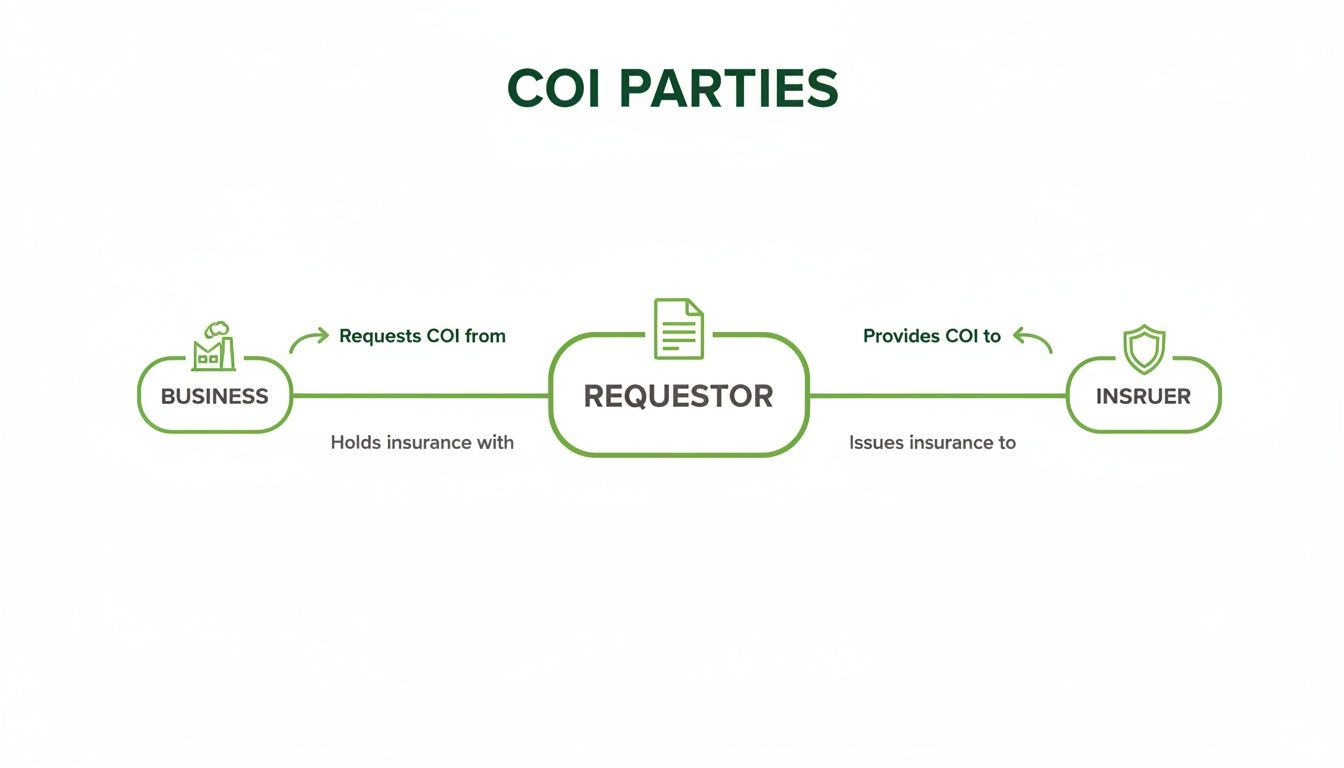
As you can see, it creates a triangle of trust. The insurer issues the certificate directly to you, giving you assurance that their client—the business you're working with—is covered.
- Producer: This is just the insurance industry’s term for the agent or broker who put the policy in place and issued the certificate.
- Insured: This is the person or company you’re hiring—the vendor, contractor, or tenant. Their name and address listed here must exactly match the name on your contract with them. No exceptions.
- Certificate Holder: That’s you! You’re the one who requested the COI. Make absolutely sure your company’s full legal name and address are correct.
Navigating the Coverage Section
The middle of the COI is the main event. This is where the specific insurance policies are listed, and it’s your chance to verify that the coverage meets the minimums you set in your contract.
You’ll find a few standard types of insurance, each designed to cover different kinds of risks.
- General Liability: This is the big one. It’s the most common and critical coverage, protecting against things like someone getting hurt on-site (bodily injury) or accidental property damage. Look closely to see if the policy is an "occurrence" or "claims-made" form, as this changes the rules for when a claim can be filed.
- Commercial Auto: This part confirms they have insurance for any vehicles used for their business. It should specify if the coverage applies to vehicles they own, hire, or even their employees' cars used for work (non-owned).
- Workers' Compensation: This is mandatory in most states and proves the business has coverage for its own employees if they get injured on the job. The box for "WC STATUTORY LIMITS" must be checked. This confirms they have the legally required amount of coverage for their state.
Key Takeaway: Remember, a Certificate of Insurance is just a snapshot in time. It proves coverage was active on the day it was issued, but it’s not a guarantee for the future. A policy could be canceled for non-payment the very next day.
That’s why you also have to check the policy dates. If the expiration date is before your project or contract ends, you’ll need to flag it and request a new, renewed certificate later to avoid a serious gap in protection. While the COI is a great summary, if you want to dig deeper into the details, you can learn more about how to read an insurance policy in our full guide.
Finding Critical Details in the Fine Print
While the big numbers for coverage limits are important, some of the most vital information is tucked away in the bottom two boxes of the form. This is where you find the special conditions and extra protections that apply specifically to you.
Description of Operations / Locations / Vehicles
This big, open text box is where the real action is. It’s not just a description; it’s where crucial endorsements that extend coverage to you are listed. You need to look for specific phrases here:
- "Certificate Holder is named as Additional Insured." This is huge. It means you’ve been officially added to their liability policy, giving you direct protection if a claim arises from their work.
- "Waiver of Subrogation applies." This clause prevents the vendor’s insurance company from coming after you to recover money they paid out on a claim, even if you were partially at fault.
- "Coverage is Primary and Noncontributory." This is a power move. It dictates that their insurance policy must respond and pay first, before your own insurance has to chip in.
Cancellation
This box describes the notice the insurer will try to provide if the policy gets canceled. The key word here is endeavor. State laws often clarify that a COI itself can't create contractual rights that aren't in the policy. So, unless there’s a specific endorsement on their policy guaranteeing it, that notice isn’t always a sure thing.
Understanding the Power of Insurance Endorsements
A Certificate of Insurance gives you the basic plot of a coverage story, but the endorsements are the critical chapters that provide real protection. Think of an endorsement as a rider or an amendment attached to an insurance policy. It customizes the policy by adding, removing, or changing the coverage to fit the specific needs of a contract.
These add-ons aren't just fancy extras; they're often the most important part of transferring risk from one party to another. Without the right endorsements listed on the certificates of insurance, the document can give you a dangerous and false sense of security.

What Is an Additional Insured?
The most common and vital endorsement you'll see is for Additional Insured status. Picture your general liability policy creating a protective bubble around your business. When you name another party as an Additional Insured, you're essentially stretching that bubble to cover them, too—but only for liability that stems from your work or operations.
Here's a classic example: a general contractor hires a plumbing subcontractor. The GC demands to be named as an Additional Insured on the plumber's policy. If the plumber’s faulty work causes a leak that damages the client's property, the client will likely sue both parties. Because the GC is an Additional Insured, the plumber’s insurance policy has to step in and defend the contractor.
This simple endorsement is a cornerstone of managing risk in contracts. It makes sure the party actually performing the work (and creating the risk) provides the first line of defense for the party that hired them.
The Power of a Waiver of Subrogation
Next up is the Waiver of Subrogation. The word "subrogation" sounds more complicated than it is. In simple terms, it’s an insurance company’s right to step into your shoes and sue a third party that caused a loss they had to pay for.
A waiver of subrogation is an agreement where the insurance company gives up that right. Let's go back to our construction site. A subcontractor’s employee gets hurt and claims it was due to an unsafe condition the general contractor created. The sub's workers' comp carrier pays the employee's medical bills and lost wages.
Normally, that insurance company could then turn around and sue the general contractor to recover its costs. But with a waiver of subrogation in place, the insurer is legally blocked from doing so. This prevents messy, expensive lawsuits between partners working on the same project. You can dive deeper into this topic in our guide, which answers the question: What is a Waiver of Subrogation?
Defining Who Pays First
Finally, Primary and Noncontributory wording is a powerful clause that sets the pecking order for how insurance policies respond to a claim. It’s like setting the rules of a tag-team match before the bell rings.
- Primary: This part says the policyholder's insurance must pay first, before any other policy can be asked to chip in.
- Noncontributory: This part backs up the "primary" status by preventing that insurer from asking the additional insured's own policy for a contribution.
When you require this wording, you’re making sure your own insurance policy sits on the sidelines, acting as a secondary or excess layer. It won’t be touched unless the other party’s policy limits are completely drained. This is a smart move that helps protect your own loss history and keeps your insurance premiums from climbing.
The need for these endorsements is even greater in today's tough insurance market. Global commercial insurance rates rose for the 25th consecutive quarter in late 2023, a clear sign of the pressures from inflation and major catastrophic events. In this kind of climate, making sure your certificates of insurance have these specific protections isn't just good business—it's essential for financial survival. For property owners, it’s also crucial to understand how these endorsements apply to specific policies, which is why it's wise to compare landlord insurance options for California rentals to ensure all bases are covered.
Common Scenarios Where You Need a COI
A Certificate of Insurance stops being an abstract idea and becomes a real-world necessity the moment your business interacts with another. Think of it as the handshake before the actual handshake—a critical verification step that supports countless daily business deals. Knowing when to ask for one is key to shielding your business from risks you didn't create.
Let's move past the theory and look at some real situations where demanding a COI isn't just a good idea; it's a non-negotiable part of doing business safely.
Construction and Contractor Engagements
The construction world is probably the most common place you'll see certificates of insurance in action. Picture yourself as a general contractor (GC) managing the build of a new office complex. You've brought on a whole team of specialized subcontractors for plumbing, electrical work, and HVAC installation.
Before any of those subs even think about stepping onto your job site, you need a COI from every single one. This isn't just paperwork; it’s a foundational piece of your risk management plan.
- Who Asks for It: The general contractor or the project owner.
- Who Gives It: Every subcontractor, from the plumber to the electrician.
- Why It Matters: If an electrician’s shoddy wiring sparks a fire, the GC needs proof that the electrician's own general liability policy is going to pay for the damage. Without that COI, the liability—and the massive bill that comes with it—could fall right into the GC's lap.
This simple step ensures the party creating a specific risk is also the one financially on the hook for it. For a closer look at this, our guide on general contractor insurance requirements is a great resource. In construction and beyond, COIs are a pillar of effective contractor management.
Commercial Leases and Property Management
Another area where the stakes are high is commercial real estate. Imagine you're a landlord leasing a storefront to a new coffee shop. The lease is signed, but you don't hand over the keys until you have a Certificate of Insurance from your new tenant.
This single document protects your property and your own financial interests from anything that might happen as a result of the tenant's business.
A COI is the landlord's shield. It confirms the tenant has enough liability coverage to handle a situation where a customer slips and falls in their shop or their operations somehow damage the building itself.
In this case, the landlord would be named as the Certificate Holder and almost always as an Additional Insured. This gives the landlord the power to be defended by the tenant's insurance policy if a claim arises from the tenant's actions.
Hiring Vendors and Freelancers
The need for certificates of insurance isn't just for big construction projects or property deals. Let's say your marketing agency hires a freelance photographer for a huge ad campaign. The shoot is happening on-site at your client's corporate headquarters.
Your agency, being smart, requests a COI from the photographer before they ever show up.
- What to Look For: You'd want to see General Liability to cover any property damage (like if the photographer’s tripod topples an expensive piece of art) and Professional Liability (also called Errors & Omissions) in case the final photos are completely unusable.
- The "What If": Without that COI, if the photographer accidentally injures one of your client’s employees with a light stand, your agency could be the one getting sued for medical bills.
These examples just scratch the surface, showing how vital the COI is across totally different industries. They all play a part in the massive U.S. property and casualty (P&C) insurance market, where direct premiums written have rocketed past $954 billion. That staggering number gives you a sense of just how many business transactions rely on COIs to run smoothly every single day. By understanding these common scenarios, you can get ahead of the curve and protect your business from serious financial hits.
How to Verify COIs and Spot Red Flags
Getting a Certificate of Insurance is the first step, but it’s definitely not the last. Real risk management starts when you actually verify that piece of paper. Think of yourself as a detective checking an alibi—you have to make sure the story the COI tells you is the whole truth. Skipping this part could leave your business wide open to risk.
Properly vetting a COI isn't just about giving it a quick once-over. It's about methodically checking every detail against the requirements you laid out in your contract. This is what turns a simple document into a legitimate shield for your company.
A Quick Guide to Reading a COI
To make sure nothing gets missed, it helps to have a consistent game plan. Think of it like a pre-flight checklist for your business partnerships.
-
Check the Insured's Name: Does the legal name on the COI perfectly match the name on your contract? A small difference, like "ABC Construction" versus "ABC Construction, LLC," might seem minor, but it could be a major headache during a claim.
-
Confirm the Policy Dates: Look at the policy's effective and expiration dates. Do they cover the entire time you'll be working together? If a policy is set to expire mid-project, you need to set a reminder to get the renewed certificate. Otherwise, you could be left with a serious coverage gap.
-
Verify the Coverage Limits: Pull out your contract and compare the liability limits on the COI to what you required. Are the general liability, auto, and workers' comp limits all meeting or exceeding the amounts you specified? Don't just assume they are.
It's crucial to remember that a COI is just a snapshot—it's proof of insurance, not the policy itself. By law, it can't change, extend, or alter the coverage provided by the actual policy.
It's also worth knowing how a COI differs from other temporary documents. For a deeper dive into short-term proof of coverage, check out our guide on what an insurance binder is and how it fits into the picture.
The COI Verification Checklist
To make things easier, we've put together a simple table you can use as a checklist every time you review a COI from a vendor or partner.
| Check Point | What to Look For | Common Red Flag |
|---|---|---|
| Insured Name & Address | The name and address must exactly match your contract. | A different legal name or a P.O. Box when you expect a physical address. |
| Insurance Producer | Is it a legitimate, licensed insurance agency? A quick Google search can confirm. | A producer that is unheard of, has no website, or has bad reviews. |
| Policy Dates | Do the effective/expiration dates cover your entire project or lease term? | The policy expires next week, or it doesn't cover the project start date. |
| Coverage Limits | Do the liability limits meet or exceed your contractual requirements? | Any limit that is lower than what your contract demands. |
| Additional Insured Status | Are you explicitly named as an Additional Insured in the "Description" box? | The box is blank, or the language is vague and non-committal. |
| Waiver of Subrogation | Is a Waiver of Subrogation noted for the required policies? | The term "Waiver of Subrogation" or "WOS" is completely missing. |
| Producer's Signature | Is the certificate signed by an authorized representative? | A missing signature or one that looks digitally copied and pasted. |
| Notice of Cancellation | Does it specify the number of days for cancellation notice (30 days is standard)? | A notice period of 10 days or less, or no mention at all. |
Running through this checklist consistently will help you catch potential issues before they become real problems.
Spotting Common Red Flags on a COI
While most COIs are on the level, you have to be aware that fraudulent or doctored documents are out there. Learning to spot the tell-tale signs of a fake is a critical skill for protecting your business from a partner who is uninsured or underinsured.
Here are a few things that should make you pause:
- White-Out or Obvious Edits: Any sign of correction fluid, mismatched fonts, or blurry text is a massive red flag. A real COI comes straight from the insurance agency and should look clean and professional.
- Missing Producer Signature: That signature from the authorized representative is what makes the document official. If it’s not there, the COI may have been altered or was never properly issued in the first place.
- Vague Endorsement Language: The "Description of Operations" box is where the important details live. If your Additional Insured status or a Waiver of Subrogation isn't clearly spelled out here, you can bet those protections aren't actually in place.
- Unusually Low Premiums (If Visible): You won't usually see premium amounts, but if you do and they seem way too low for the kind of work being done, it could signal a junk policy or flat-out fraud.
If anything about a COI feels off, trust your gut. The best thing you can do is contact the insurance producer listed on the form to verify the policy details directly. And one more pro tip: use the phone number from their official website, not the one printed on the certificate you're questioning.
Got Questions? We've Got Answers: Your COI FAQ
Even with a solid grasp of what a Certificate of Insurance is, a few tricky questions always seem to pop up. Nailing down the answers to these common sticking points is key to managing your risk properly and avoiding expensive mistakes. Let's tackle some of the most frequent questions we hear from business owners.
How Long Does It Take to Get a COI?
Honestly, it all comes down to your insurance provider. The old way of doing things could be a real drag, sometimes taking days for an agent to manually type up the form and email it over. That kind of delay can bring a project to a screeching halt and create friction with your partners.
Thankfully, technology has changed the game. Many modern agencies, like us, provide instant access through online client portals. You can hop online, generate a standard COI yourself in a matter of minutes, 24/7, and keep your business moving at the speed it needs to. No more waiting around.
Is a Certificate of Insurance Actually a Contract?
No, and this is a big one. It's probably the most common (and dangerous) misunderstanding out there. A COI is not a legally binding contract. Think of it more like a snapshot or a summary of insurance coverage as it existed on the day the certificate was created.
A COI is for informational purposes only. It can't change, add to, or take away from the coverage laid out in the actual insurance policy. When a claim happens, it's the policy document—not the certificate—that dictates everything.
What Happens If My Subcontractor’s Insurance Lapses Mid-Job?
This is where things get risky, fast. If a subcontractor's policy gets canceled or expires while they're still working for you, your business is suddenly wide open to liability. If an accident happens after their coverage is gone, any claims for injuries or property damage could land squarely on your policy.
This scenario is exactly why tracking COIs isn't a one-and-done task. Without a system to flag expiration dates and follow up for renewed certificates, you could be working with an uninsured partner and not even know it. That single oversight completely wipes out the protection you thought you had, potentially leading to huge financial hits and a spike in your own insurance premiums.
What’s the Difference Between a "Certificate Holder" and an "Additional Insured"?
Getting this right is absolutely critical because the two roles offer vastly different levels of protection.
-
Certificate Holder: This is just the person or company who gets the certificate. It proves that a policy exists, but that’s it. Being a certificate holder gives you zero rights under that policy. You can't file a claim or expect any protection from it.
-
Additional Insured: This is the status you really want. When you're added as an "additional insured" (which requires a specific policy endorsement), you are officially covered under the other party's policy for work they do for you. This means you can file a claim against their policy and are entitled to a legal defense if you get sued because of their actions.
Bottom line: just having the certificate in hand isn't enough. For real protection, you need to be listed as an Additional Insured.
Navigating the world of certificates of insurance doesn't have to be a headache. At Wexford Insurance Solutions, we make it easy with our 24/7 client portal that lets you issue and manage COIs instantly. To make sure your business is always covered, learn more about our paperless COI solutions.
 What Is Personal Property Insurance and How Does It Work?Insurance Requirements for Independent Contractors: A Practical Guide


