

Building a successful business is your top priority, but safeguarding its future is just as crucial. The world of business insurance can seem overwhelming, with a confusing array of policies and industry jargon. Misunderstanding your coverage needs can leave your company exposed to devastating financial losses from lawsuits, accidents, property damage, or cyberattacks. One significant claim without the right protection can jeopardize everything you’ve worked to build.
But what if you had a clear, simple roadmap to understand exactly what you need? This guide demystifies the essential types of commercial insurance policies, breaking down precisely what each one does, which businesses need it, and how it protects your hard-earned assets. We are moving beyond generic definitions to provide a comprehensive and scannable resource you can use to identify potential gaps in your risk management strategy.
Think of this article as your personal insurance playbook. We'll explore 12 key policies, from General Liability to specialized Aircraft Insurance, using real-world claim scenarios, actionable tips, and insider insights. Our goal is to empower you to build a comprehensive shield against financial loss. By the end, you'll have the confidence to make informed decisions and secure the right protection for your company's unique risks, transforming a complex topic into a manageable and strategic part of your business plan.
1. General Liability Insurance
Often considered the cornerstone of a business’s risk management strategy, General Liability (GL) insurance is a fundamental policy that protects your company from financial loss resulting from third-party claims of bodily injury, property damage, and personal or advertising injury. It acts as your first line of defense against the everyday operational risks that can lead to costly lawsuits and settlements. This coverage is essential for nearly every business, from a solo consultant to a large retail chain.
GL insurance covers legal defense costs, medical expenses for injured parties, and financial judgments or settlements, up to your policy’s limits. Without it, a single slip-and-fall incident or an allegation of slander could jeopardize your company’s financial stability.

Who Needs It & Why?
Virtually every business needs this coverage. Landlords, clients, and lenders often require you to carry a minimum amount of GL insurance before signing a lease or contract. It’s critical for any business that interacts with the public, visits client sites, or has a physical location.
Claim Scenario: A customer at your coffee shop slips on a recently mopped floor, fractures their wrist, and sues for medical expenses and lost wages. Your general liability policy would cover the legal fees to defend your business and pay for the customer's medical bills and any settlement reached. You can explore more real-world examples by reviewing our detailed guide on common General Liability claims.
Actionable Tips for Your Policy
- Verify Limits: Ensure your coverage limits align with industry standards and any contractual obligations.
- Bundle & Save: For significant savings, bundle GL with commercial property insurance in a Business Owner's Policy (BOP).
- Document Everything: Promptly document and report all potential incidents to your insurer, even if a claim hasn't been filed yet.
2. Commercial Auto Insurance
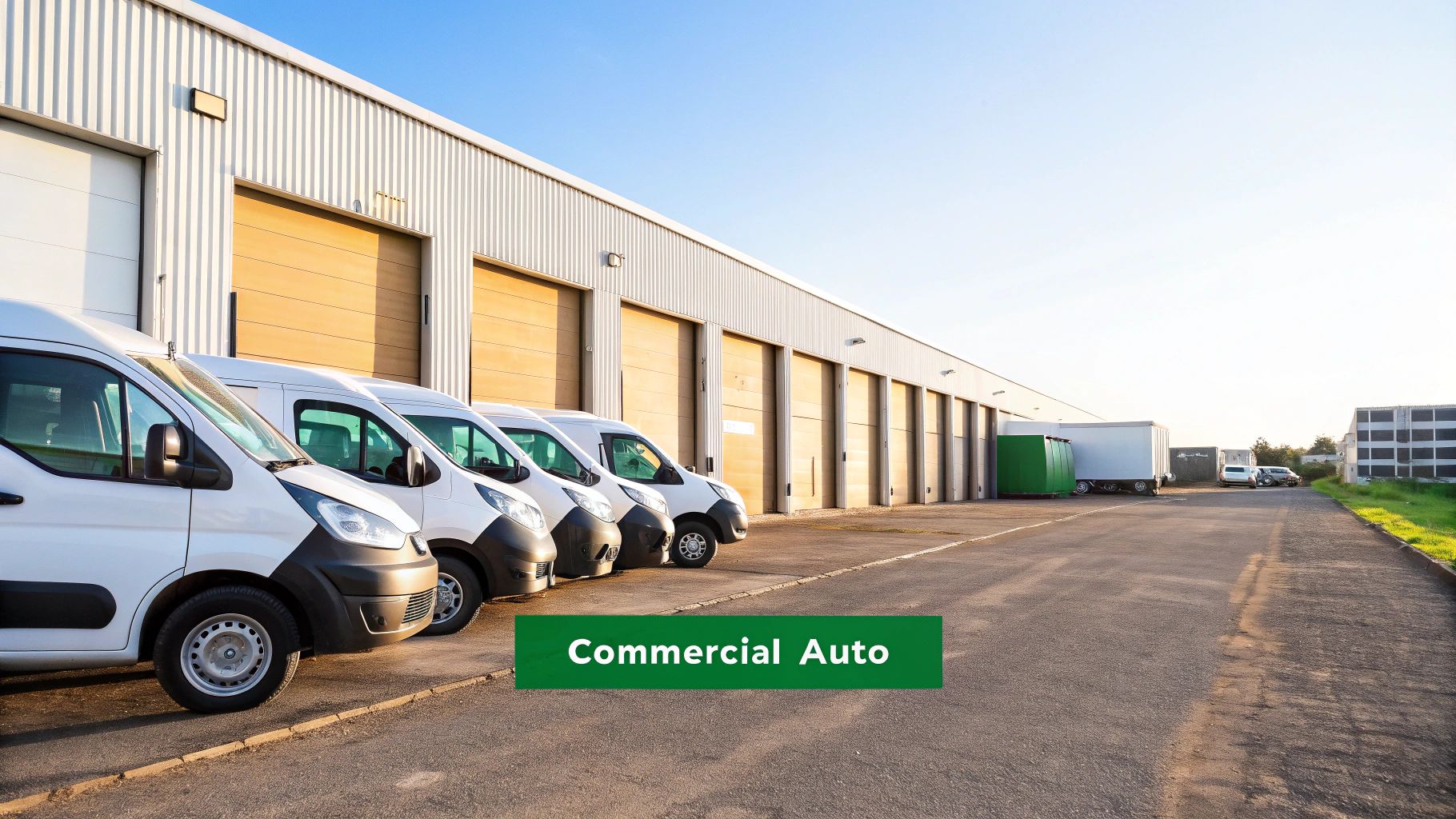
Essential for any business that uses vehicles for work-related purposes, Commercial Auto Insurance provides specialized coverage that personal auto policies do not. This policy protects your company-owned, leased, or rented vehicles, as well as non-owned vehicles used for business, from financial loss due to accidents, theft, or other damages. It is a critical component for businesses ranging from delivery services and construction firms to real estate agencies.
Commercial auto insurance covers liability for bodily injury and property damage, collision and comprehensive damage to your vehicles, and medical payments. A personal auto policy will often deny claims related to business use, making this coverage non-negotiable for protecting your company’s assets and operations on the road.
Who Needs It & Why?
Any business that owns, leases, or rents vehicles, or has employees who drive their own vehicles for work, needs this policy. This includes companies with dedicated fleets, like HVAC technicians or florists, and businesses where employees make deliveries or visit clients. Without it, a single at-fault accident can lead to devastating liability costs and vehicle repair expenses.
Claim Scenario: A technician from your HVAC company is driving a company van to a service call and rear-ends another vehicle, causing significant damage and injuring the other driver. Your commercial auto policy would cover the repair costs for both vehicles, the other driver's medical bills, and any legal defense fees, preventing a major financial blow to your business. You can dive deeper into the key distinctions by reading our guide on commercial vs. personal auto insurance.
Actionable Tips for Your Policy
- Implement Telematics: Use GPS tracking and driver monitoring programs to potentially earn significant premium discounts.
- Establish Clear Policies: Create a formal, written vehicle use policy for employees to minimize risky driving behaviors.
- Add Hired & Non-Owned Coverage: If employees use personal vehicles for work, ensure this endorsement is on your policy.
- Maintain Your Fleet: Keep detailed vehicle maintenance records to support your position in the event of a claim.
3. Workers' Compensation Insurance
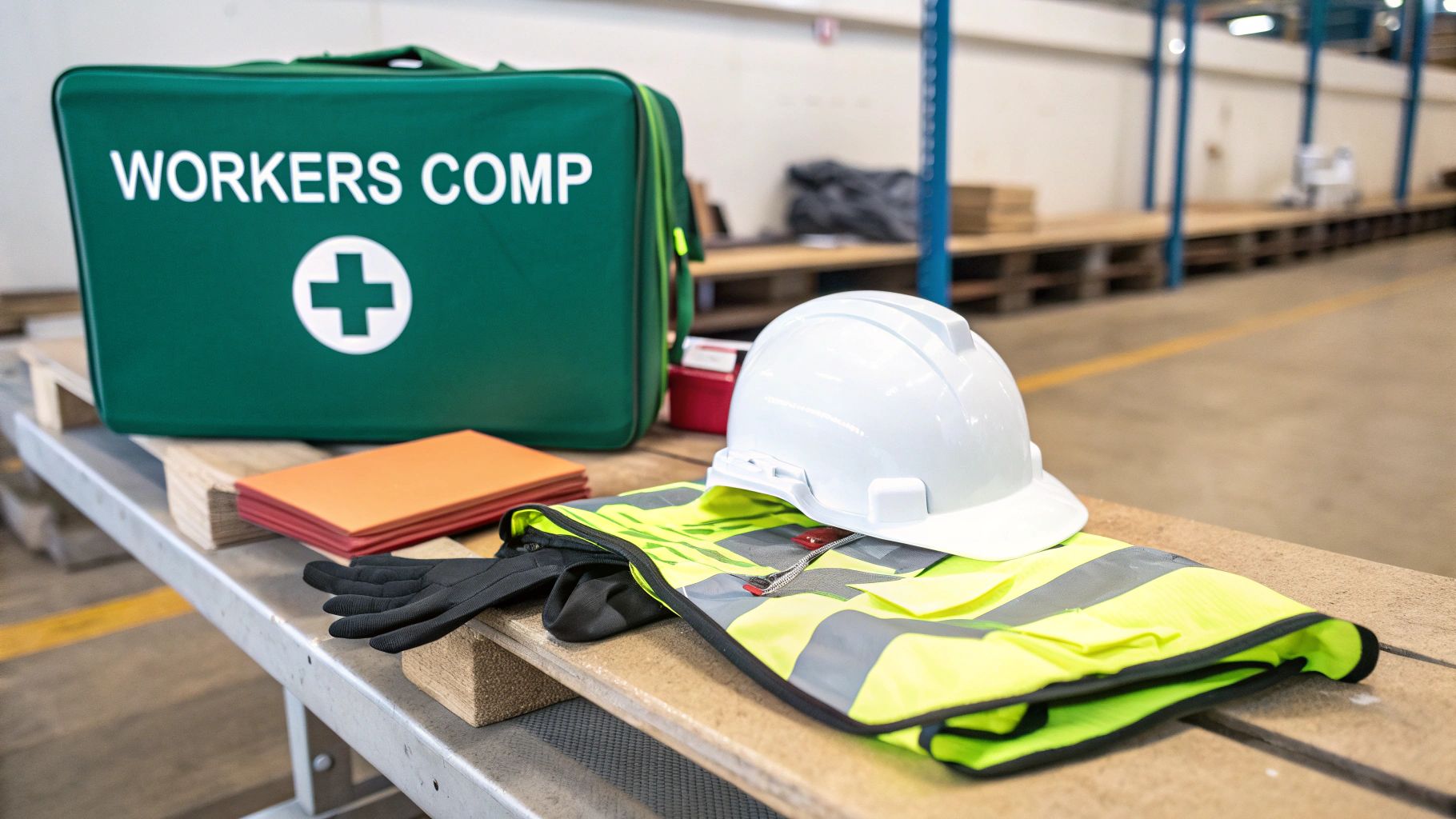
A crucial component of any employer's risk management plan, Workers' Compensation insurance is a state-mandated policy that provides benefits to employees who get injured or become ill as a direct result of their job. This no-fault coverage protects both parties: it pays for employee medical care, lost wages, and rehabilitation costs, while shielding the employer from lawsuits related to the workplace injury. It is a fundamental policy for nearly every business with one or more employees.
This coverage is vital for maintaining a safe and secure workforce and ensuring your business complies with state law. Failing to carry required workers' comp insurance can result in severe penalties, fines, and direct liability for employee injuries, which could be financially devastating for your company.
Who Needs It & Why?
If you have employees, you almost certainly need workers' compensation insurance. Requirements vary by state, but most mandate coverage as soon as you hire your first employee. This policy is essential not just for legal compliance but also for protecting your most valuable asset: your team.
Claim Scenario: A construction worker falls from a ladder at a job site, sustaining a back injury that requires surgery and months of physical therapy. Your workers' compensation policy would cover their medical bills, prescription costs, and a portion of their lost wages while they are unable to work, preventing a potentially crippling lawsuit against your business.
Actionable Tips for Your Policy
- Implement Safety Programs: Proactively reduce claims and lower your premiums by establishing comprehensive workplace safety protocols and training.
- Report Injuries Promptly: Immediately and accurately report all work-related injuries to your insurance carrier to ensure a smooth claims process.
- Review Class Codes: Annually verify that your employees are classified correctly, as these codes directly impact your premium calculations.
- Understand Your EMR: Your Experience Modification Rate (EMR) significantly affects your premium. Discover how your claims history impacts your EMR to better control costs.
4. Commercial Property Insurance
Your business's physical assets, from the building you operate in to the inventory on your shelves and the equipment you use daily, are significant investments. Commercial Property Insurance is designed to protect these tangible assets from financial loss due to perils like fire, theft, windstorms, and vandalism. This coverage is the financial backstop that allows your business to repair, rebuild, or replace its property after a disaster.
This policy safeguards your company’s building, inventory, tools, equipment, and fixtures. It ensures that a covered event doesn't cripple your operations or force you to pay for catastrophic repair costs out of pocket. For any business with a physical location or valuable equipment, this is a non-negotiable part of a comprehensive insurance plan.
Who Needs It & Why?
Any business that owns or leases a physical space, holds inventory, or relies on equipment needs this coverage. It’s often a requirement from landlords and commercial mortgage lenders to protect their financial interests in the property. Without it, a single fire or major theft could put you out of business permanently. Understanding commercial property fire safety regulations is also crucial for compliance and ensuring your policy remains valid.
Claim Scenario: A fire breaks out overnight in your retail store, causing severe smoke and water damage to your building, inventory, and point-of-sale systems. Your commercial property policy would cover the costs to repair the structural damage, replace the ruined stock, and purchase new computer equipment, allowing you to reopen your doors.
Actionable Tips for Your Policy
- Conduct an Inventory Audit: Annually, document all business assets with photos, serial numbers, and valuations to ensure accurate coverage.
- Consider Replacement Cost: Opt for Replacement Cost Value (RCV) over Actual Cash Value (ACV) to be reimbursed for the cost of buying new items, not their depreciated value.
- Add Business Interruption: Enhance your policy with Business Interruption coverage to replace lost income and cover operating expenses while your property is being repaired.
5. Business Owner's Policy (BOP)
Often called the ideal insurance package for small to mid-sized businesses, a Business Owner's Policy (BOP) is a convenient bundle that combines several essential coverages into one streamlined, cost-effective policy. It typically includes General Liability, Commercial Property, and Business Interruption insurance, offering broad protection against some of the most common risks a company faces. This integrated approach simplifies insurance management and is almost always more affordable than purchasing each policy separately.
By bundling these core coverages, a BOP provides a comprehensive foundation for your risk management plan. It protects your physical assets, covers you from third-party liability claims, and helps you stay afloat financially if a covered event forces a temporary shutdown. This makes it one of the most popular types of commercial insurance policies for eligible businesses.
Who Needs It & Why?
A BOP is designed for small to medium-sized businesses in lower-risk industries, such as retail stores, local contractors, small offices, and restaurants. If your business owns a building, has significant physical assets like equipment and inventory, and deals with the public, a BOP is likely a perfect fit. It streamlines protection for both liability and property exposures under a single, manageable plan.
Claim Scenario: A fire breaks out in the kitchen of your small restaurant, causing significant damage to the equipment and forcing you to close for a month for repairs. Your BOP would cover the cost to replace the damaged kitchen equipment (Commercial Property), pay for the revenue you lost during the closure (Business Interruption), and cover medical bills if a customer was injured (General Liability). For a deeper look at how it compares to standalone coverage, see our guide on Business Owner's Policy vs. General Liability.
Actionable Tips for Your Policy
- Review Business Interruption Limits: Ensure your policy's Business Interruption coverage is sufficient to cover your operating expenses, payroll, and lost profits for a realistic recovery period.
- Add Endorsements: Customize your BOP with riders or endorsements for specific risks not included, such as cyber liability or professional liability.
- Document Your Assets: Keep a detailed, updated inventory of all business property, including equipment and stock, to simplify and expedite the claims process.
6. Professional Liability Insurance (Errors & Omissions)
Distinct from other liability coverages, Professional Liability insurance, often called Errors & Omissions (E&O), protects professionals and service-based businesses from claims of negligence, malpractice, or mistakes made in the delivery of their expert services. It specifically addresses financial losses suffered by a client due to an alleged failure or error in the professional work you provided. This policy is a critical safeguard for any business that offers advice, consultation, or specialized services.
E&O insurance covers your legal defense expenses, settlements, and financial judgments up to your policy limit. Without it, a single claim alleging a professional mistake, whether valid or not, could lead to a devastating lawsuit that threatens both your personal assets and your business’s future.
Who Needs It & Why?
This coverage is essential for any professional who provides services or advice for a fee. This includes accountants, attorneys, architects, consultants, financial advisors, real estate agents, and even IT specialists. If your work product is knowledge or expertise, you have a professional liability exposure that requires this specific type of commercial insurance policy.
Claim Scenario: An accountant makes a clerical error while preparing a client's taxes, resulting in significant IRS penalties and fees for the client. The client sues the accountant to recover their financial losses. The accountant's professional liability policy would cover the legal costs and the settlement amount paid to the client.
Actionable Tips for Your Policy
- Review Scope of Services: Ensure your policy explicitly covers every professional service your firm offers.
- Implement Quality Control: Use peer review processes and maintain detailed documentation of all client work and communication to mitigate risks.
- Consider Tail Coverage: If you are retiring or selling your business, purchase "tail coverage" to protect yourself from claims filed after your policy expires.
7. Cyber Liability Insurance
In today’s digitally-driven world, Cyber Liability Insurance has become a critical safeguard for businesses of all sizes. This specialized policy protects your company from the significant financial fallout of cyber events like data breaches, ransomware attacks, and system failures. It addresses risks that are typically excluded from standard general liability or property policies, making it an essential component of modern risk management.
Cyber liability coverage helps pay for expenses such as notifying affected customers, credit monitoring services, forensic investigations to determine the cause of a breach, legal defense costs, and regulatory fines. Without this protection, a single cyber incident could lead to devastating financial losses, reputational damage, and operational disruption.
Who Needs It & Why?
Any business that stores, processes, or transmits sensitive electronic data needs this coverage. This includes customer information, employee records, payment details, or proprietary company data. From healthcare providers managing patient records to retailers handling credit card transactions, the risk of a breach is universal and growing.
Claim Scenario: A hacker gains access to your retail company's server, stealing the credit card information of thousands of customers. Your cyber liability policy would cover the costs of notifying each customer, providing them with credit monitoring services, and defending your business against lawsuits filed by the affected individuals.
Actionable Tips for Your Policy
- Implement Strong Security: Insurers often require businesses to have robust security measures in place, like multi-factor authentication, regular employee training, and documented data backup plans.
- Develop an Incident Response Plan: Having a clear, documented plan for how to respond to a breach can help mitigate damage and may even lower your premiums.
- Review Your Coverage Annually: The cyber threat landscape evolves rapidly. Ensure your policy limits and coverages are sufficient for emerging risks by reviewing our cyber insurance coverage checklist and consulting with your agent.
8. Umbrella & Private Client Protection
Also known as excess liability, Umbrella insurance provides an essential layer of security that sits on top of your existing liability policies, such as General Liability and Commercial Auto. When the costs of a catastrophic claim exhaust the limits of an underlying policy, this coverage kicks in to pay the remaining amount, protecting your business from devastating financial loss. For high-net-worth individuals and business owners, Private Client Protection integrates this excess liability with specialized coverage for personal assets.
This type of commercial insurance policy is designed to handle "worst-case scenarios." It ensures that a single large lawsuit doesn't bankrupt your company or put your personal wealth at risk. The policy activates only after the primary insurance limits are reached, offering millions in additional coverage for a relatively low premium.
Who Needs It & Why?
Any business with significant assets or high exposure to liability risks should have an umbrella policy. This includes contractors, manufacturers, property owners, and companies with vehicle fleets. High-net-worth business owners also need this to create a seamless shield between their business and personal assets, which is a core focus of our specialized Private Client services.
Claim Scenario: A contractor carries a $1 million General Liability policy. A severe on-site accident results in a $2.5 million judgment against their company. The GL policy pays its $1 million limit, and their $2 million Commercial Umbrella policy covers the remaining $1.5 million, preventing the business from having to liquidate assets to pay the settlement.
Actionable Tips for Your Policy
- Maintain Underlying Limits: Your umbrella policy will require your primary policies (GL, Auto) to have specific minimum liability limits. Ensure they meet these requirements to keep coverage active.
- Assess Your Total Risk: Conduct a comprehensive assessment of your business and personal net worth to determine an adequate umbrella limit.
- Review Annually: As your business grows and your assets increase, revisit your umbrella coverage to ensure it still provides sufficient protection against potential liabilities.
9. Builders Risk Insurance
Designed specifically for projects under construction, Builders Risk Insurance is a specialized form of property insurance that protects a building, its materials, and onsite equipment during the course of construction or renovation. This policy, also known as "course of construction" insurance, covers damages from perils like fire, wind, theft, and vandalism. It is a critical, temporary policy that safeguards the immense financial investment made in a project before it is completed.
Builders Risk insurance provides peace of mind for contractors, property owners, and developers by covering the structure and materials from the ground up. Without this coverage, a single fire or severe weather event could completely derail a project, leading to catastrophic financial losses and devastating delays.
Who Needs It & Why?
This policy is essential for anyone with a financial stake in a construction project, including general contractors, subcontractors, property owners, and developers. Lenders will almost always require proof of a builders risk policy before financing a construction project. It protects the project’s value from the moment materials are delivered to the site until the work is substantially complete.
Claim Scenario: During the construction of a new commercial office building, a major thunderstorm with high winds causes a partially completed wall to collapse, damaging steel framing and other materials stored on-site. Your builders risk policy would cover the cost to clear the debris, replace the damaged materials, and rebuild the collapsed section, allowing the project to continue without a devastating financial setback.
Actionable Tips for Your Policy
- Secure Early: Obtain coverage before any materials arrive at the job site to ensure there are no gaps.
- Provide Detail: Give your insurer a detailed project plan, including blueprints, budget, and a precise timeline, to ensure accurate coverage.
- Plan for Extensions: If your project faces delays, contact your insurer immediately to arrange for a policy extension to avoid a lapse in coverage.
- Document & Secure: Maintain a detailed inventory of all materials and equipment on-site and implement strong security measures to mitigate theft risks.
10. Valuable Items & Fine Art Insurance
For individuals or businesses with high-value assets, Valuable Items & Fine Art insurance provides specialized protection that goes far beyond the limited coverage offered in standard commercial or homeowner policies. This policy is designed to safeguard items like fine art, jewelry, antiques, collectibles, and rare musical instruments from risks such as theft, damage, and loss, often on a worldwide basis. It offers superior, tailored coverage for your most prized possessions.
This insurance typically provides "agreed value" coverage, meaning the value of each item is determined and agreed upon when the policy is written. In the event of a total loss, you receive the full agreed-upon amount without any deduction for depreciation, ensuring your investment is fully protected.
Who Needs It & Why?
This coverage is crucial for art collectors, jewelry enthusiasts, museums, galleries, and any individual or business with significant investments in valuable personal property. Standard policies often have low sub-limits for such items, leaving you severely underinsured after a loss. This policy closes that critical gap, providing peace of mind and financial security.
Claim Scenario: A fire damages a portion of your corporate art collection, including a sculpture valued at $75,000. Your valuable items policy would cover the full agreed value of the sculpture, along with the cost of restoration for other partially damaged pieces, ensuring your company's assets are made whole without dispute over depreciation.
Actionable Tips for Your Policy
- Get Appraisals: Obtain professional, updated appraisals from qualified experts to establish an accurate agreed value for each high-value item.
- Keep Detailed Records: Maintain a thorough inventory with photos, receipts, and provenance documentation for every insured piece. Beyond general categories, specific items like jewelry often have their own considerations. For instance, understanding the nuances of engagement ring insurance costs can help individuals protect their most cherished possessions.
- Review Regularly: Re-evaluate your coverage and appraisals every 3-5 years, or whenever the market value of your collection changes significantly.
11. Aircraft Insurance (Owners & Operators)
One of the most specialized types of commercial insurance policies, Aircraft Insurance provides comprehensive coverage for owners and operators of private or commercial aircraft. This policy is designed to protect against the significant financial risks associated with aviation, including liability for bodily injury or property damage to third parties, passenger injury, and physical damage to the aircraft’s hull itself. It addresses the unique, high-stakes exposures that standard commercial policies explicitly exclude.
Aviation insurance covers your aircraft both on the ground and in flight. Given the high value of aircraft and the potential for catastrophic loss, this coverage is indispensable for protecting your assets and operations. Without it, a single incident could result in multi-million dollar liabilities and the complete loss of a valuable asset.
Who Needs It & Why?
This coverage is mandatory for any individual or business that owns, leases, or operates an aircraft. This includes private business jet owners, corporate flight departments, flight schools, and charter operators. Lenders and airport authorities will almost always require proof of adequate aircraft insurance before providing financing or granting operational permissions.
Claim Scenario: During landing, a business’s private jet experiences a landing gear malfunction, causing it to veer off the runway and strike a parked ground-service vehicle. The aircraft's hull suffers extensive damage, and the vehicle is destroyed. The aircraft insurance policy would cover the cost to repair the jet's hull and pay for the replacement of the damaged ground vehicle.
Actionable Tips for Your Policy
- Document Pilot Currency: Maintain meticulous and up-to-date records of all pilot training, certifications, and flight hours to ensure policy compliance.
- Disclose Full Usage: Be transparent with your broker about all intended uses of the aircraft, such as charter, training, or business transport, to avoid coverage gaps.
- Work with a Specialist: Partner with an insurance broker who specializes in aviation to navigate complex underwriting requirements and secure appropriate coverage for your specific needs.
12. Directors & Officers Liability Insurance (D&O)
Designed to protect the personal assets of corporate leaders, Directors & Officers Liability (D&O) insurance shields your company’s executives from financial loss arising from alleged wrongful acts in their capacity as managers. This policy responds to claims of mismanagement, breach of fiduciary duty, and regulatory violations, which can lead to expensive lawsuits brought by shareholders, employees, competitors, or government agencies. It is a critical coverage for any business with a board of directors or corporate officers.
D&O insurance covers legal defense costs, settlements, and financial judgments resulting from covered claims. Without this protection, a single allegation of a poor strategic decision or a regulatory misstep could place a director's or officer's personal wealth, such as their home and savings, at risk. This coverage is essential for attracting and retaining qualified executive talent.
Who Needs It & Why?
Any organization, public or private, with a board of directors or an advisory committee should secure D&O coverage. It becomes indispensable as a company grows, takes on investors, or considers a merger or acquisition. This policy ensures that leaders can make important business decisions without the fear of personal financial ruin from potential litigation.
Claim Scenario: Following a significant drop in stock price, a group of shareholders files a lawsuit against the board of directors, alleging they failed to disclose crucial market risks. Your D&O liability policy would step in to cover the substantial legal fees required to defend the directors and would pay for any resulting settlement or judgment.
Actionable Tips for Your Policy
- Document Everything: Maintain meticulous records of board meeting minutes and the rationale behind significant business decisions.
- Implement Governance: Establish clear compliance programs and corporate governance procedures to minimize risk.
- Coordinate Coverage: Ensure your D&O policy works in tandem with other liability policies like EPLI and Fiduciary Liability to avoid coverage gaps.
Comparison of 12 Commercial Insurance Types
| Policy | 🔄 Implementation complexity | ⚡ Resource requirements | ⭐ Expected outcomes | 📊 Ideal use cases | 💡 Key advantages |
|---|---|---|---|---|---|
| General Liability Insurance | Low — standard underwriting | Low — affordable premiums, basic docs | ⭐ Protects against 3rd‑party bodily/property claims and legal defense | Small–mid businesses, retail, service providers | 💡 Cost‑effective baseline; scalable; easy to bundle (BOP) |
| Commercial Auto Insurance | Moderate — vehicle lists & usage reporting | Moderate — higher premiums for fleets; telematics reduces cost | ⭐ Liability and physical damage coverage for business vehicles | Delivery fleets, service vehicles, employee business use | 💡 Enables compliance; fleet discounts; telematics improves rates |
| Workers' Compensation Insurance | Moderate — state‑specific compliance & reporting | Moderate–High — premiums tied to payroll & risk class | ⭐ Covers employee medical, wage replacement and employer liability | Any employer with employees (mandatory in most states) | 💡 Mandatory compliance; reduces litigation; supports return‑to‑work |
| Commercial Property Insurance | Moderate — asset valuation & location underwriting | Moderate — premiums vary by location/exposure | ⭐ Replaces/repairs buildings, inventory, equipment; BI options available | Businesses with physical assets: retail, offices, warehouses | 💡 Protects critical assets; often required by lenders; BI continuity |
| Business Owner's Policy (BOP) | Low — simplified bundled underwriting | Low — cost‑effective combined premium | ⭐ Broad baseline protection (property + liability + BI) | Small non‑specialized businesses under ~$5M revenue | 💡 Affordable bundle; simpler policy management; add riders easily |
| Professional Liability (E&O) | High — detailed service disclosures, claims‑made nuances | Moderate — premiums by profession and exposure | ⭐ Covers negligence/errors, defense costs, settlements | Consultants, accountants, architects, legal/professional services | 💡 Often contractually required; protects professional assets/reputation |
| Cyber Liability Insurance | High — requires security controls & risk assessments | Moderate–High — premiums rising; requires active RM | ⭐ Covers breach response, forensics, notification, BI, regulatory costs | Any business handling sensitive customer/employee data (healthcare, retail, law) | 💡 Incident response support; limits remediation and regulatory exposure |
| Umbrella & Private Client Protection | Moderate — requires underlying policy minima & asset review | Moderate — cost‑effective excess; higher for HNW clients | ⭐ Extends liability limits for catastrophic claims across personal/business | High‑net‑worth individuals, business owners needing excess limits | 💡 Large extra limits affordably; integrates personal and business coverage |
| Builders Risk Insurance | Moderate — project‑specific timelines and specs | Variable — short‑term premiums; possible separate equipment cover | ⭐ Protects construction‑phase structures, materials, temporary works | Contractors, developers, renovation and new‑build projects | 💡 Tailored project cover; lender often requires; theft/vandalism included |
| Valuable Items & Fine Art Insurance | Moderate — professional appraisals and schedules required | Moderate–High — premiums based on value and security measures | ⭐ Agreed‑value worldwide protection with specialized claims handling | Collectors, galleries, musicians, HNW clients with art/jewelry | 💡 No depreciation; in‑transit cover; expert appraisers and claims service |
| Aircraft Insurance (Owners & Operators) | High — detailed pilot, maintenance, usage underwriting | High — significant premiums by aircraft type and use | ⭐ Hull and liability protection for aircraft, passengers, third parties | Private jet owners, flight schools, charter operators | 💡 Required by regulators/financiers; protects high‑value aviation assets |
| Directors & Officers (D&O) Liability | High — comprehensive corporate and governance review | High — premiums for established companies; layered coverage options | ⭐ Protects officers/directors from personal liability and defense costs | Companies with boards, multiple shareholders, or seeking investors | 💡 Attracts/retains board members; often required by investors; covers legal defense |
Your Next Step: Building a Custom Insurance Plan with Confidence
Navigating the landscape of commercial insurance can feel like learning a new language. From General Liability to Cyber Liability, and specialized coverages like Builders Risk or Aircraft Insurance, each policy acts as a distinct tool designed to protect a specific part of your business. As we've detailed, understanding the core types of commercial insurance policies is the first crucial step toward building a resilient enterprise.
You now have a foundational understanding of how these coverages work. You've seen how Commercial Auto protects your fleet, how Workers' Compensation supports your team, and how Professional Liability defends your expertise. But knowledge alone isn't a strategy. The true power lies in applying this information to create a customized shield that perfectly fits your unique operational risks, industry regulations, and future ambitions.
From Theory to Action: Crafting Your Custom Shield
The most common mistake business owners make is viewing insurance as a simple commodity or a box to be checked. This often leads to purchasing standalone policies without considering how they interact, creating dangerous gaps or expensive overlaps in coverage. A far more effective approach is to think of your insurance program as an interconnected ecosystem.
Key Takeaway: Your insurance portfolio shouldn't be a random collection of policies. It should be a strategically integrated program where each coverage complements the others, providing seamless, multi-layered protection against a wide spectrum of risks.
For example, a standard Business Owner's Policy (BOP) is a fantastic starting point for many small businesses, bundling General Liability and Commercial Property. However, a tech consultant relying solely on a BOP would be critically exposed to data breach lawsuits without adding Cyber Liability. Likewise, a growing company's board could face personal liability for management decisions without Directors & Officers (D&O) insurance, a risk completely unaddressed by standard liability policies.
The real art and science of risk management involve:
- Identifying Interdependencies: Recognizing how a single event, like a cyber-attack, could trigger claims across multiple policies (Cyber Liability, Professional Liability, and even D&O).
- Layering for Strength: Using Umbrella or Excess Liability policies to add a crucial layer of high-limit protection over your primary policies like General Liability and Commercial Auto.
- Tailoring to Your Niche: Selecting specialized endorsements and policies, such as Inland Marine for equipment that travels or Aircraft Insurance for aviation operations, that address the precise risks your standard policies exclude.
Mastering these concepts transforms insurance from a necessary expense into a powerful strategic asset. It provides the financial stability and confidence needed to innovate, expand your team, and pursue ambitious goals, knowing you have a robust safety net in place.
The Wexford Advantage: Your Partner in Protection
Building this comprehensive shield requires more than just an online quote. It demands a partnership with experts who can diagnose your unique risk profile and prescribe the right combination of coverages. This is where we excel. At Wexford Insurance Solutions, we don't just sell policies; we build customized risk management programs. Our team dives deep into your operations, using industry-specific knowledge to identify potential exposures you may have overlooked. We then leverage our extensive network of top-rated carriers to assemble a cost-effective plan that provides true peace of mind.
Don't let a preventable claim derail the business you've worked so hard to build. Take the next step with a team that is committed to your security and success.
Ready to move from learning about the types of commercial insurance policies to building a plan that actively protects your future? The expert advisors at Wexford Insurance Solutions are here to provide a complimentary, no-obligation review of your current coverage and design a customized proposal. Let us translate the complexities of insurance into a clear, actionable strategy that empowers your business to thrive.
 Insurance Requirements for Independent Contractors: A Practical GuideHow to Winterize a House Plumbing System and Prevent Frozen Pipes


