

When you hear the term “risk assessment for small business,” it’s easy to tune out. It sounds like something meant for a giant corporation with a dedicated risk department, not for a business owner juggling a dozen roles at once.
But in reality, it's just a structured way of thinking about what could derail your company, figuring out how likely those things are to happen, and deciding what to do about them. It's less about corporate bureaucracy and more about smart survival.
Why Your Business Needs a Risk Assessment Yesterday
Let's be honest. As a small business owner, you're already putting out fires every single day. The idea of pausing everything to list out all the things that could go wrong feels unproductive, maybe even a little paranoid. You're focused on serving customers and growing the business.
But what happens if your top supplier suddenly goes belly-up? Or a ransomware attack locks you out of your customer database and accounting files? These aren’t just boogeyman stories; they are the kinds of real-world problems that can shutter a business that isn't ready for them. A proactive risk assessment turns this process from a chore into your best line of defense.
From Anxiety to Advantage
The real magic of a risk assessment is that it gives you a sense of control. Instead of constantly reacting to problems as they pop up, you start to see them coming. That mental shift is often what separates the businesses that thrive long-term from those that just get by.
A solid assessment gives you a clear roadmap to:
- Protect Your Assets: This isn’t just your building or inventory. It includes your customer lists, your brand's reputation, and your hard-earned cash reserves.
- Ensure Business Continuity: You can spot the weak links in your operations before they break, giving you time to build a backup plan.
- Make Informed Decisions: Knowing where your vulnerabilities lie helps you make smarter calls on everything, from choosing the right insurance to deciding whether to make a big investment.
- Build Stakeholder Confidence: When employees, lenders, and customers see that you have a plan, it builds a powerful sense of trust and stability.
A risk assessment isn’t just a defensive checklist; it’s a strategic asset. When you truly understand what could go wrong, you gain the clarity to confidently pursue what can go right. It turns potential liabilities into a real competitive edge.
Ultimately, this process is about more than just dodging bullets. It's the first step in a much bigger strategy. To get a handle on the complete picture, you can learn more about what risk management is in business and see how this all fits together.
It’s about turning that nagging anxiety about the unknown into a concrete plan, giving you the confidence that your business is built on a solid foundation, ready for whatever comes next.
A Practical Framework for Finding and Sizing Up Threats
This is where the rubber meets the road. A risk assessment for a small business isn't some complex corporate exercise—it's about creating a simple, repeatable way to see your business with fresh eyes. Forget the dense manuals. The real goal is to develop a practical lens for spotting threats, figuring out how much they could hurt, and making smarter, more informed decisions.
The best place to start? A good old-fashioned brainstorming session. Get your team together, or if you're flying solo, grab a notepad and a coffee. The idea is to list out everything that could possibly go wrong. And I mean everything. Don't just think about fires or floods. What happens if that one client who makes up 40% of your revenue suddenly walks away? Or what if your most experienced employee quits tomorrow, taking all that crucial knowledge with them?
This is the basic flow you're looking at: a potential threat hits a weak spot (a vulnerability), which forces you to put a control in place to manage it.
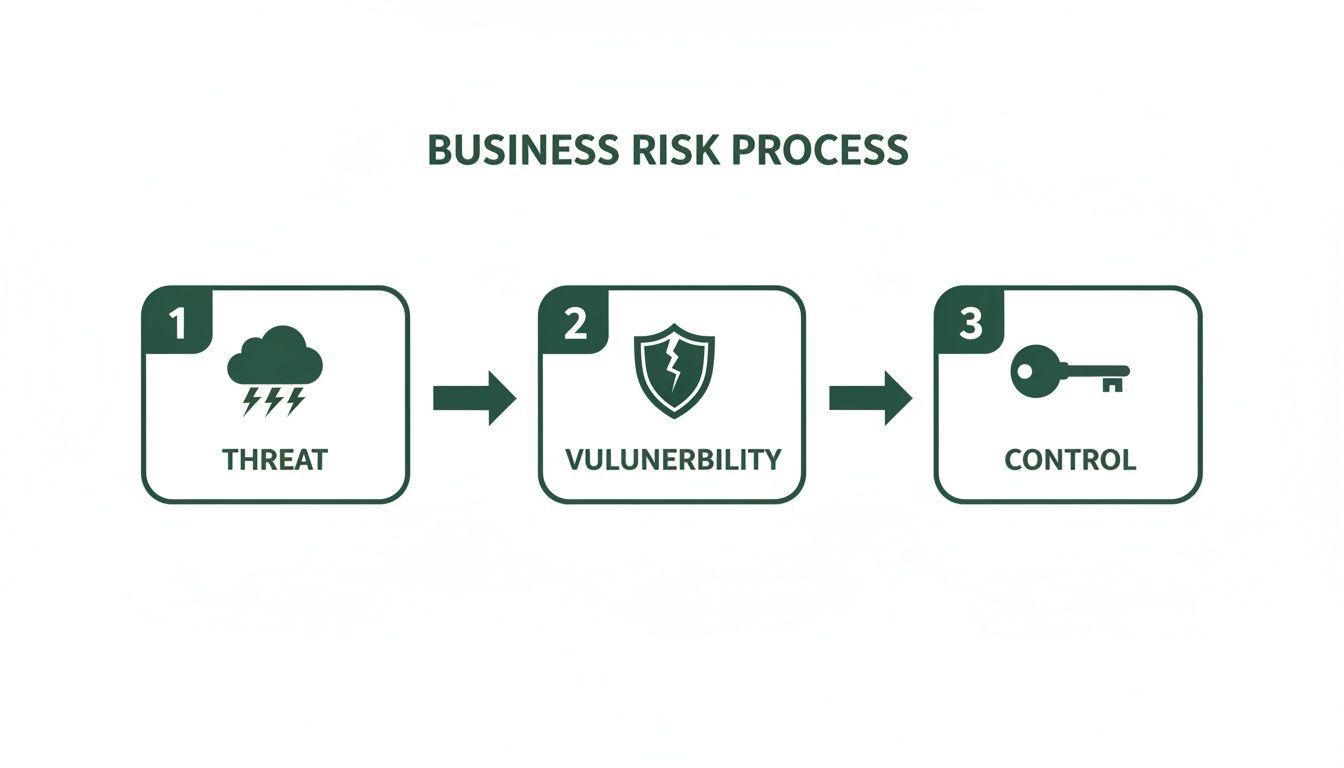
It’s a simple but powerful model. It shows that risk isn't just about bad luck—it's about being caught unprepared when that bad luck strikes.
Sorting Your Business Risks into Buckets
To make that brainstorming list less overwhelming, it helps to group potential threats into categories. This simple step ensures you don't miss entire chunks of your operation. It’s a systematic way to scan for those hidden weak spots that aren’t always obvious at first glance.
You can start with these four foundational buckets:
- Operational Risks: These are the threats lurking in your day-to-day processes. Think about a vital piece of equipment failing, a key supplier not delivering on time, or a critical system going down. Anything that stops you from actually doing business.
- Financial Risks: This one's pretty straightforward—it’s anything that could mess with your money. Maybe it's a sudden spike in material costs, customers who are slow to pay (or don't pay at all), or an economic dip that dries up sales.
- Strategic Risks: These are the big-picture threats that can change the game you're playing. A new competitor could pop up, customer tastes might shift away from your product, or a few bad online reviews could tarnish your hard-earned reputation.
- Compliance and Legal Risks: This is all about staying on the right side of the rules. It could be anything from a safety violation on-site to mishandling customer data and facing a privacy breach, or simply not having the right business licenses to operate legally.
If your business runs on Microsoft 365, a significant part of this process should include following a detailed guide to security risk management in Microsoft 365 to lock down your specific digital vulnerabilities.
Gauging Likelihood and Impact
Okay, you've got a list of potential problems. Now what? You can't fix everything at once, so you have to prioritize. This is where a quick and dirty analysis comes in. For every risk you've identified, ask yourself two simple but critical questions:
- How likely is this to actually happen?
- If it does happen, how bad would it be?
You don't need a fancy algorithm for this. A simple High, Medium, Low scale works perfectly for most small businesses.
To make this even clearer, you can use a basic risk matrix. It helps you visualize where each risk falls so you can decide what to tackle first.
Simple Risk Matrix for Prioritization
This visual tool helps you quickly categorize risks based on their potential impact and likelihood, allowing you to prioritize your mitigation efforts effectively.
| Impact Level | Low Likelihood | Medium Likelihood | High Likelihood |
|---|---|---|---|
| High | Medium Priority | High Priority | Urgent Priority |
| Medium | Low Priority | Medium Priority | High Priority |
| Low | Monitor | Low Priority | Medium Priority |
For example, a key supplier going bankrupt might be a low-likelihood event, but its impact would be huge, landing it in the "Medium Priority" or "High Priority" box. On the other hand, minor employee scheduling mix-ups might happen all the time (high likelihood) but have a very low impact, so you’d just monitor them.
The whole point of this exercise is to separate the everyday annoyances from the genuine, business-threatening disasters. It helps you aim your limited time and money at the threats that truly matter.
This structured thinking is a cornerstone of any solid risk strategy. You can explore this and other key concepts further in our guide to risk management best practices. By organizing your risks this way, you're not just worrying—you're creating an actionable plan to protect what you've built.
Confronting Today's Digital Dangers
It's one of the most dangerous myths in business: thinking you're too small to be a target for hackers. The reality is, cybercriminals often go after small businesses for that exact reason—they're counting on you not having the same defenses as a large corporation. Let's cut through the noise and talk about the real digital threats that can sink a small company.
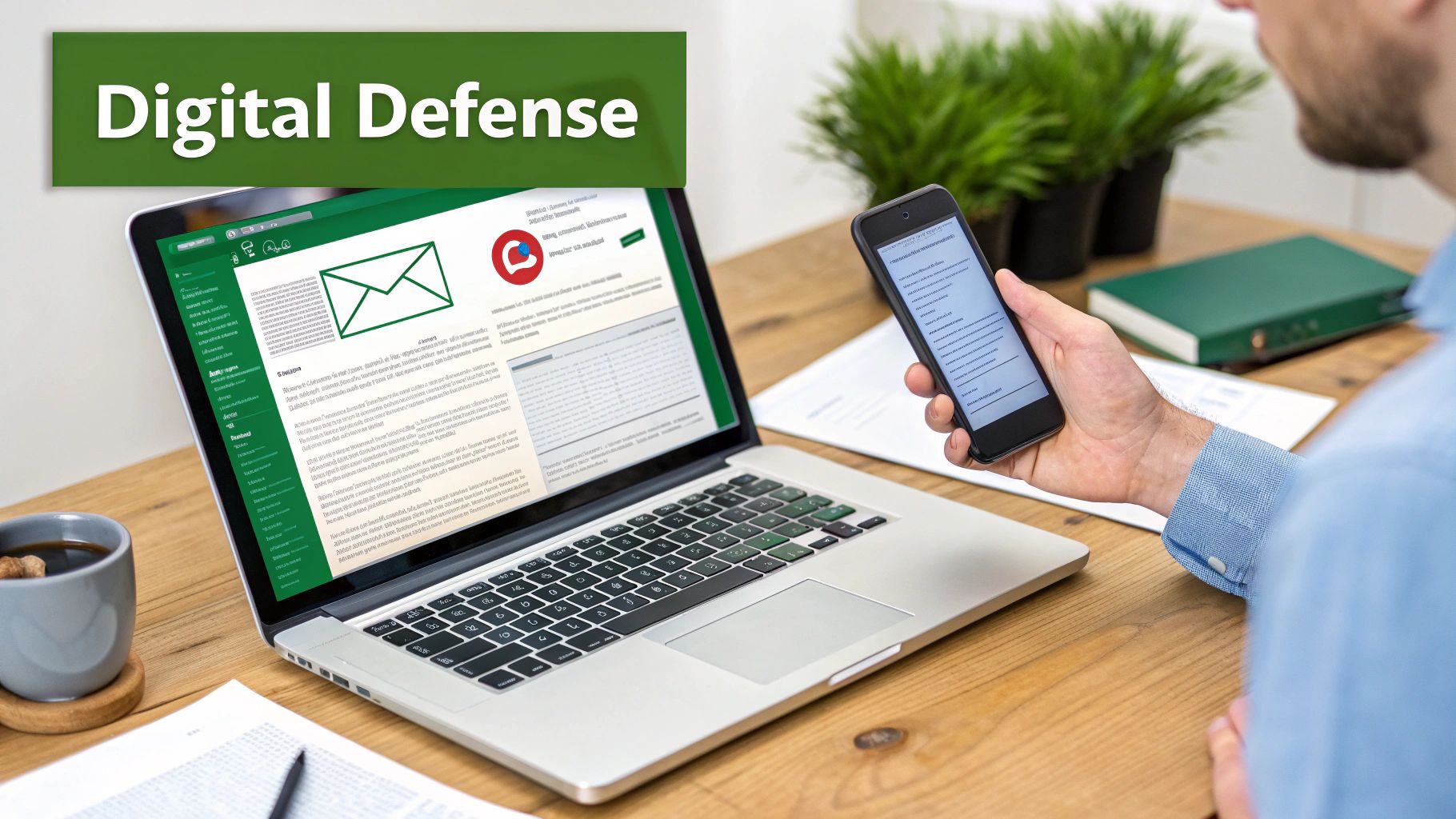
The numbers don't lie. We're seeing a massive wave of cyberattacks, with incident rates in the US jumping by 47% year-over-year. For tiny businesses with 1-10 employees, a shocking 43% of attacks are successful.
Globally, 46% of small businesses have been hit by at least one cyberattack. For nearly one in five of them, it was a fatal blow, leading to bankruptcy. Yet, despite this clear and present danger, a mere 17% carry cyber insurance. That leaves a massive number of businesses completely exposed.
Your First Line of Digital Defense
Before you start thinking this requires a six-figure IT budget, take a breath. Good cybersecurity isn't just about expensive software; it's about smart habits and building a security-first culture. The idea is to create enough layers of protection that opportunistic hackers decide you're too much trouble and move on to an easier target.
When you kick off your risk assessment for a small business, zero in on these big three threats first:
- Phishing & Social Engineering: These are the classic cons. A fraudster sends an email pretending to be your bank, a key supplier, or even the CEO, trying to trick an employee into handing over passwords or wiring money. They've gotten incredibly sophisticated.
- Ransomware: This is the digital equivalent of kidnapping. Malicious software gets into your system, encrypts all your critical files—customer lists, financial records, everything—and demands a hefty payment to unlock them. It can stop a business dead in its tracks.
- Data Breaches: This is when an attacker gets in and steals sensitive information. Losing customer data is a double whammy—you face potential fines and legal action, but you also destroy the trust you've worked so hard to build.
The weak link in most security systems isn't the technology; it's human error. One person clicking one bad link can render millions of dollars in security software useless. This is why making your team smarter about threats is the single best investment you can make.
Practical and Actionable Security Controls
You don't need to be a tech genius to drastically lower your risk. A handful of fundamental controls can shut down the most common attack methods. Think of these as the digital locks on your doors.
Here’s where to start, right now:
- Enforce Multi-Factor Authentication (MFA): Make this mandatory for everything. MFA adds a simple second step to logging in, like a code sent to your phone. It's a massive roadblock for criminals, even if they manage to steal a password.
- Conduct Regular Employee Training: Your team is your human firewall. Train them to recognize suspicious emails, avoid clicking strange links, and use strong, unique passwords. A trained employee is your most valuable security tool.
- Implement a Solid Backup Strategy: Consistently back up your critical data to a separate, secure location (preferably off-site or in the cloud). If ransomware hits, you can wipe the infected system and restore your data without paying the ransom. It's your ultimate safety net.
Finally, a key part of your strategy involves dealing with data you no longer need. Implementing a process for secure data destruction for businesses ensures old hard drives and files can't come back to haunt you.
For a more structured plan, our guide on cyber security risk management walks you through building a complete defense. These are the proactive moves that build true digital resilience.
Breaking Free from the 'It Won't Happen to Me' Mindset
If there's one vulnerability that cripples more small businesses than any other, it’s not a weak password or an unlocked door. It's the quiet, dangerous belief that "it won't happen to me."
This mindset is a complacency trap. It’s built on the understandable but mistaken idea that your business is too small, too new, or just too obscure to attract real trouble. Many owners fall into this, underestimating the value of their own data and staying blind to what modern threats actually look like.
The reality, however, is that small businesses are prime targets because they are often unprepared. The data tells a story that should make every owner sit up and pay attention.
The Sobering Statistics on Small Business Risk
The gap between perception and reality is huge. One recent study revealed that while 79% of small businesses were hit by at least one cyberattack in the last five years, a staggering 64% still think they're too insignificant for hackers to bother with.
This is a dangerous miscalculation, especially when you learn that 43% of all cyberattacks are aimed squarely at small businesses. Yet the disconnect persists: 36% of owners admit to having zero concern about cyber threats, with most of them believing their small size is their best defense. You can dig deeper into these numbers over at B.D. Emerson.
This lack of awareness creates a massive weak spot. With 51% of small businesses admitting they have no cybersecurity measures in place, they become the low-hanging fruit for attackers.
The most expensive mistake you can make is assuming your business is invisible. In the digital world, every business is on the map, and being unprepared is an open invitation for trouble.
It's Not Just About Technology—It's About People
Even with the best security software, a simple human mistake can bring everything crashing down. One employee clicking on a convincing phishing email can unleash a devastating ransomware attack or expose all your customer data. This is why a real risk assessment for a small business has to look beyond technology and focus on people.
Think about these everyday scenarios. They aren't just IT problems; they're business problems.
- Credential Theft: An employee uses the same weak password for everything, from their personal social media to your company's financial software. A breach on one end gives attackers the keys to your kingdom.
- Physical Security Lapses: A contractor is left to wander unsupervised through a sensitive area, or a team member leaves a company laptop in their car, full of unencrypted client information.
- Supplier Weaknesses: Your security might be solid, but what about the vendors you rely on every day? A data breach on their end can easily spill over and disrupt your operations.
These examples show that risk isn't just hiding in complex code; it's everywhere. You can see how quickly these situations escalate by looking through our collection of general liability claims examples.
Ultimately, your best line of defense isn't a firewall—it's building a culture of awareness. When you invest in proactive training and clear policies, you turn your team from a potential liability into your greatest security asset. An educated team that knows how to spot risks becomes an active part of your protection strategy, safeguarding the business from the inside out.
Don't Just Make a Plan—Make It Your Competitive Edge
So you've finished your risk assessment. That's a huge accomplishment, but don't let it become a document that just gathers dust on a shelf. The real magic happens when you weave that knowledge into the very DNA of your business operations.
Think of it as a living, breathing guide that grows and changes right alongside your company.

When you actively manage your risk plan, it stops being a simple defensive checklist and becomes a powerful tool for growth. It’s a clear signal to clients, partners, and even lenders that you’re not just winging it. You’ve built a stable, resilient business ready for the long haul. In a crowded market, that kind of preparation is a serious advantage.
Weave Risk Management into Your Business Rhythm
The only way to keep your risk plan from becoming obsolete is to make it a part of your regular routine. By proactively checking in on it, you stay ahead of new threats instead of just reacting to them.
Here are a few practical ways I've seen this work well:
- Schedule Annual Reviews: At an absolute minimum, put a full review of your risk assessment on the calendar once a year. Treat it like you would your taxes or annual budget.
- Revisit After Big Changes: Did you just launch a new product line? Expand to a new office? Onboard a major new piece of software? Any significant shift is a trigger to pull out the plan and see what's changed.
- Talk About It with Your Team: Make risk a regular agenda item in your team meetings. It can be as simple as asking, "Has anyone seen any new challenges this month?" or "Have any of our known risks become more or less likely?"
This kind of open dialogue turns risk management from a management chore into a shared responsibility. It builds a culture where everyone is looking out for the business.
A well-maintained risk plan does more than just prevent disasters; it builds institutional confidence. It’s a clear signal to everyone—from your newest hire to your biggest client—that you are a serious, stable, and dependable organization.
This whole process is foundational to your operational readiness. A solid risk plan is the bedrock of a strong continuity strategy. To see how prepared you are to respond to disruptions, not just identify them, check out our business continuity plan checklist.
By turning your assessment into real-world action, you're not just securing your present—you're building a more competitive future.
Common Questions About Risk Assessments
Even with a solid plan, you're bound to have questions as you dive into your first risk assessment. That's completely normal. Think of this as a continuous cycle of improvement, not a one-and-done task.
Here are a few of the most frequent questions we get from business owners just like you.
How Often Should I Be Doing This?
Think of a formal risk assessment as your business's annual physical—it's something you should do at least once a year. So much can change in 12 months, and a small issue from last year could easily become this year's biggest headache.
But don't just file it away and forget about it. Your risk assessment should be a living document. You'll want to pull it out and dust it off whenever your business goes through a major change.
This could be things like:
- Rolling out a new flagship product or service.
- Bringing on a new business partner or key leadership.
- Moving your operations to a new software platform.
- Opening up a new storefront or expanding into a different city.
Any of these events can introduce brand-new risks you hadn't considered before. Staying on top of it means your plan never gets stale.
Can I Really Do a Risk Assessment on My Own?
For most small businesses, the answer is a resounding yes. You live and breathe your business every day, which gives you an insider's perspective that no consultant can match. Following the framework in this guide is a fantastic way to build a strong foundation.
However, know when to call for backup. If you're dealing with something highly specialized, bringing in an expert is a smart investment.
For example, if you're handling sensitive customer payment information, a cybersecurity pro can spot technical weak points you'd never see. Likewise, if you're navigating complex industry regulations, a quick chat with your lawyer or insurance advisor can save you from major compliance blunders down the road.
The most dangerous—and expensive—mistake a small business owner can make is thinking they're too small to be a target. This leads to doing nothing, which leaves you wide open when the unexpected happens.
What’s the Biggest Risk Management Mistake I Should Avoid?
The number one mistake is thinking, "that'll never happen to my business." That mindset is a massive blind spot. In reality, cybercriminals, fraudsters, and even litigators often see small businesses as soft targets precisely because they assume they’re unprepared.
Running a close second is relying on insurance as your only form of risk management. Insurance is absolutely essential for transferring risk—it’s the financial backstop that helps you recover after something goes wrong.
But a good risk assessment helps you prevent those incidents from happening in the first place. It’s the difference between buying a fire extinguisher and actually fireproofing your building. You need both.
A detailed risk assessment gives you a clear roadmap to a more resilient business, but the right insurance policy is your safety net. At Wexford Insurance Solutions, we specialize in connecting your unique risks to the specific coverage you need to protect everything you've built. Let our experts offer a no-obligation review of your policies. Protect your hard work by visiting us at https://www.wexfordis.com today.
 How to Winterize a House Plumbing System and Prevent Frozen Pipes12 Essential Types of Commercial Insurance Coverage for Your Business in 2026


